The market has been told Nvidia will do something close to $700 billion in revenue next fiscal year, and it has responded by letting the stock lag QQQ a...
The market has been told Nvidia will do something close to $700 billion in revenue next fiscal year, and it has responded by letting the stock lag QQQ and the semiconductor complex. That is not indifference. It is a considered bet, held on the buy-side, that the guided number and the durable number are not the same thing. The gap between what Nvidia said on the call and what its own segment disclosures can support is where the real position sits, and it is not the gap the headline is measuring.
The Number That Broke the Models
Start with the scale of the miss, because it reframes what "accuracy" even means here. A year ago, sell-side consensus put FY2028 revenue near $310 billion. Even after twelve months of upward revisions, analysts arrived at the call at roughly $574 billion. Then management guided to about 70% growth, which lands close to $700 billion. The estimate was off by around $400 billion a year out, and still short by roughly $125 billion after a year of chasing it.
The instinctive read is that analysts are hopeless and Nvidia is unstoppable. That read is too easy. The more useful observation is that a forecasting community that revised aggressively, repeatedly, in the correct direction, still could not close the gap. That tells you the constraint on the estimate was not analyst timidity. It was the absence of visibility into a demand curve that reprices every quarter. And management gave the tell itself: the outlook is supply constrained, and revenue could roughly double if it were not. When a company frames its guide as a floor imposed by capacity rather than a ceiling imposed by demand, 70% growth stops being a forecast and becomes an allocation decision.
Why the Stock Won't Re-Rate
Here is the fact the guidance narrative talks past. Through the same twelve months in which Nvidia made a mockery of the models, the stock barely outperformed the S&P 500 and underperformed both QQQ and the semiconductor ETF. Operating performance vertical, share performance flat relative to the complex it leads.
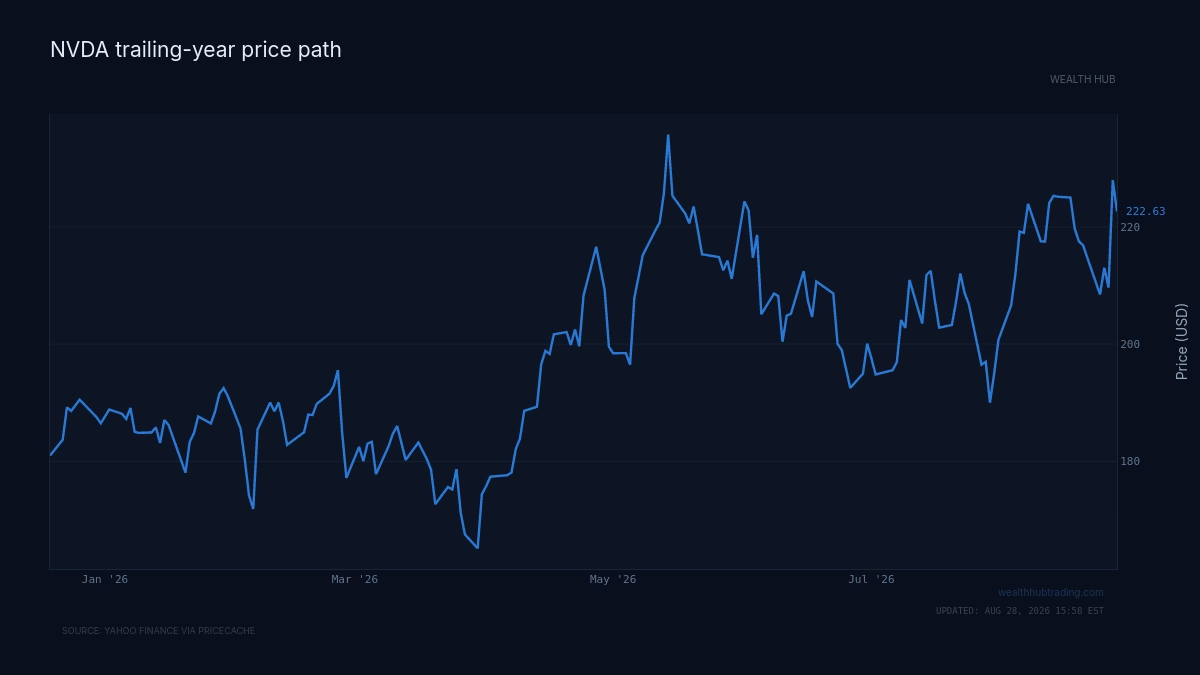
That divergence is the disclosure the market is actually pricing. It means the buy-side is running a materially different model from the sell-side. Sell-side has revenue compounding with operating margins in the mid-to-high 60s. The multiple Nvidia currently trades on implies the marginal buyer does not believe that margin structure survives contact with the next two years. This is not a claim that the buy-side is right. It is a claim that the price already contains a skepticism the guidance language does not address, and that anyone reading the headline as bullish confirmation is reading a signal the tape rejected in real time.
The mechanism connecting the two is straightforward once you name it. A stock re-rates when the market's confidence in future cash flows rises faster than those cash flows themselves. Nvidia's cash flows are rising almost vertically, and the market's confidence is not keeping pace. The refusal to re-rate is the market saying it will underwrite the growth but not the durability.
Where the Growth Is Actually Coming From
The revenue mix shows what Nvidia is executing to answer that skepticism, and it also shows why the skepticism is rational. Hyperscaler revenue doubled year over year. But the AI Clouds, Industrial and Enterprise segment grew around 140%, and inside that number is the neocloud build-out. Management now expects neoclouds to exit 2026 with roughly 8 GW of installed capacity, up from about 3 GW in 2025.
Put that in proportion. AWS, the largest hyperscaler, ran an estimated 15 GW in 2025. If Amazon adds 7 to 8 GW this year on its way to doubling capacity by 2027, then the neoclouds in aggregate are adding something like 60 to 70% of AWS's incremental capacity, and they buy almost exclusively Nvidia. On its face, that is an enormous tailwind and a deliberate one. Nvidia wants to commoditize the hyperscalers just as the hyperscalers work to commoditize the chip layer, and funding an independent neocloud tier does exactly that.
The problem is who sits in the neoclouds' backlog. The answer is the same hyperscalers. So a meaningful slice of the 140% growth is hyperscaler demand routed through an intermediary that exists partly because Nvidia willed it into being. If the hyperscalers ever pull their own capacity closer to their own demand curve, the neocloud tier is the first layer to feel it, and it is precisely the layer carrying the fastest reported growth. Concentration risk dressed as diversification.
The Frontier-Lab Dependency Under the Surface
The second vector of the same concern is demand concentration at the model layer. Much of the incremental compute may come down to a handful of frontier labs. Nvidia noted that OpenAI's existing and planned commitments represent 12 GW of Nvidia compute, an extraordinary single-customer figure by any historical standard.
Both OpenAI and Anthropic have said plainly they want heterogeneous fleets and do not intend to run exclusively on Nvidia. That intent softens whenever Nvidia participates in the financing that lets them buy the GPUs, which is itself a tell about where pricing power is migrating. When a supplier's largest growth commitments are underwritten in part by the supplier's own capital, the revenue is real but the independence of the demand is not. That is the disclosure a $700 billion headline cannot carry on its own, and it is the one that explains why the durability question sits unanswered in the multiple.
What Would Settle It
The bull and bear cases here do not disagree about the next four quarters. Supply-constrained demand means the near-term number is close to underwritten. They disagree about what the demand curve looks like once supply catches up, and that is not observable yet.
The thesis that the market is right to withhold a re-rating breaks on one measurable condition: if hyperscaler capex guidance holds through the next two reporting cycles while neocloud backlog converts to recognized revenue without hyperscaler cancellations, the durability discount is wrong and the stock has room to close the gap to the complex. The thesis holds if neocloud additions decelerate, or if frontier-lab commitments increasingly require vendor financing to close, because both would confirm that the fastest-growing revenue is the least self-sustaining.
Watch the segment disclosure, not the guidance tone. The number that matters next is not aggregate revenue, which is nearly locked. It is the composition of the AICE line and whether the neocloud share keeps compounding on genuinely independent demand. Until that composition proves it can stand without hyperscaler backlog underneath it, the market's refusal to re-rate the best operating performance anyone has seen is the cleaner reading of the evidence, not the anomaly the headline makes it look like.