The market is reading Carney's collapse of US-Canada trade talks as a negotiation tactic. The more consequential read is that he is manufacturing the po...
The market is reading Carney's collapse of US-Canada trade talks as a negotiation tactic. The more consequential read is that he is manufacturing the political cover for a Canadian pipeline construction boom, and the party forced to act is not Washington but Ottawa's own regulatory apparatus, which has spent a decade blocking exactly the infrastructure a "masters in our own house" energy doctrine now requires.
The Slogan Is the Signal
Politicians choose historical phrases the way lawyers choose precedents: for what they license, not for what they describe. "Maîtres Chez Nous" was not a slogan about electricity in 1962. It was a slogan about who controls critical infrastructure, and the answer it demanded was: not foreign owners, but us. Jean Lesage used it to nationalize private power generators into Hydro-Québec and to reframe economic dependence as a sovereignty problem.
Mark Carney reaching for that exact phrase, in both official languages, during a press conference explaining the breakdown of trade talks with the United States, is a deliberate frame. He is not describing a tariff dispute. He is invoking a doctrine that historically justified building state-backed energy infrastructure in the name of self-determination. A man who ran the Bank of Canada and the Bank of England does not stumble into a loaded piece of Quebec nationalist vocabulary by accident.
The surface game is obvious and widely reported: protect politically sensitive industries, call Trump's bluff, extract better terms before the US midterms shift the leverage. Measured that way, success is whatever trade deal emerges. That reading is not wrong. It is just incomplete, because it treats the language as rhetoric rather than as policy scaffolding.
What a Sovereignty Frame Forces Ottawa to Do
The second-order read starts from a simple question: if you accept the premise that Canada can no longer rely on the United States for critical goods and energy flows, what are you obligated to build?
The answer is the infrastructure Canada has conspicuously refused to build. For most of the last decade, Canadian energy policy has been defined by pipelines that were cancelled, contested, or strangled in regulatory review. A country that has just declared, at the prime ministerial level, that it must be master in its own house has handed itself the political justification to reverse that posture. Energy security becomes patriotism. New export corridors that reduce dependence on a single southern buyer become national strategy rather than fossil-fuel indulgence.
This is why Carney's own trajectory matters more than the trade headlines. The same figure who built a public identity as a climate-finance advocate has, over roughly two years, moved steadily toward accommodating the hydrocarbon sector. A sovereignty crisis resolves the contradiction. It lets a former climate warrior sponsor pipeline construction not as a reversal of principle but as a response to external coercion. The frame does the political work that economics alone could not.
The regulatory point is the one the market underprices. Approvals, environmental review, and interprovincial coordination are slow-moving processes that get dismissed as procedural noise. But a national-sovereignty framing is precisely the instrument that compresses those timelines, because it reclassifies infrastructure delay as a security liability. The party forced to act is the Canadian permitting and review apparatus, and the timeline is measured in the political will now being assembled rather than in engineering years.
Why Midstream Is the Right Place to Look
Emotions in a trade fight are temporary. Tariff levels move week to week, and nobody can say which rung of the escalation ladder either leader occupies at any given moment. Midstream assets are the opposite: long-lived, contracted, and closer to immortal than almost anything else on a balance sheet. If the political frame is real, the durable expression of it is not the current spread on Canadian crude but the pipe that gets built to carry it somewhere other than the United States.
That is the analytical bet. The trade dispute is the catalyst and the cover; the construction program is the consequence. A reader watching only the tariff scoreboard will miss the more permanent shift, which is a reordering of where Canadian energy is allowed to flow and who is politically permitted to build the corridors that carry it.
Canadian midstream and integrated energy names are the cleanest listed proxies for that thesis. The chart below frames the reference point: how the sector has traded through the period in which Canadian energy policy has been openly contested. 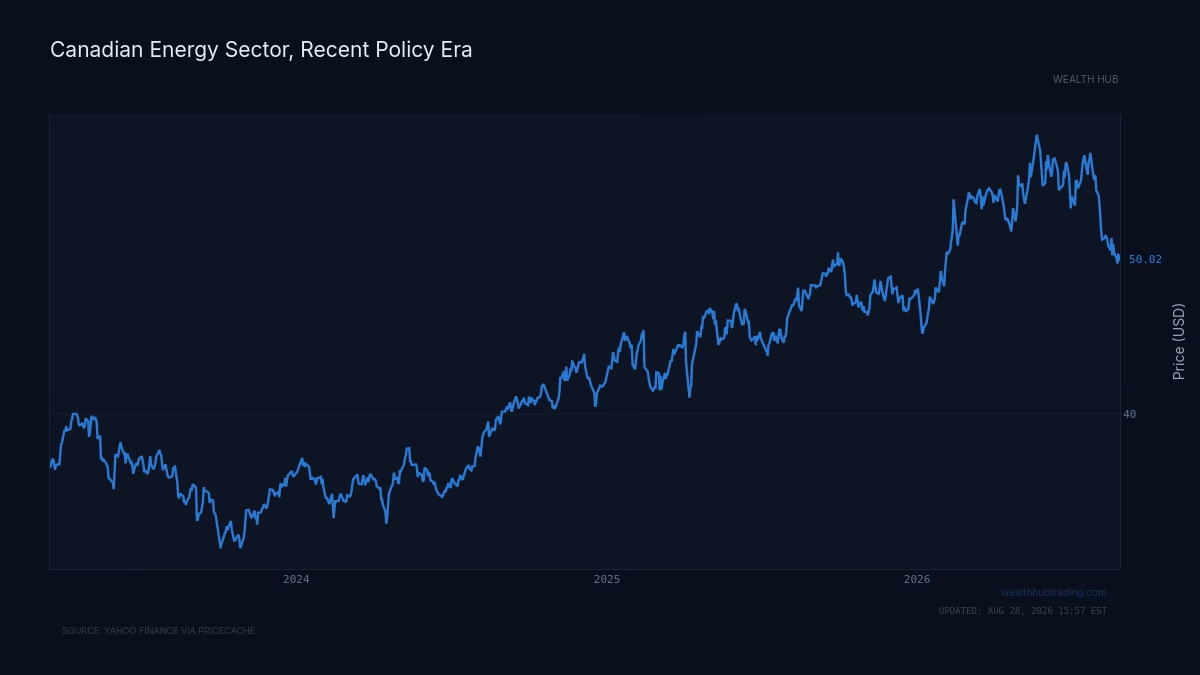
The Counterargument That Would Break This
The honest version of this thesis has a clear failure condition. If the trade confrontation is genuinely just a negotiation, it resolves the way negotiations resolve: a deal is signed, tariffs unwind, and the sovereignty language is quietly retired as campaign theater. In that world, "Maîtres Chez Nous" was a bargaining posture, nothing more, and no durable construction program follows. The pipelines that were blocked stay blocked, because the underlying regulatory and environmental coalitions that blocked them never actually lost the argument.
There is a real basis for that skepticism. Canada has announced energy ambition before and delivered permitting gridlock instead. A slogan is not a shovel. Provincial resistance, Indigenous consultation requirements, and the sheer capital intensity of new corridors have killed projects that had far more momentum than a single press-conference phrase. The market's dismissal of slow catalysts as noise is often correct, because most slow catalysts genuinely are noise.
The distinction that decides which reading is right is whether the sovereignty frame survives the resolution of the trade fight. If Carney continues to deploy energy-security language after a deal is struck, and if federal approvals or funding commitments follow rather than merely rhetoric, the construction thesis is live. If the language disappears the moment tariffs ease, it was theater.
What To Watch
The observable condition is specific: concrete regulatory action, an approval, a funding commitment, a fast-tracked review, that outlasts the trade dispute itself. A trade deal accompanied by a new pipeline sanction confirms the read. A trade deal accompanied by silence on infrastructure invalidates it.
Byron mocked the country patriots who existed only to hunt, vote, and raise the price of corn, protectionism dressed as principle. The question here is whether Carney's patriotism ends at the tariff line or whether it becomes steel in the ground. The frame he chose suggests he intends the latter. The next confirmation will not come from a trade communiqué. It will come from a permit.