
LeMaitre's guidance cut on the August 4 call was not the story. The story is what the guidance cut confirms: an organic-growth model that has been leaning on list-price increases rather than unit demand, and a management team practiced at pulling earnings-quality levers precisely in the quarter it is now admitting fell short. When a company's best seasonal quarter underperforms its own sales guidance and the full-year organic outlook is lowered across the board, the market's instinct is to reprice the multiple. The sharper read is that the price-led algorithm itself is the disclosure, and it was legible in the filings before George LeMaitre opened the call by conceding the miss.
Why Pricing-Led Growth Is a Timing Bet, Not a Moat
Organic growth built primarily on higher pricing is not the same asset as organic growth built on rising units. Both print the same headline number for a while. They diverge the moment elasticity bites.
A med-device firm that raises list prices into a stable installed base can manufacture several quarters of respectable organic growth without selling a single additional unit. That works until distributors and hospital purchasing groups have absorbed the increase, at which point the next comparison has no volume underneath it and no fresh price lever left to pull without pushing customers to substitute. The tell is deceleration inside the organic line even as the reported figure stays positive. That was the red flag flagged two weeks before the print, and it is the mechanism the guidance cut now validates: when the company lowered full-year organic guidance "across the board," it was conceding that the pricing runway had shortened faster than the volume base could compensate.
This is why the timing of the miss matters more than its size. It landed in the quarter management itself frames as historically its strongest, and in a company with a documented history of managing earnings quality. A pricing-led model has the most room to flatter results in its best quarter. If the levers still could not hold the guided sales number there, the read is not a soft quarter. The read is that the underlying demand signal deteriorated enough to overwhelm the discretionary tools that usually smooth it.
The Gap Between the Call Language and the Ledger
Consensus anchors to the guided narrative and the reasons cited on the call. The more useful exercise is to hold that language against what the filings disclose about how growth was actually assembled.
CEOs cite reasons for a miss the way any operator does: order timing, a distributor destock, a tough comparison, macro softness in a geography. Each is individually plausible and none is falsifiable in the moment. What is falsifiable is the composition of prior-period growth. If the preceding several quarters show price contribution running ahead of volume contribution, then the cited "reasons" are describing the arrival of the constraint, not an exogenous shock. The constraint was always the pricing ceiling. The call simply named the date it was reached.
That distinction changes what an investor should do with the guidance cut. A demand shock is a level reset that can be re-based and grown from. A structural exhaustion of the pricing lever is a change in the slope of the achievable growth line. The first argues for buying the reset once the number is clean. The second argues that each subsequent quarter inherits the same headwind, because the comparison base now contains embedded price that cannot be re-earned.
The Counterargument Worth Taking Seriously
The honest counter is that price increases in specialized med-device niches can be durable, and calling them a red flag can be premature.
LeMaitre operates in vascular device categories where clinical switching costs are real, product cycles are long, and a well-positioned firm can push measured annual price with limited volume loss for years. Under that reading, a single guided-sales miss in one quarter, even the seasonally strong one, is noise inside a genuinely defensible model, and the guidance cut is conservatism rather than confession. Med-device demand is also lumpy at the quarter level in ways that do not reflect any deterioration in the franchise.
That case is defensible and it is the fact pattern that would break the bearish thesis. What would confirm it is straightforward and observable: a subsequent quarter where the organic line reaccelerates on volume rather than price, with unit or procedure metrics doing the work and the previously lowered full-year range being met or raised. If that appears, the August miss was a timing artifact and the pricing-ceiling read was wrong.
What would confirm the bearish read instead is continued organic deceleration with price still carrying a disproportionate share of whatever growth remains, and further guidance revisions lower. That is the pattern that turns a "quick comment" into a repeated red flag.
Where CDW Fits, and Where It Doesn't
CDW belongs in the "other" bucket the market is ignoring while it stares at AI infrastructure, but it is a different animal, and conflating the two would be an error. CDW's model is not a pricing-led med-device franchise; it is a thin-margin, capital-light technology reseller whose economics live in cash conversion, not list-price power.
The filings make the contrast concrete. CDW's FY2025 10-K shows revenue of $22.4B against operating income of $1.7B, a 7.4% operating margin, on capex of only $117.1M, roughly 0.5% of revenue and about 9.7% of operating cash flow. That produced $1.1B of free cash flow off $1.2B of operating cash flow. This is a distribution business: enormous revenue, slim margin, negligible capital intensity, and high cash conversion. Its growth question is volume and mix in corporate IT demand, not whether a price lever is exhausted.
Set against its FY2025 peers, CDW is the low-margin outlier by design. Check Point ran a 30.5% operating margin, Corpay 43.1%, and GoDaddy 23.0%, against CDW's 7.4%. Those are software and payments economics, not reseller economics, so the comparison is one of business model rather than execution. 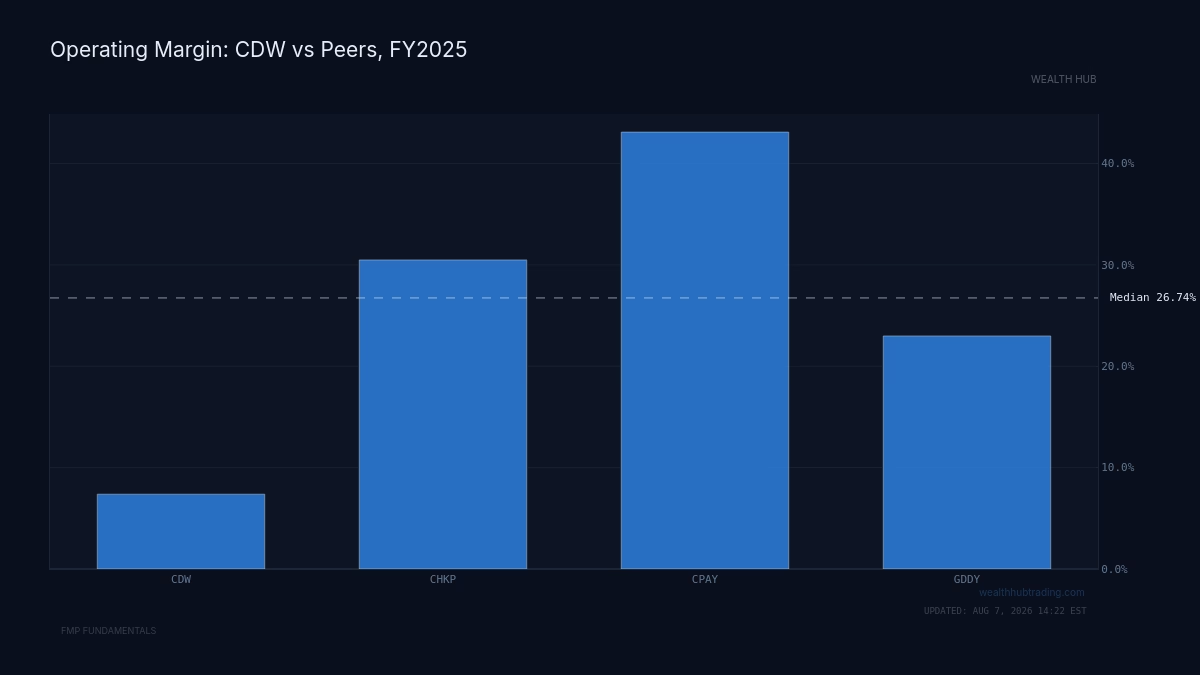
What Would Change the Read
The decision variable for LeMaitre is the composition of the next organic-growth print, not its sign. Positive organic growth carried by price into an already-elevated base is not evidence the thesis is wrong; it is the thesis continuing. Reacceleration led by units, with the lowered full-year range held or raised, is the condition that breaks it.
Until one of those two appears, the cleaner reading is that a company relying on higher pricing to mask decelerating volume finally hit the point where the seasonally strong quarter and the earnings-quality toolkit could no longer cover the gap, and said so on the record. The guidance cut across the board is the constraint arriving on schedule, not a surprise landing from outside.