
The headline figure attached to this twelve-name serial acquirer portfolio, an average shareholder return of +34% a year, describes the past and does not address what a new buyer will earn. The source's own disclosures point somewhere less comfortable. In the small-cap acquirers it profiles, the most important facts concern how the deal count is financed and who controls the capital, not how many deals get done. Software Circle grew revenue at a 26.2% five-year compound rate while revenue per share went down. Sygnity posted +47% revenue growth in H1 2026, but outside shareholders hold perhaps a tenth of the company. Read correctly, the VMS bucket contains three versions of one question: does the acquisition engine compound value per share for the minority holder, or mainly for the platform and its sponsors?
The Average That Hides the Dispersion
An average of twelve share-price CAGRs is not a portfolio return. The figures come from different start dates. Chapters is measured from its first acquisition in late 2018, when it compounded at roughly +40% a year. Software Circle is measured from a trough of £0.04. The names were also chosen because they compounded, so the number contains survivorship by construction. That is a normal feature of a model-portfolio exercise and is not a criticism of the businesses. It does mean the +34% figure says almost nothing about forward returns, and the analysis has to turn to the per-share mechanics.
The source supplies those mechanics in its footnotes and parentheticals, which is where the useful information usually sits in small-cap acquirer coverage.
Software Circle and the Per-Share Gap
Software Circle is the cleanest case of a gap between headline and disclosure in the piece. The bull summary is strong. The company has made eleven acquisitions in the UK and Ireland over five years. Free cash flow swung from -£1.5 million in 2020 to +£5.9 million in 2025. Organic growth at acquired businesses was +7% in 2025. It has a shareholder register that reads like a serial-acquirer hall of fame: P&R Real Value at 12.7%, Will Thorndike's Sun Mountain Partners at 10.3%, and Chapters Group at 9.8%. Chapters' COO and the CFO of Judges Scientific sit on the board.
The same snapshot also says revenue per share was negative over the period in which revenue compounded at 26.2%. The arithmetic is direct. Revenue roughly tripled over five years, so the share count must have grown faster than that for per-share revenue to fall. The company bought growth with paper, and in aggregate each share's claim on the revenue base shrank. The move from £0.04 to a £0.31 peak was a rerating of a former printing-software shell, Grafenia, into a recognised acquisition platform. It did not reflect per-share fundamentals compounding at the rate the price implied. The subsequent fall of roughly 50% to about £0.16, attributed to AI-disruption fears, partly unwound that rerating.
This is why the funding transition carries the investment case. The company appears to be moving from equity issuance to debt and internal cash, backed by a new £25 million credit line. Against £5.9 million of 2025 free cash flow, that facility is a little over four years of current FCF in borrowing capacity. If it is deployed at sensible multiples into businesses with the same +7% organic profile, per-share metrics should finally inflect, because the denominator stops growing. If acquisitions keep outrunning internal cash generation and the company returns to equity markets, the pattern of the last five years repeats, and the 2025 shareholder base is diluted alongside everyone else.
The case for buying at £0.16 is therefore narrow and testable. It rests on the first full year of per-share growth under debt funding, and it does not rest on deal flow, which the company has already shown it can generate.
Sygnity Is Cheap Because of Who Owns It
Sygnity has the most impressive operating numbers in the bucket. H1 2026 revenue grew +47% and EBITDA +74%, both the best in the five-company Constellation universe of Constellation, Topicus, Lumine, Asseco Poland and Sygnity. The forward EV/EBITDA multiple is below 12x. The operational turnaround is also credible on the evidence given. Topicus installed its ROIC-based incentive system and gave Sygnity access to its acquisition-target database. It brought in Maciej Różycki, who spent more than six years at Total Specific Solutions, as CEO. Four VMS acquisitions have closed since February 2024. The source describes a melting ice cube turned into a business compounding at +15%.
The disclosure the headline understates is the ownership structure. Topicus owns 72.7%, and the estimated public float is around 10%. The source attributes the low valuation to this, which is correct, but it treats the discount as a temporary barrier for large investors. A float that thin is also a statement about whose interests set capital allocation. Topicus decides the acquisition pace, the dividend policy, the intra-group transfer of targets, and whether a minority buyout ever happens and at what price. A sub-12x multiple on a controlled company with a 10% float is not an anomaly waiting for discovery. Markets often apply a durable discount to it.
The source's own position confirms this reading: "We are very happy to own Sygnity through Topicus." The author takes exposure through the controlling parent, where the economics and the control sit together, and not through the cheap listed minority. That is the right choice. A direct Sygnity holder is betting on one of three outcomes: Topicus buys out the minority, the float widens, or the group consistently favours Sygnity's per-share value. None of these is in the minority holder's control.
The growth figures need one qualification. With four acquisitions closed since early 2024, an unknown share of the +47% is acquired revenue rather than organic. The source does not separate the two, and the organic rate should not be inferred from the total.
Chapters and the Price of a Famous Register
Chapters is the purest form of the "trust the allocator" thesis. Jan Mohr took control of the cash shell left behind when Medical Columbus sold its strategic assets. He closed the first acquisition at the end of 2018, and the shares have since compounded at about +40% a year. That makes it a 15-bagger in eight years. The company now owns more than 60 VMS businesses across 8 acquisition platforms, at a market capitalisation of around €1 billion.
The register is the distinguishing feature. Mitch Rales, co-founder of Danaher, owns 15.1% and speaks with Mohr weekly. Daniel Ek owns 12.7%. Those two holders alone control more than a quarter of the equity. This is a real asset. Patient, sophisticated anchors make it easier to hold through a drawdown, and they will likely support financing when acquisition multiples are attractive.
The same fact cuts the other way for a new buyer. A famous register is visible to everyone, and markets usually price visible quality into the multiple. After 15x, the outside investor no longer buys an unknown allocator at a shell-company valuation. They buy a recognised platform whose next decade requires deploying much larger sums across eight platforms and 60-plus businesses, while keeping the decentralised discipline that produced the first eight years. The figures available here do not include Chapters' share count history or per-share cash flow. So it cannot be said whether its record suffers from the Software Circle problem. That gap matters, and a buyer should close it before relying on the 40% figure.
The Countercase: Operators, Not Just Allocators
The strongest objection to this framing is that it reduces these companies to financial engineering, and the source pushes back on exactly that. It argues that Constellation and Topicus are "highly talented operators" and not only capital allocators. The evidence supports it in places. VMS products typically cost less than 1% of a customer's revenue while being mission-critical, which gives incumbents pricing power. Software Circle's +7% organic growth at acquired businesses is an operating result and has nothing to do with accounting. Sygnity's turnaround under Topicus ownership is an operating story too.
If operations are where the value is created, dilution and control discounts become secondary. A business that grows organically at high single digits and reinvests at high returns can absorb a lot of share issuance and still compound per share once the issuance stops.
This objection is fair, and it explains why the view here is not bearish on any of the three names. It does not remove the per-share question. It only makes the question more pressing. Strong organic growth is the condition under which switching to debt funding produces visible per-share acceleration. If that acceleration does not arrive at Software Circle once equity issuance stops, the organic-growth story was weaker than it looked.
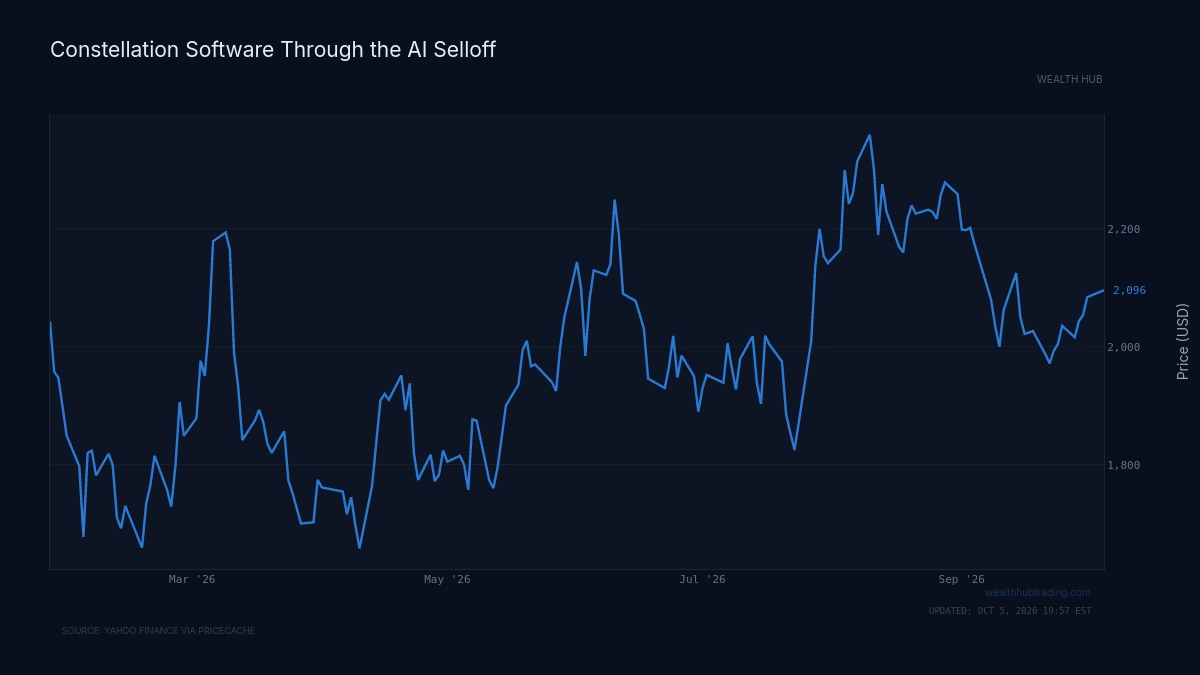
The AI-disruption discount should also be weighed with care. The source treats the drawdowns at Software Circle and Sygnity as overreactions. The traditional VMS moat argument holds that no ambitious engineer will target the chicken-coop software niche, and that argument implicitly assumed software was expensive to build. If AI tools sharply lower the cost of replicating narrow vertical products, the "limited competition" pillar weakens even though mission-criticality and switching costs remain. This is a plausible risk, not a demonstrated one, and the 2025 organic growth data does not yet show erosion. The larger Constellation complex appears to have recovered from its own AI-related selloff while Sygnity has not, which suggests the market is discounting small-cap illiquidity more than it is pricing a sector-wide verdict on VMS.
What Would Confirm the Read
The view comes down to three conditions, one per name, each visible in upcoming disclosures.
- Software Circle: revenue and free cash flow per share rise in the first full year funded by the £25 million facility and internal cash, with no new equity raise. A fresh placement would show that the debt transition was a pause, not a change of model.
- Sygnity: any change to Topicus's 72.7% stake or to the float. A minority buyout offer or a placement that widens the float would close the control discount. Without one, the sub-12x multiple is a reasonable price for a passenger seat, not an obvious mispricing.
- Chapters: disclosure of per-share cash-flow growth across the 8 platforms. That would show whether the 40% share-price CAGR rested on per-share compounding or on rerating and issuance.
The serial acquirer model works, and VMS is a strong setting for it. For an outside buyer of these three companies, though, the variable that matters is per-share outcomes under the current funding and control structure, not the 34% average. Software Circle's next annual report will be the first clean test of that.