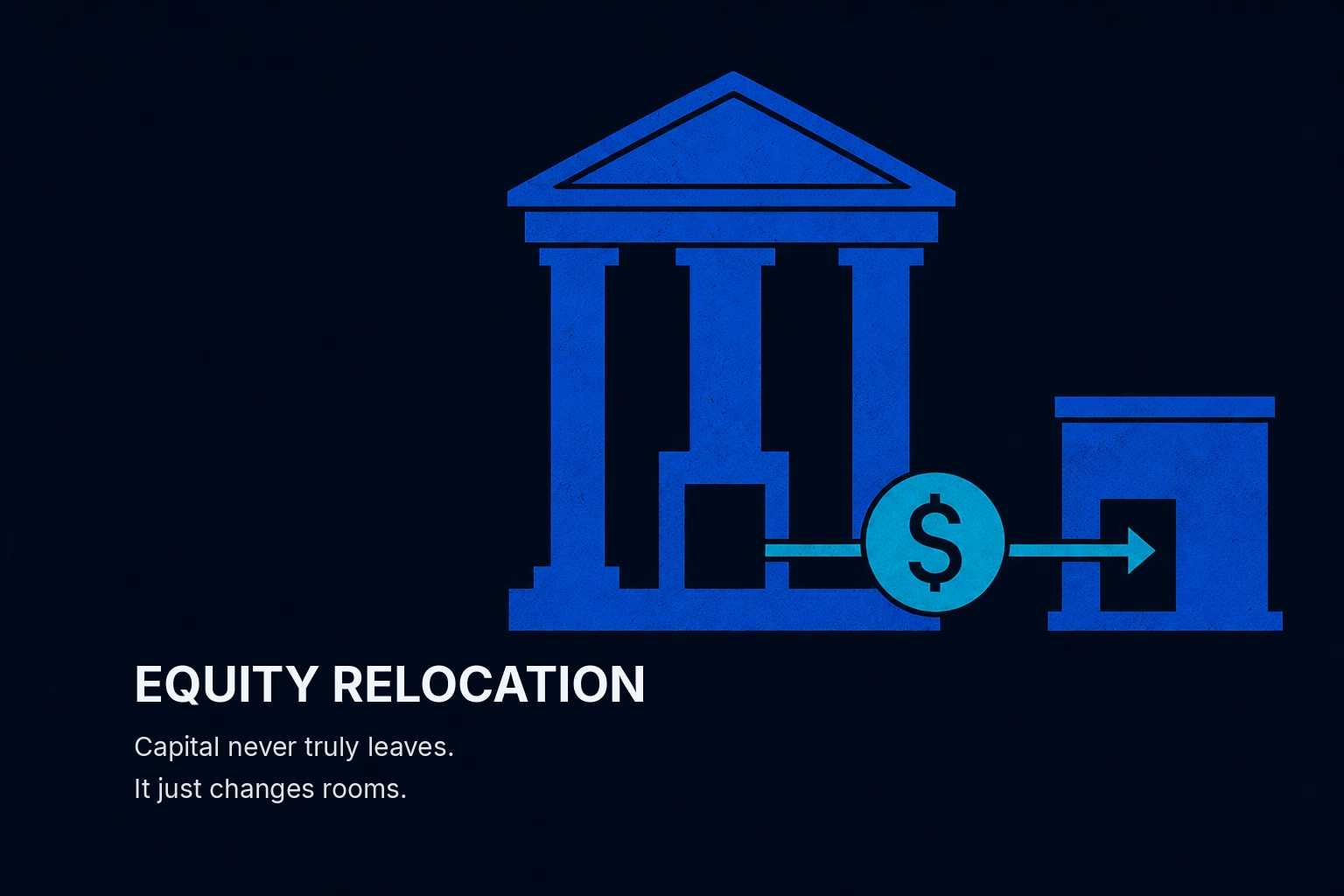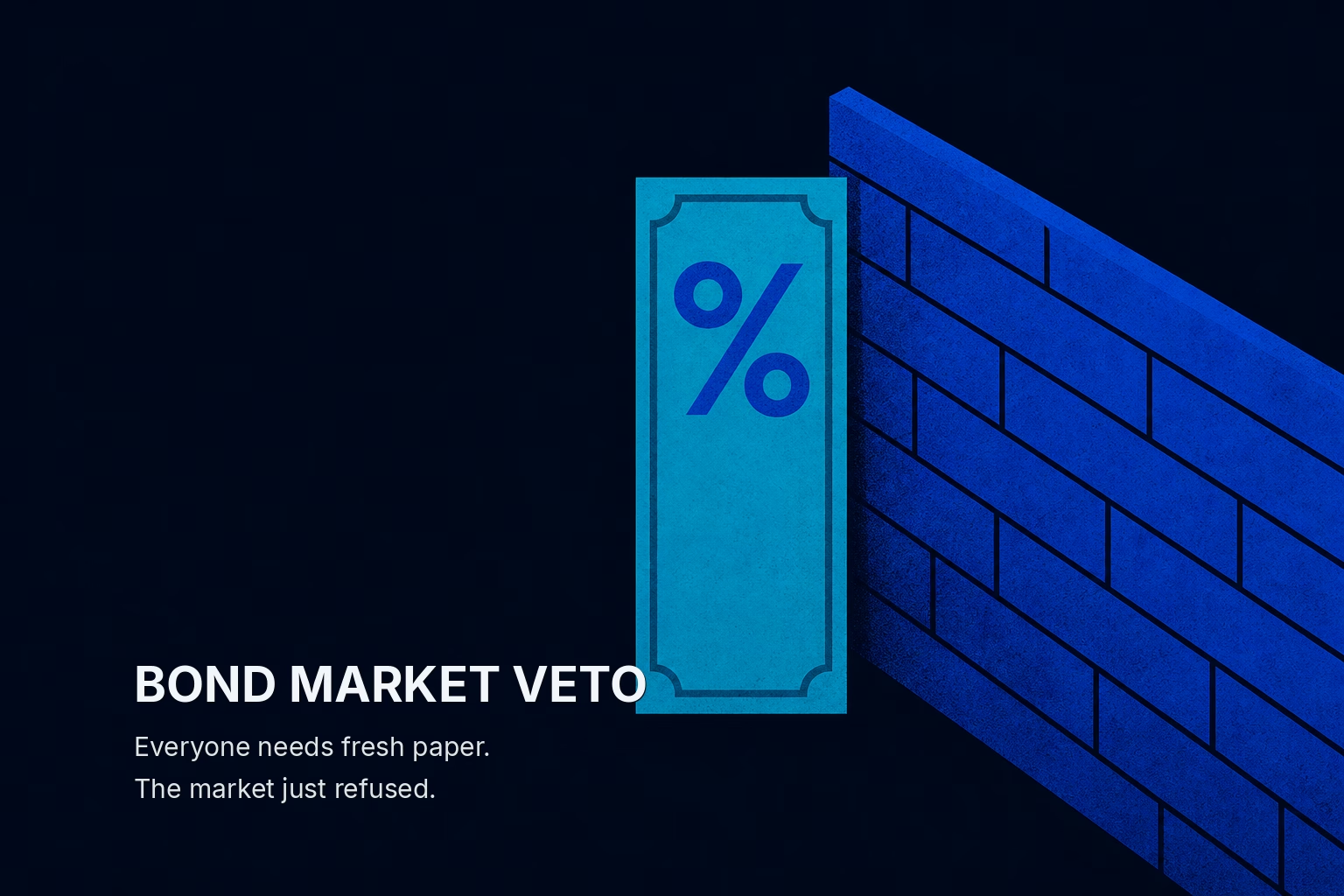
The flow that matters in AI is no longer money going into chips. It is new securities coming out of the companies that buy them. CoreWeave is the cleanest place to see what that supply is doing. Its unsecured debt now yields 15% while its equity falls, so both halves of its capital structure are being repriced at once. A company whose business model is borrowing cheaply to lease compute dearly cannot absorb that for long. The market is not making a judgment about GPU demand. It is setting a clearing price for AI paper, and CoreWeave is the marginal issuer that pays it first.
A Lender Disguised as a Cloud
Marc Rubinstein makes the core point in his latest Net Interest piece. CoreWeave sells itself as "The Essential Cloud for AI," but it behaves like a conduit to capital markets. That framing deserves to be pushed further, because it changes which numbers matter.
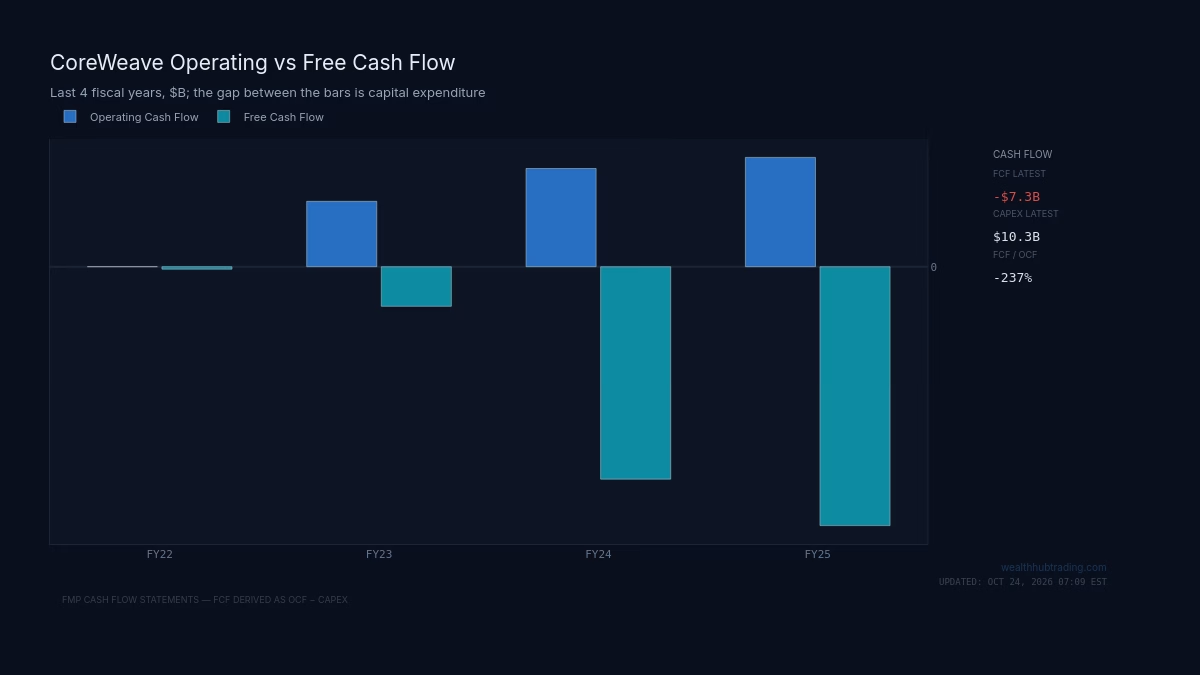
The company runs 51 data centers across the US and Europe and draws 1.5 gigawatts of power. Last November it had contracts to deliver 2.9 gigawatts. That figure has since grown to 4.2 gigawatts. Closing the gap between power it has and power it has promised requires $35 billion to $39 billion of spending in 2026 alone, and that cash has to be borrowed.
The economics are those of a specialty lender. CoreWeave raises capital, turns it into GPU deployments, and leases those deployments to Microsoft, OpenAI and Meta. Profit is the spread between lease yield and funding cost, earned over a contract life that must outlast the hardware's useful economic life. If the spread is wide and the contract runs long, the model compounds. If funding costs rise into a fixed lease rate, the spread compresses on every new tranche, and growth becomes value-destructive at the margin before the income statement shows it.
This is why the stock price matters more for CoreWeave than for a normal operating company. For a business that funds itself on the cash it generates, a falling share price is an opinion. For a non-bank financial that must keep issuing, it is an input cost. A lower equity value thins the cushion under the unsecured debt. Thinner cushion pushes up the yield on new debt. Higher yields narrow the spread on the next deployment, and that justifies the lower equity value. The loop feeds itself, and nothing in it requires a single customer to cancel a contract.
The Supply Wave Behind the Spread
The common reading of CoreWeave's troubles is that investors have doubts about AI. That reading misses the mechanism. The pressure on its yields fits a supply story better than a demand story.
Look at what else came to market this year. Rubinstein notes that operating cash flow at the largest tech companies covered capital investment through 2025 and stopped doing so in 2026. That one change converts the biggest buyers of compute from self-funders into issuers. Meta has said it will "need to raise hundreds of billions of dollars [of equity] over a period of several years beginning as early as fall 2026." SpaceX took $85.7 billion of equity in its June IPO, earned investment-grade ratings, and then placed another $25 billion of bonds.
Those deals draw on overlapping pools of capital: growth equity mandates, AI-themed funds, high-grade and crossover credit buyers. When issuers of that size come to market, every other AI name must offer a better price to win allocation. Investment-grade issuers with diversified cash flows set the floor. A levered, concentrated, unrated or high-yield issuer like CoreWeave clears well above it. We have no live positioning data on who holds CoreWeave paper or how crowded the AI-credit trade is, so the crowding link here is an inference from issuance volume, not a measured flow. The direction of the inference is strong, though. A market asked to absorb hundreds of billions of new AI equity and debt will reprice the weakest borrower first. That is what a 15% yield looks like.
Musk's timing shows the other side of the same flow. Raising early, while demand for the paper was deep, locked in funding before Meta and others crowded the window. Getting to investment grade then opened a cheaper market that CoreWeave cannot reach. In a supply-constrained funding market, access to capital is the competitive moat, and it is allocated in sequence. The first issuers get the best terms. CoreWeave is issuing late, at high leverage, into a crowded book.
Why CoreWeave Moves Before the Complex
Rubinstein observes that CoreWeave's troubles came before those of the broader AI complex. The flow mechanism explains why that ordering should be expected and is not a coincidence.
Credit spreads on a marginal borrower work like a margin call on the whole system. Hyperscalers can delay a buyback, slow a project or draw on cash for a quarter. CoreWeave cannot slow down without breaching delivery commitments on the 4.2 gigawatts it has contracted, and it cannot keep building without new capital. It has the least flexibility of anyone in the chain, so it shows funding stress first and most clearly.
There is a second-order exposure that the "contracted backlog" defence tends to skip. CoreWeave's customers are now capital-market dependent themselves. Meta is both a lessee and a forthcoming issuer of hundreds of billions in equity. A backlog with Meta and OpenAI looked like quasi-sovereign credit when those buyers paid from operating cash flow. It looks more correlated now. The funding window that decides CoreWeave's cost of capital also decides how comfortably its customers can pay for capacity. Risk in the counterparty and risk in the funding market have merged into a single variable.
The Countercase: Contracts Are Collateral
The strongest objection deserves full weight. CoreWeave is not lending into speculative demand. Much of its build is contracted in advance with some of the most creditworthy companies alive. Debt secured against specific GPU fleets and specific leases can price well below the 15% on unsecured paper, because the lender looks at Microsoft's covenant rather than CoreWeave's. On this view the unsecured yield is a residual-claim price. It is real and painful, but it applies to a slice of the capital stack, not to the marginal dollar of every deployment.
If that is right, the spread on contracted capacity may still be positive, and the equity sell-off overstates the damage. A pure supply-driven repricing also tends to reverse. Once the Meta and SpaceX deals are absorbed, the pressure on everyone else eases.
This view has merit, and the source material does not let us check secured funding costs or lease yields directly. It still leaves two gaps. First, unsecured and equity capital is what absorbs losses, and it is the capital CoreWeave needs to keep raising secured debt against. If that layer is expensive or unavailable, secured capacity tightens too. Second, the supply wave is not a single event. Meta describes its equity needs as running "over a period of several years." An issuance calendar that long is a regime, and the marginal AI borrower pays the regime price for as long as it lasts.
The Spread as Barometer
The decision variable for CoreWeave is not GPU utilization, AI adoption or the next model release. It is the gap between what it earns on newly leased capacity and what it pays for the marginal dollar that funds it. The yield on its unsecured debt is the most public reading of the second half of that equation.
The view changes on observable conditions. If CoreWeave's unsecured yields compress meaningfully while Meta's equity program is under way, the supply interpretation is wrong, and the market is separating issuers on quality instead of crowding them out. If the yields hold near 15% or rise as the Meta raise begins this fall, the read gets stronger: AI financing has become a queue, CoreWeave stands near the back, and each new gigawatt it adds earns a thinner spread than the one before. The time to watch that reading is when the largest issuer in the queue starts selling.