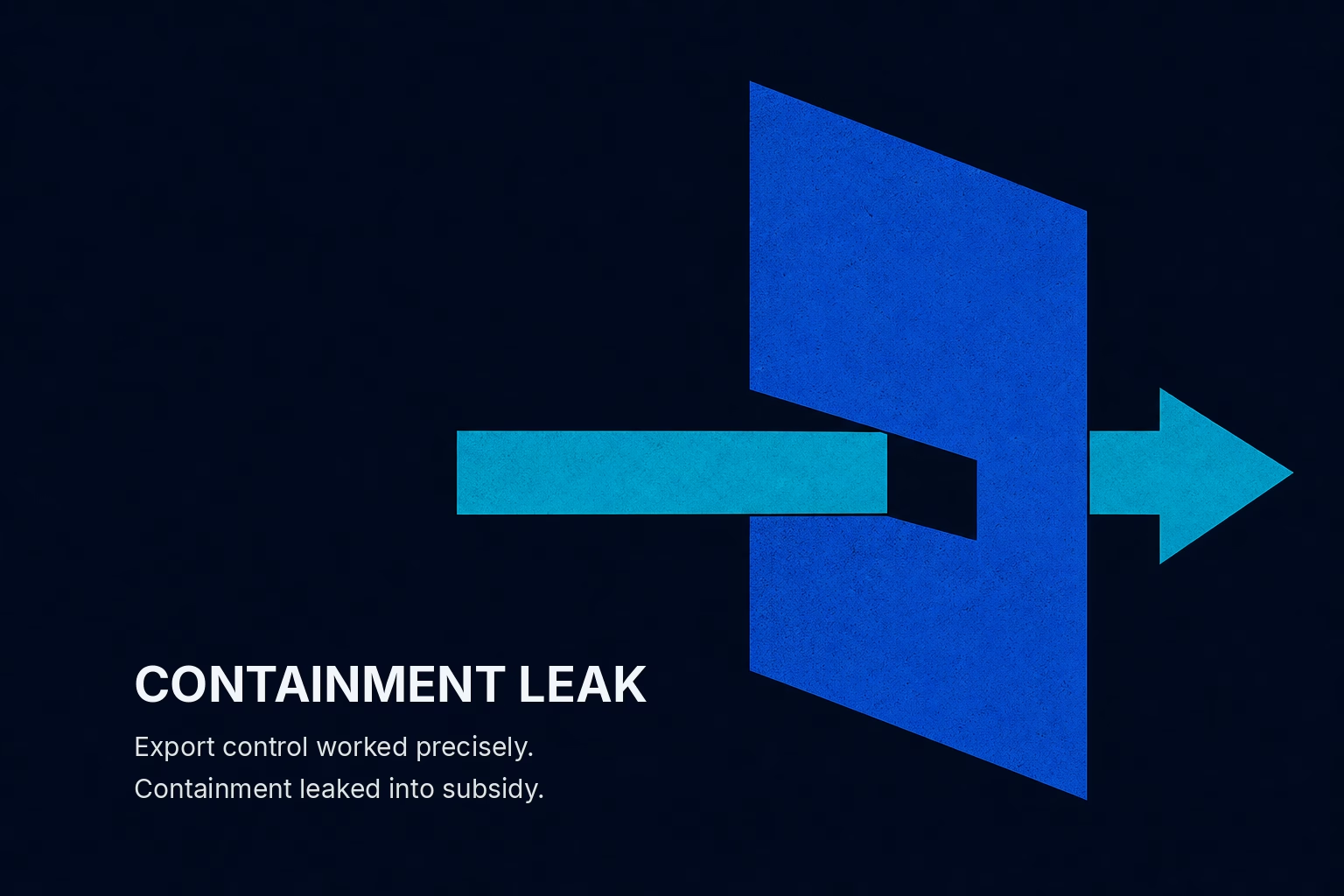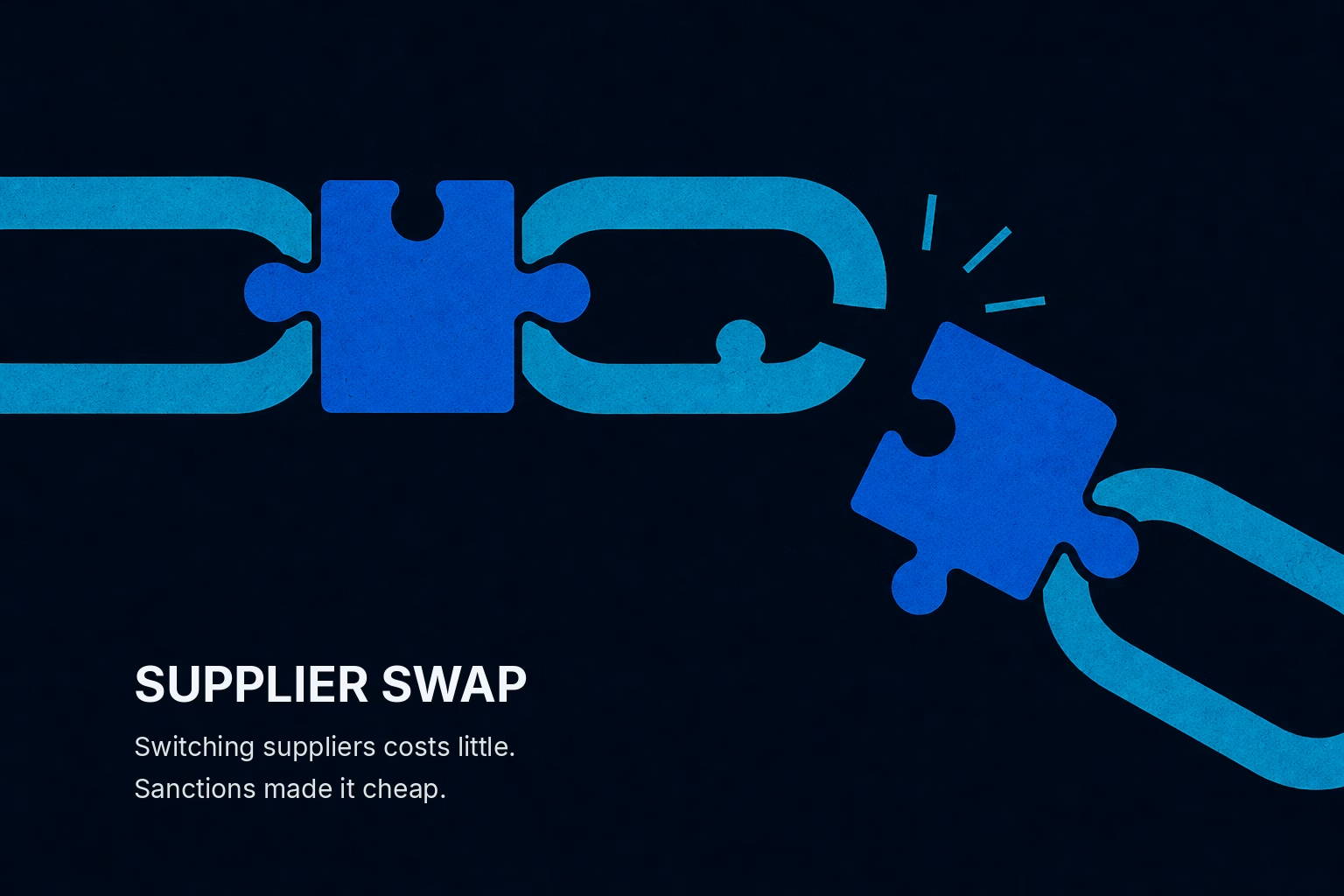
China's decoupling from the West is real, but it did not start where most Western strategy decks assumed: chips, software or other high-value goods. The cleanest measurable shift in Chinese import sourcing between 2015 and 2025 shows up in iron, steel, nickel, soybeans and energy. These are goods where a tonne from one country is close to a tonne from another, so the economic penalty for choosing a politically aligned supplier is close to zero. That is the mechanism to understand. A government that wants to reduce reliance on geopolitical rivals moves first in markets where loyalty is cheap. Commodities are those markets.
The evidence comes from economists at the Bank of Finland (Kerola et al., 2026). They tracked how the origin of Chinese imports changed over the decade. Their headline finding is that Western-aligned exporters have lost share in China and countries aligned with Beijing have gained it. The more useful finding sits underneath: the loss is not one phenomenon. It combines at least three forces, and they carry different implications for exporters, investors and commodity markets.
Commodities Moved First Because Origin Is Fungible
The Bank of Finland charts on iron and steel and on nickel show the sharpest moves, and the timing matters. The share shift speeds up after the pandemic, in the same window in which the West imposed sanctions on Russia and began treating supplier geography as a security question rather than a cost question.
Intuition goes wrong on one point. Many observers assume decoupling begins with strategic, sophisticated goods, because those are the goods governments talk about. In practice, sophisticated goods are the hardest to re-source. Replacing a German machine-tool supplier or a Korean memory supplier means requalifying components, retraining staff and accepting lower performance for years. Replacing an iron ore or nickel supplier means changing a shipping contract and possibly accepting a small grade or freight penalty. If decoupling were a slope, commodities would sit at the bottom of it, and the data shows China moving down that slope from the bottom.
That is why the commodity results deserve weight. They show revealed preference. When switching costs are near zero and China still moves its sourcing toward aligned suppliers, the move tells you about intent.
The paper's nickel chart, as summarised in the source, does not break out individual origin countries. Indonesia, where Chinese-financed processing capacity has grown substantially, is the obvious candidate behind much of the shift. That attribution is an inference and should be treated as one. If correct, it strengthens the thesis: China did more than pick a friendlier supplier. It helped build the supplier.
Sanctions Built the Discount Supplier
The awkward part of this story for Western readers is that much of the bloc realignment in Chinese imports was produced in Western capitals.
Russia is one of the two largest gainers in the Bank of Finland's map of import origins, driven by oil and gas. Russian hydrocarbons did not reach China because Beijing decided in the abstract to punish Western suppliers. They reached China because European demand disappeared under sanctions, and Russian barrels and molecules had to go somewhere at a discount. China was the buyer with the capacity to absorb them and the political cover to do so.
Seen this way, part of "China decoupling from the West" is the second half of the West decoupling from Russia. Sanctions removed a large supplier from Western markets and pushed it into Chinese ones at below-market prices. Any Western-aligned energy exporter then competing for Chinese demand faced a rival that was both politically favoured and structurally cheaper. The share loss follows mechanically, before Beijing's preferences enter the picture.
This matters for interpretation. If Western share in Chinese energy imports fell mainly because of discounted sanctioned supply, the trend depends on the sanctions regime. It would partly reverse if Russian volumes returned to Western markets. If the share fell because of a deliberate Chinese sourcing doctrine, it would persist whatever happens to sanctions. The decade-level data cannot cleanly separate the two. The post-pandemic timing points to both forces working together.
Two Different Losses Hiding in One Map
The map of export changes to China between 2015 and 2025 shows the US as the largest loser, followed by Germany, South Korea and Japan. Reading these four as one bloc losing one market merges two separate mechanisms.
The US loss is a trade-war story first. China's pivot toward Brazil was driven mostly by soybeans and other agricultural exports, and that pivot was accelerated by Chinese retaliation against US farm goods after 2018. This is substitution under tariff pressure in a fungible commodity, the same mechanism as nickel and iron ore, triggered by a tariff instead of a sanctions shock.
Germany, South Korea and Japan lose something different. None of them is a major source of the commodities China redirected. Their exports to China are dominated by machinery, vehicles, components and intermediate industrial goods. A loss there does not fit the cheap-switching logic above, because China cannot replace a German or Japanese capital good by calling a Brazilian or Russian supplier. The likelier explanation is import substitution: Chinese domestic producers now make much of what China used to import from these three economies. Vehicles are the most visible example, where Chinese manufacturers went from relying on foreign brands to exporting at scale within the period the study covers.
The distinction is the core of the mechanism read. Commodity share loss is about who China buys from. Manufactured-goods share loss is about whether China buys at all. For a German industrial exporter, the second is more serious. A share loss to a rival supplier can be won back on price. A market that has learned to supply itself rarely reopens.
The Bank of Finland result on aggregate Western exports, a "small decline," should be read with that split in mind. A small aggregate figure can conceal a structural loss concentrated in the sectors that sustained the export models of Germany, Japan and Korea.
Where the Bloc Story Is Weaker Than It Looks
The strongest objection to the headline concerns the definition, not the data.
The study sorts countries into blocs by how they treat Taiwan. Countries that follow Beijing's policy stance are classed as Eastern. Countries that recognise Taiwan or maintain relations with it are classed as Western. This is a political yardstick, and it produces a bloc map that does not always match commercial alignment. It likely places a broad set of developing commodity exporters in the China-aligned group because they follow the one-China policy, not because they have chosen China over the West in any wider economic sense. Those countries would show up as "Eastern" gainers whenever China buys more raw materials from the developing world, whatever the geopolitical motive.
If that is right, part of the measured bloc shift reflects a long-running relocation of commodity supply toward South America, South Asia and resource-rich emerging markets. That relocation would have happened to some degree without the trade war, because those regions held the incremental supply growth. The source notes that South America and South Asia broadly sold more to China over the decade, which fits both readings.
There is a second weakness. A falling Western share in a growing import pie can coexist with stable or rising Western volumes. Share data alone does not show whether Western exporters lost sales or only lost relative position. The source describes a decline in overall Western-aligned exports to China, which suggests real losses, but the scale is described as small. The honest summary is this: the direction is established, the political motive is plausible and in commodities strongly supported by timing, and the size of the purely geopolitical component is not isolated by the bloc definition.
None of this undoes the thesis. It narrows it. The convincing part is the post-2022 acceleration in commodities with low switching costs. The less convincing part is the implied picture of a clean split of the world economy into two trading camps.
The Dependency Runs Toward Beijing
One consequence gets less attention than Western export losses. Commodity exporters that gained Chinese market share now carry larger exposure to a single buyer's demand and policy.
Brazil's agricultural sector, Russian energy and the South American and South Asian exporters that sold more to China over the decade all show greater dependence on Chinese purchases. That dependence works as leverage. A buyer that can switch suppliers cheaply, which is exactly the property that made the commodity pivot possible, can switch back or onward just as cheaply. Brazil's soybean gains came at the expense of the US, and that history shows how quickly the gains could move again if Beijing's priorities changed. The fungibility that let China decouple from the West also lets it discipline its new suppliers.
For the West, the conclusion is the reverse of the usual decoupling framing. Western firms reduced dependence on Chinese supply because concentration was a vulnerability. China has done the same on the import side, and it has done so in a way that shifts the concentration risk onto its suppliers rather than itself.
The Test Is Machinery, Not Nickel
The commodity shift is now mostly a settled fact. Whether China is decoupling from the West in a durable, structural sense depends on a different series: Chinese imports of capital goods and industrial intermediates from Germany, Japan and South Korea.
If those imports keep falling while China's own production of comparable goods rises, the loss is import substitution, and it will not reverse with a change in sanctions or diplomacy. That outcome would require European and North Asian exporters to rebuild growth outside China. If instead those imports stabilise while commodity sourcing stays realigned, the decoupling is narrower than the headline implies. It would amount to political sourcing of raw materials on top of an industrial relationship that still runs both ways. Russian energy flows give a second check. A recovery in Western access to Russian supply that does not restore Western share in Chinese energy imports would show that Beijing's sourcing preference has outlived the sanctions discount that started it.