The US-China chip ban did exactly what it was designed to do at the level of a customs form and the opposite of what it was designed to do at the level ...
American chip exports to China fell somewhere between 22% and 36% after 2020. Over roughly the same window, China's share of the global semiconductor market rose by 18% between 2017 and 2023. Both numbers are true, and the space between them is where the actual mechanism lives. The ban did not shrink Chinese chip output. It reassigned the invoices.
The substitution nobody priced
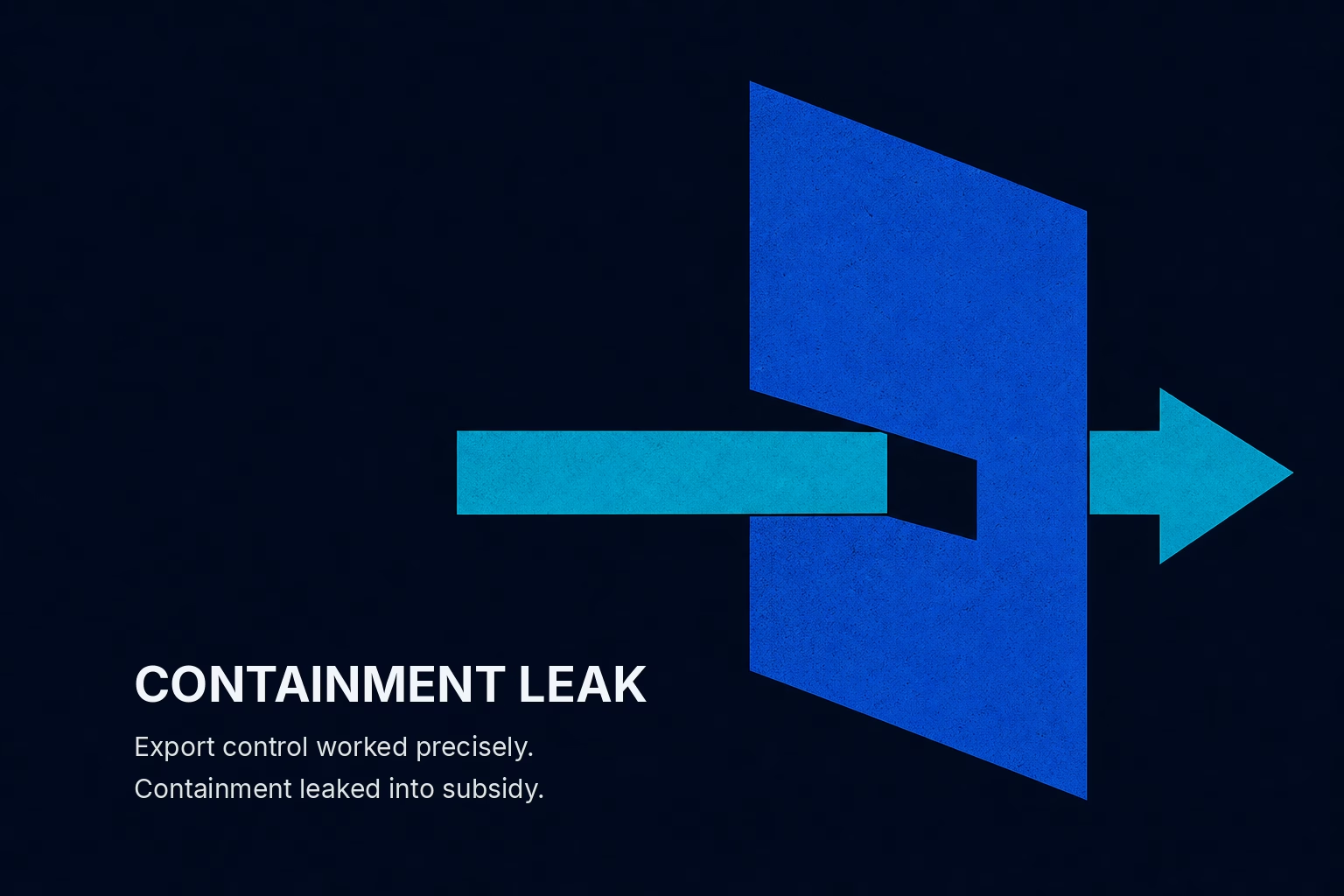
Start with the intuition that gets it wrong. The mental model behind an export ban is a valve: close the American tap and the flow of advanced chips into China slows, degrading Beijing's ability to build a domestic industry. That model assumes the American tap is the only one connected to the same pipe.
It is not. Semiconductor manufacturing equipment is a global supply chain with redundant nodes. When US firms were told to stop shipping equipment and advanced chips into China, Chinese buyers did what any buyer facing a supply shock does. They rerouted. According to the European Commission work by Bonnet and coauthors, the offsetting flows showed up in specific places: the EU, Japan, and Singapore recorded statistically significant increases in exports to China. South Korea and Malaysia also saw more volume, though not at a level the study could distinguish from noise. Taiwan was the lone economy whose exports to China fell in step with the US.
That last detail is the tell. If the ban had genuinely denied China the goods, everyone's exports to China would have dropped, because the goods themselves would have been contraband. Instead, only the American supply and its closest security-aligned partner in Taiwan declined. The rest of the world stepped into the hole. The chip did not become harder to get. It became American companies' problem to have lost the sale.
Why the valve model fails
The reason containment failed is structural, and it is worth being precise about the channel rather than waving at "globalization."
An export control binds on the seller's jurisdiction, not on the buyer's need. The US can compel companies inside its legal reach to stop selling. It cannot compel demand to disappear. As long as a comparable good is manufacturable outside US jurisdiction, the control converts into a market-share transfer rather than a denial. The buyer pays a switching cost, a delay and possibly a premium, and then continues.
There is a narrower version of the policy that had a real chance of working, and it is the one worth separating out honestly. The most advanced lithography, extreme ultraviolet in particular, is close to a genuine chokepoint because the supply is concentrated in effectively one firm's ecosystem. Where the toolchain has no substitute, a control can bind. But the CHIPS and Science Act sanctions reached far past that narrow chokepoint into a broad category of chips and equipment that other countries can and do build. Broad controls on substitutable goods do not deny; they redirect. Narrow controls on genuine chokepoints can deny, at least for a while.
Even the chokepoint case has a shelf life. Eleven months after the 2022 sanctions, Huawei shipped a phone built on process technology the controls were meant to keep out of reach. One data point is not a trend, and reverse-engineering a working node is not the same as matching yield and cost at scale. But it establishes the direction: a determined state buyer facing a broad control treats the control as a timeline, not a wall.
Where the money actually went
The financial consequence is cleaner than the strategic one. US semiconductor and equipment firms surrendered a chunk of the largest single national market for chips, and European, Japanese, and Singaporean firms absorbed it. This is not a hypothetical redistribution. It is the observed pattern in the trade data: the same volume of goods flowing to China, sourced from a different set of national suppliers.
For the American firms that build wafer-fab equipment and sell into China, the loss is direct revenue. For their non-US competitors, the gain is direct revenue plus a durable relationship, because once a Chinese fab qualifies a Japanese or European tool into its line, the switching cost now runs the other way. The ban did not just move one year of sales. It moved the incumbency.
The broad semiconductor equipment complex is the cleanest place to see the pressure, because that is where the substitution physically happened. 
The counterargument that has to be answered
The honest counter to this read is that the point of the ban was never the current invoice. It was to slow China's access to the leading edge, buy the US and its allies time, and raise Beijing's cost of catching up. On that framing, a 22% to 36% drop in US exports is a feature, and the redirected sales to allied economies are tolerable because they keep the advanced toolchain inside a friendly perimeter.
That defense has real content, and it is where the policy is strongest. Keeping EUV concentrated among allies is a coherent goal. But it does not survive contact with the breadth of what was actually banned. If the aim were purely to hold the leading edge, the controls would have been tight around the chokepoint and indifferent to the trailing-edge and equipment categories that any advanced economy can supply. They were not. They swept broadly, which is precisely the design that guarantees substitution rather than denial. The policy conflated two goals, holding the frontier and shrinking China's overall industry, that require opposite instruments. Narrow controls hold a frontier. Broad controls do not shrink an industry with global alternatives; they relocate the profit.
What would change the read
This interpretation flips on one measurable condition: multilateral alignment. If the EU, Japan, and Singapore adopt controls that materially match the US perimeter, the substitution channel closes, and the ban stops being a subsidy to allied equipment makers and starts functioning as an actual denial. The signal to watch is not another American export figure. It is whether third-country exports of advanced equipment to China turn down the way Taiwan's already did.
Until that alignment shows up in the trade data, the cleaner reading stands. The US-China chip ban is two policies wearing one name: a working narrow control on a real chokepoint, and a leaky broad control that hands market share to whichever allied supplier is willing to keep selling. The third parties in the title are not bystanders. They are the beneficiaries, and the trade statistics name them.