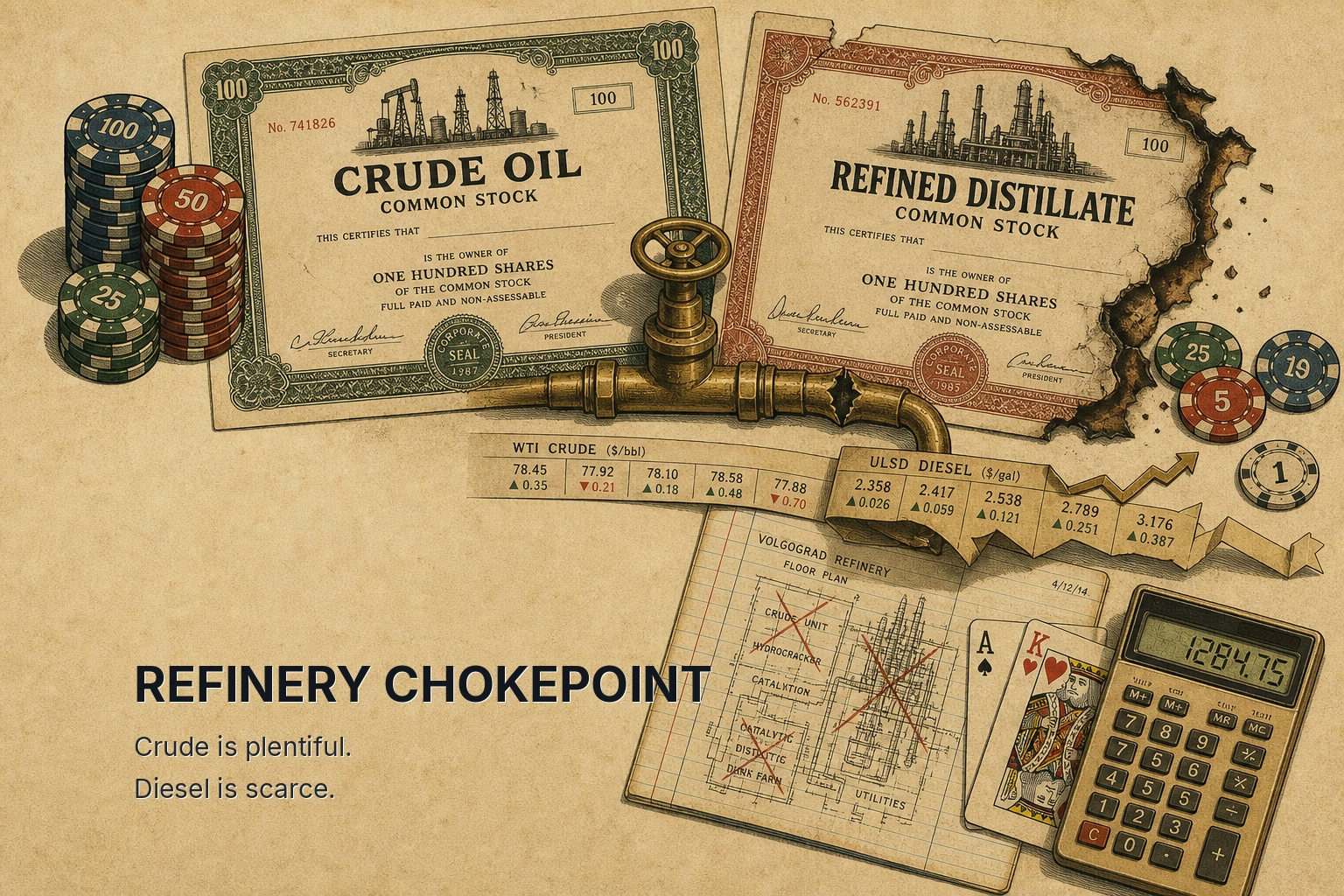
The oil market is watching the wrong number. Crude sits comfortably supplied; the shortage that matters is in refined product, specifically middle disti...
That is the constraint the diesel headlines bury. When French pump prices set an all-time record at $10.50 per gallon on a Sunday, the story is not that the world lacks oil. It is that the world lacks the industrial capacity to turn oil into the fuel that moves freight, farms, and heats homes, and that capacity is being destroyed by drone strikes faster than it can be replaced.
Crude Is Not the Constraint, Distillate Is
There is a persistent reflex to read energy stress through the lens of the crude benchmark. It is the number on every terminal, the one politicians reference, the one that anchors the retail narrative. But crude is a feedstock, not a fuel. The barrel becomes useful only after a refinery cracks it into gasoline, jet fuel, diesel, and the heavier cuts. Diesel and the broader middle-distillate complex are the workhorse: they run trucks, tractors, rail, marine freight, backup generators, and, across much of Europe, home heating.
The refineries reportedly struck in recent weeks add up to real capacity. Ryazan at 320,000 barrels per day, Yaroslavl at 300,000, the Gazpromneft Moscow facility at 245,000, Bashneft-Ufaneftekhim at 190,000, Syzran at 150,000, Saratov at 140,000. These figures come from the source account and should be treated as reported nameplate throughput rather than confirmed lost output, because a strike that damages a distillation unit does not necessarily zero a plant, and repair timelines vary from weeks to quarters. But even a partial, sustained reduction across this many facilities removes a meaningful slice of the product that reaches export markets. Russia is a major exporter of diesel and fuel oil. When its refineries run at reduced rates, it exports less product and, paradoxically, may export more crude, which keeps the crude benchmark soft while the product it can no longer make gets scarce and expensive everywhere else.
That is the mechanism the spot-crude watcher misses. A refinery attack is bullish distillate and neutral-to-bearish crude at the same time. The two prices move apart, and the spread, the crack, is where the stress is legible.
Why the Product Market Cannot Absorb This Quickly
Refining capacity is not fungible on short notice. You cannot spin up a new distillation train the way you can open a spare wellhead. Global refining has been structurally tight for years: closures in the developed world during the pandemic, environmental and cost pressure on aging complexes, and a build-out concentrated in the Middle East and Asia that is optimized for local grades and local demand. Europe in particular has been running a distillate deficit, importing diesel from Russia before sanctions redirected those flows, then from the US, the Middle East, and India.
Now layer the refinery strikes on top of a market that was already thin. When the marginal supplier is impaired, the price does not adjust gently. It gaps, because there is no elastic replacement capacity waiting to fill the hole. The French pump record and the reports of blockaded fuel depots and revived Yellow-Vest agitation are not political theater detached from the commodity; they are the retail terminus of a distillate supply shock working its way through the chain from refinery gate to filling station.
The heating season compounds it. European distillate demand is seasonal and rises into winter. A supply constraint that lands in early autumn has months to tighten before demand peaks, which is exactly the window in which inventories are supposed to be building, not drawing.
Where the Confirmation Should Appear
If this read is correct, the tell is in the relationships, not the headline crude quote. The diesel crack, the margin between distillate product prices and crude, should widen and stay wide. Regional diesel differentials, especially the northwest Europe premium, should blow out relative to the US Gulf and Asian benchmarks, because Europe is the short region. Product tanker rates should firm as cargoes get pulled from further afield to cover the European hole. And crude itself may underperform product, or even soften, as displaced Russian barrels look for a home.
For readers who want a liquid instrument to track the theme rather than physical cracks, a broad energy proxy captures the crude-linked leg but not the distillate stress directly; the distillate story lives in the crack spread and in refiner margins, which is precisely why watching the crude ETF alone will mislead. 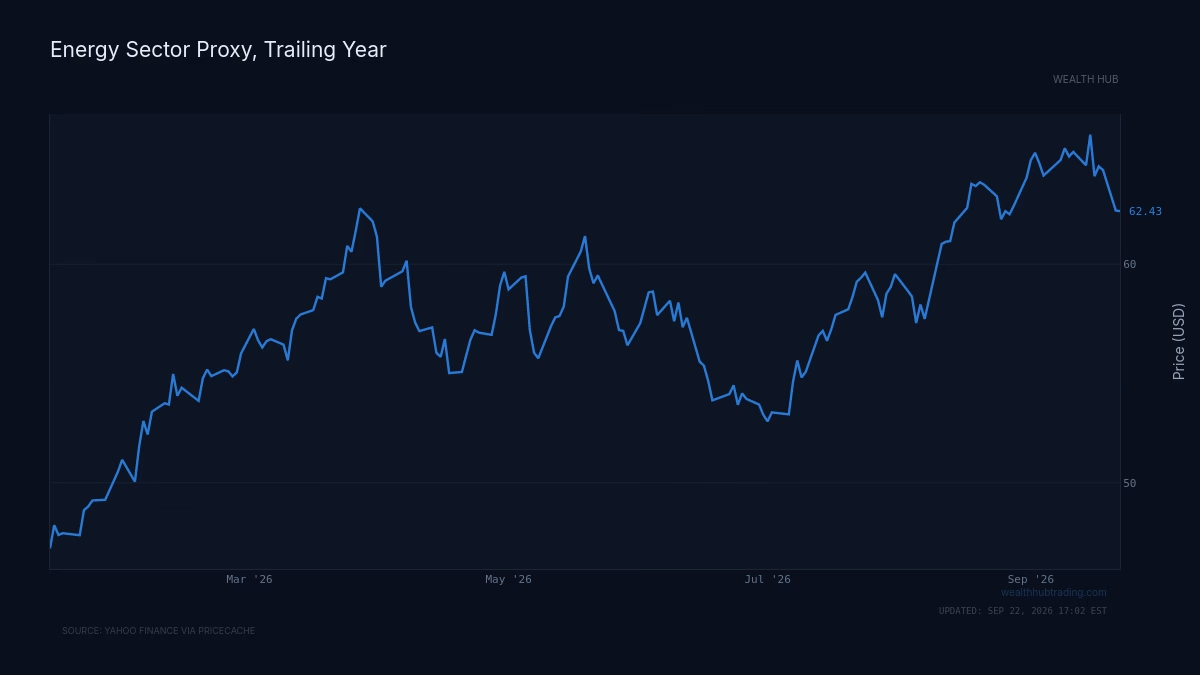
The macro backdrop does not obscure this. US CPI stood at 334.1 as of August, and while a distillate shock is inflationary at the margin through freight and heating costs, the causal channel here is supply, not monetary. This is a physical constraint story, and it should be read as one.
The Case Against Pressing It
The thesis has a real weakness, and it deserves a fair hearing. Reported strike damage routinely overstates actual capacity loss. Russian refiners have shown they can restore units faster than initial reports imply, cannibalizing parts, rerouting throughput to undamaged trains, and leaning on domestic stocks. If the aggregate impairment turns out to be a few weeks of partial downtime spread across plants that keep running at reduced rates, the product market absorbs it with a spike and a fade rather than a structural repricing.
There is also a demand-side offset. High diesel prices destroy demand: freight slows, industrial activity cools, discretionary driving falls. A distillate spike in a weakening European economy may meet softer consumption that caps how far the crack can run. And politics cuts both ways. Le Pen's call for fuel-tax cuts and the pressure on Macron and Merz point toward政策 relief, subsidies, tax suspensions, or strategic releases, that would blunt the retail price without fixing the underlying supply, but would still take pressure off the acute phase.
The single fact that would break the read: durable evidence that Russian refined-product exports have recovered to pre-strike levels within a month or two. If the export data shows product flows holding up, the strikes were noise and crude was the right thing to watch after all.
What Actually Resolves This
The decision variable is the diesel crack spread and the trajectory of Russian product exports, not the crude benchmark. As long as the crack stays wide and European differentials stay bid, the constraint is binding and the retail pain, and its political fallout, keeps building through the heating season. The moment product exports normalize and the crack compresses back toward its historical band, the shock is over regardless of what crude is doing.
Watch the spread, not the spot. The place the diesel emergency shows up first is the margin between a barrel of oil and the fuel it becomes, and right now that margin is where the whole story is being written.