The interesting result in the New York Fed's job-postings work is a negative one. If generative AI were already carving out labor demand, the cleanest p...
Audoly, Guerin, and Topa look for exactly that divergence and do not find it. Hiring has slowed since 2022, but the slowdown is broad. It does not concentrate in the jobs a task-level exposure metric flags as most automatable. The headline "is AI killing jobs" question gets a "not yet, not visibly" answer from the vacancy data, and the reason it does is more instructive than the answer itself.
What The Exposure Metric Actually Measures
Start with what "AI-exposed" means here, because the mechanism turns on it. The authors use Anthropic's task-level exposure score, built on O*NET's decomposition of each occupation into discrete activities. A copywriter edits marketing text; a web developer writes supporting code. Each task gets scored on three things: whether AI could in principle do most of it, whether AI is observed doing it in real usage data, and whether that usage automates the task rather than augments it. Tasks weighted toward automation score higher. Roll the task scores up by how much time a worker spends on each, and you get an occupation-level exposure figure between 0 and 1.
Two features of that construction do most of the analytical work. First, this is potential exposure inferred from observed usage, not realized displacement. An occupation can score high because its tasks are automatable in a lab sense while the occupation itself remains fully staffed. Second, the aggregation is unforgiving in a way that matters: a single non-automatable task inside an occupation caps how much of the whole job AI can absorb. A role that is 80 percent automatable tasks and 20 percent irreducible human judgment does not become 80 percent redundant. It becomes a role where one person does the judgment part and leans on the tool for the rest. That is augmentation, and augmentation does not delete the posting.
Why Exposure Is Thin Where It Would Need To Be Thick
The distribution is the part most readers underweight. Fewer than 10 percent of workers and fewer than 10 percent of current vacancies sit in occupations with an exposure score of at least 0.4. Roughly 40 percent of employment is in jobs with zero measured AI exposure at all. So even a large, real effect concentrated in the highly exposed tail would move a small fraction of the aggregate.
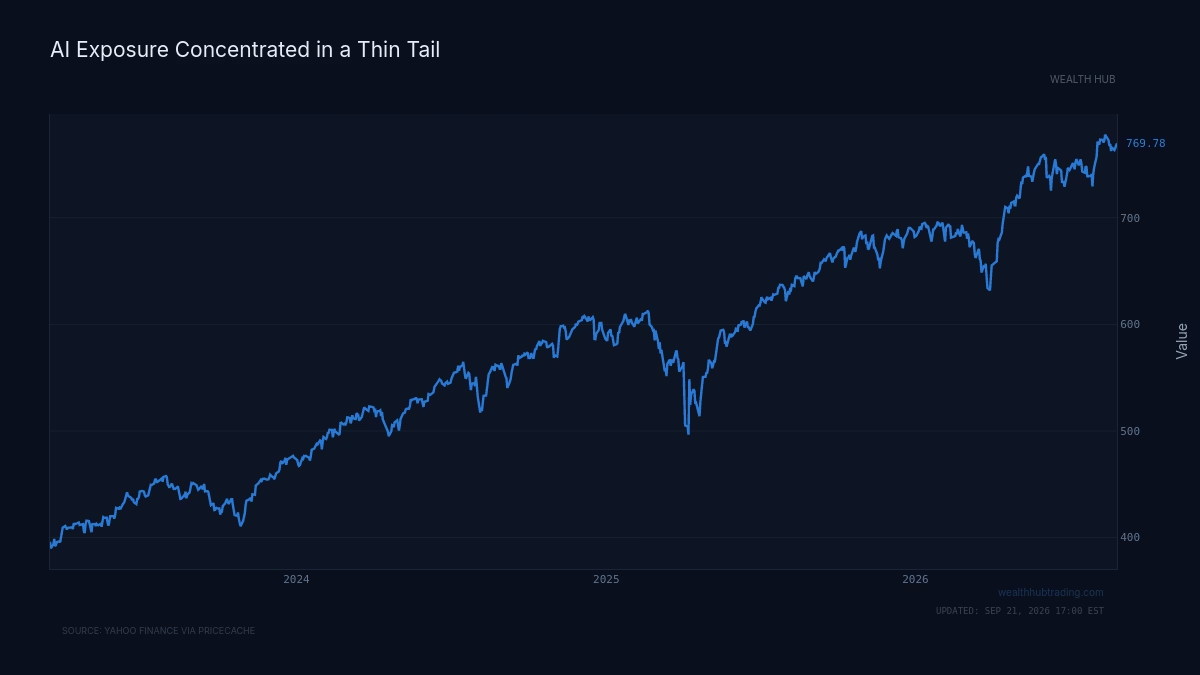
This is the point where intuition misfires. The popular mental model treats "AI-exposed" as a near-universal condition of white-collar work, so the expectation is a broad demand shock. The data say the opposite: high exposure is a narrow phenomenon. If displacement is happening, it is happening inside a slice of the labor market too thin to bend the overall postings series. A null result at the aggregate level is therefore fully consistent with a sharp result in the tail. The study's own framing supports reading it this way rather than as a clean all-clear.
The Event Study And Its Blind Spots
The authors run an event study comparing how postings evolve for high-exposure versus low-exposure occupations around the ChatGPT release. The verdict is that overall hiring cooled but the exposed occupations did not fall disproportionately. Taken at face value, that is evidence against a first-order AI demand effect operating through the vacancy channel by early 2026.
The honest reading has to sit with what a job posting can and cannot show. A posting measures the flow of new demand, not the stock of employment. The first thing a firm does when a tool raises per-worker output is usually not to fire anyone. It is to stop backfilling. Attrition does the work quietly, and attrition shows up as a posting that is never created rather than a headcount line that visibly drops. That is a slow leak, and an event study keyed to a 2022 catalyst may simply be early. The macro backdrop compounds the identification problem: rates rose steeply into 2023, and rate-sensitive hiring cooled across the board for reasons that have nothing to do with AI. Separating a broad monetary-policy slowdown from a broad automation slowdown is genuinely hard when both push the same direction on the same series.
There is also a composition trap inside the exposure metric. If AI reshapes what a job is before it reshapes whether the job exists, the posting survives but its task mix changes. The occupation keeps its exposure label and its posting count while the underlying work quietly migrates toward the human-judgment residual. The vacancy count would register nothing while the labor content shifted underneath it.
The Counterevidence The Authors Volunteer
The strongest challenge to a displacement narrative comes from the authors' own regional evidence, and it deserves weight. In the New York Fed's Second District, more firms report retraining workers in AI-exposed occupations than report reducing hiring in them. That is a firm-behavior signal, not an inference from postings, and it points at augmentation as the dominant response so far. If retraining rather than cutting is what firms are actually doing, the flat postings series is not a measurement failure. It is the correct picture of a labor market absorbing a tool rather than being hollowed out by it.
That reading has real force, and it is the case that would break the "disruption is hiding in the flow" thesis. If augmentation is genuinely the equilibrium, there is no delayed displacement wave queued behind the null result, and the postings data are telling the plain truth.
What Would Move The Read
The disagreement resolves on observables, not rhetoric. Three conditions would tip it toward displacement. First, a divergence that appears with a lag: high-exposure postings flattening or falling while low-exposure postings recover, once the rate-driven slowdown clears and the monetary confound lifts. Second, a shift in the composition of surviving postings toward the non-automatable residual tasks, which would show a job being rebuilt around the tool even as its count holds. Third, entry-level erosion in exposed fields, since junior roles are where augmentation most easily tips into substitution and where a hiring freeze bites first.
Until at least one of those shows up in the data, the cleaner reading is the one the postings support: broad hiring has slowed, the slowdown is not concentrated where AI exposure is highest, and firms are so far retraining more than replacing. The finding is not that AI has no labor-market effect. It is that the vacancy channel, this early and against a thin exposed tail and a large rate shock, is the wrong instrument to detect it. The signal, if it exists, is currently living in postings that were never written rather than in postings that fell.