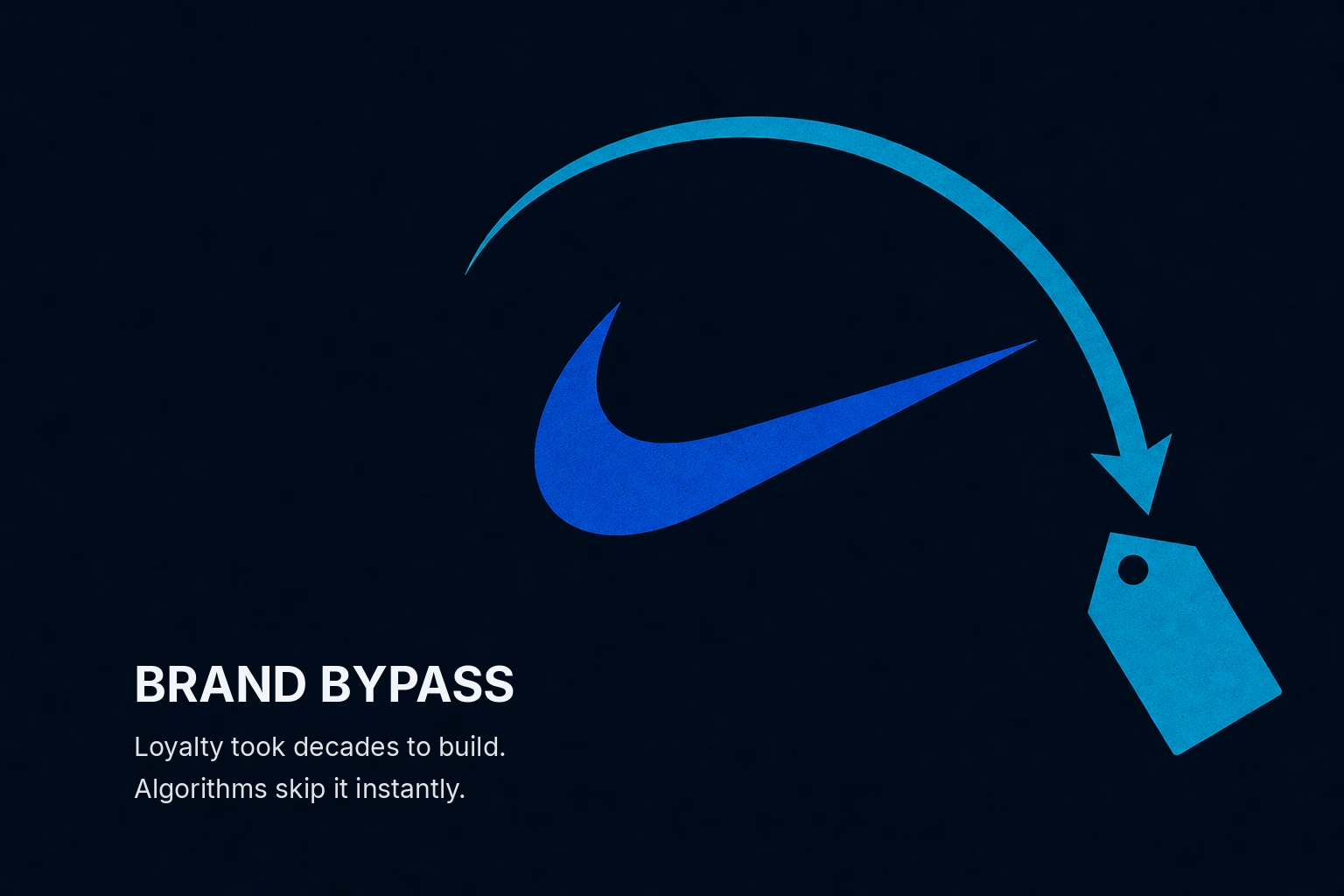
The most valuable thing Nike owns is not its factories, its athletes, or its swoosh. It is the habit that sends you straight to nike.com when you want r...
A consumer AI agent breaks that habit by construction, and that is the mechanism the "short the OTAs" trade misses entirely.
The travel version of this story is real, and the market is already pricing it. Expedia and Booking have sold off over the past month, and the drawdown lines up with the moment consumer agents like Muse and Instinct started getting attention. The logic is clean: if you can tell an agent "three days in Paris, nonstop flight, hotel under $300 a night" and get an itinerary back, the online travel agency has been disintermediated from the one job it does. It aggregates supply and charges for the search. When the search is free and automated, the toll booth has nothing to collect.

But the OTA short is the easy read precisely because the OTA never owned a relationship with you. It owned a moment of transaction. Agents replace transactions well. The harder, more valuable question is what happens to businesses whose entire economic model rests on owning your default choice before any comparison happens. That is a different mechanism, and it points at the consumer brand, not the marketplace.
What The Agent Actually Kills
Start with what an agent does mechanically. It is a comparison engine pointed at a task. You state an outcome ("running shoes, good for marathon training, under $140") and it optimizes across the option set to fill it. Every step of that process is corrosive to the things brands spend money to build.
A brand premium is, in accounting terms, the gap between what you pay and what an unbranded substitute of equal function would cost. That gap survives because comparison is expensive. You do not have time to test six pairs of shoes, so you buy the one whose name you trust, and Nike has spent decades and enormous marketing budgets making itself that name. The premium is a tax on your unwillingness to shop.
An agent makes shopping free. It does not get tired, it does not have brand loyalty, and it will happily surface the New Balance or the Hoka or the private-label shoe that scores better on the criteria you actually stated. The moment the comparison cost goes to zero, the brand premium has to justify itself on function alone, every single time. For a genuinely superior product that is survivable. For a product that is 80% as good at 60% of the price, it is not.
This is why the running-shoe example is sharper than the travel one. Booking never asked you to love it. Nike did, and the loyalty is the asset.
Where The Money Actually Goes
Follow the second-order chain and it runs straight into advertising. Consumer brands do not just spend to build the premium; they spend continuously to defend the default. That spend is the revenue base of an entire ecosystem: search, social feeds, retail media networks. If an agent is making the purchase decision, the human is no longer looking at the ad that was supposed to shape it.
You cannot retarget an algorithm. A display ad works by inserting a brand into a moment of human attention and nudging a choice. An agent has no attention to insert into and no nudge to catch. It has a spec and a ranked list. The entire apparatus of consumer persuasion is built for an audience that agents remove from the loop.
That does not zero out ad budgets, but it changes what they buy. Spending shifts from persuading the shopper toward being visible to the machine that shops for them, which is a smaller, more commoditized, more measurable market, and a worse one for the platforms that monetize attention rather than outcomes. The advertising exposure here is arguably larger than the brand exposure, because the ad ecosystem has less pricing power to begin with and a more direct dependence on human eyeballs.
The Assumption The Whole Chain Rests On
The thesis depends on one behavioral premise: that agents optimize on the buyer's stated criteria rather than on someone else's incentive. That premise is not safe, and it is where the argument could break.
The most likely business model for a consumer agent is not a neutral servant. It is a marketplace. The moment Muse or any competitor can charge a brand for placement, or take a margin on a fulfilled purchase, the agent stops being a pure comparison engine and starts being a new intermediary, one that sits exactly where the OTA used to sit. In that world the brand premium does not vanish; it gets recaptured by whoever owns the agent. Nike stops paying Google to reach you and starts paying an agent platform to be the shoe it recommends. The toll booth moves; it does not close.
There is precedent for this. Amazon was supposed to commoditize everything it touched, and in many categories it did compress brand premiums brutally. But Amazon also built one of the most profitable advertising businesses on earth by selling placement inside its own search results, and it launched private labels that competed with the brands it hosted. The disintermediator became the new gatekeeper. An agent that reaches real scale has every incentive to follow the same path.
So the honest version of the trade is conditional. If consumer agents stay closer to neutral optimizers, the pressure lands on brand premiums and on the attention-based ad ecosystem, and the running-shoe short is directionally right. If they monetize as marketplaces, the value does not disappear from the system; it migrates to the agent layer, and the correct long is whoever owns that layer rather than a short on the brands beneath it.
What Confirms Which Story You Are In
The build-out leg is the one part of this that works under both outcomes, and it is worth separating out. If consumers really do route large parts of their spending through agents, the compute demand steps up again the way it did when coding agents went parabolic earlier this year: more inference, more memory, more power. That trade does not care whether the agent is neutral or a marketplace. It only cares that the agent is used. It is the cleanest expression of the theme precisely because it sidesteps the behavioral question the consumer trades hang on.
For the consumer side, the observable that resolves the ambiguity is not a stock price; it is the agent's business model. Watch for the first paid-placement product, the first "sponsored recommendation," the first take-rate on a fulfilled order. The day an agent platform announces it will charge brands for visibility is the day the trade flips from "short the brand premium" to "long the new gatekeeper," because that announcement tells you the premium is being recaptured rather than destroyed.
Until that happens, treat the online travel agency selloff as the market pricing the easy, first-order version of a much larger idea. The running-shoe question is the one that matters, and it will be answered not by how good the agents get, but by who they end up working for.