On May 6, 2010, the S&P 500 fell roughly 5% in a matter of minutes, then recovered most of the loss almost as fast. Some individual stocks did stranger ...
On May 6, 2010, the S&P 500 fell roughly 5% in a matter of minutes, then recovered most of the loss almost as fast. Some individual stocks did stranger things. Accenture, a large consulting company, briefly traded at one cent. A few others printed at $100,000 per share. These were not typos. They were the visible result of order books emptying out, leaving trades to execute against whatever stray orders remained. The event became known as the Flash Crash, and it is the reason the modern halt system exists in the form it does.
The lesson regulators drew was not that prices fell. Prices are supposed to move. The lesson was that when liquidity vanishes faster than price discovery can function, the exchange prints values that reflect nothing about the underlying company. A one-cent Accenture is not a repricing of Accenture. It is an absence of anyone willing to trade at a sane level, captured as a number. The fix, therefore, was never about stopping prices from moving. It was about pausing them briefly so that liquidity, meaning the standing supply of buy and sell orders, could reform.
What a halt actually does
Here is the point where intuition usually gets it wrong. Most people picture a trading halt as an emergency stop, a mechanism that prevents a stock from falling. It does the opposite of what that framing implies. A halt does not cancel the repricing that is underway. It defers it.
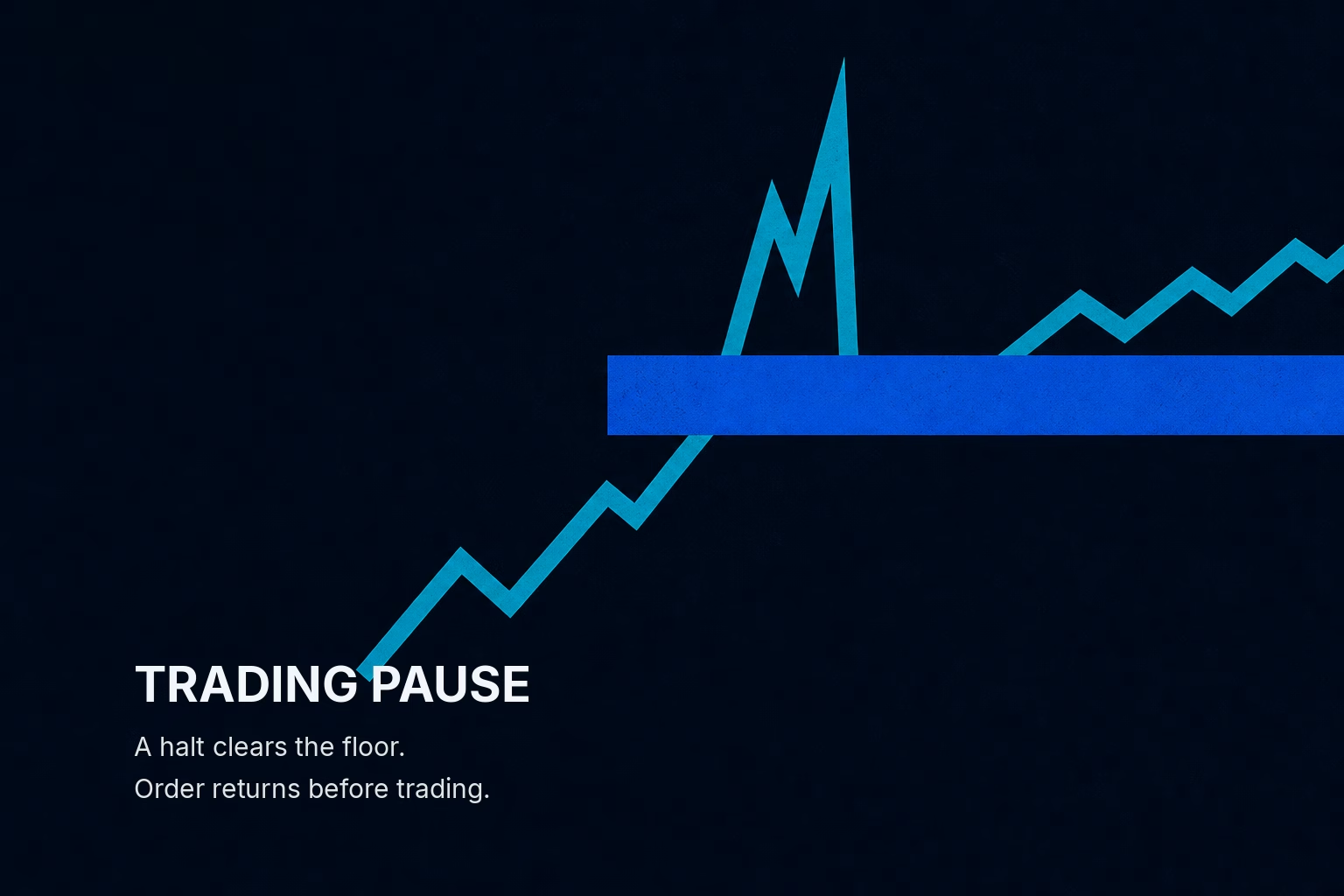
A trading halt is a temporary suspension of trading in a security or an entire market, after which trading resumes and price discovery continues. The word that matters is resumes. When the pause ends, the stock frequently reopens at a price far from where it halted, because the imbalance that triggered the halt has not disappeared. It has simply been given room to be met by fresh orders instead of being executed against an empty book.
Think of it mechanically. A price moves because buyers and sellers disagree, and each transaction nudges the level toward the point where they agree. When a large sell order arrives and there are not enough resting buy orders to absorb it, the price gaps downward through thin liquidity, filling against progressively worse bids. The halt interrupts this cascade. During the pause, market makers and other participants have time to enter new orders, rebuilding the book. Repricing then happens against a fuller book, which produces a truer number.
What this means for you: a halted stock is not a protected stock. If you hold it, the pause is not saving you from a decline. It is postponing the moment when the real level gets revealed.
The two systems, and why there are two
There are two distinct halt mechanisms, and they solve two different problems.
The first is the Limit Up-Limit Down (LULD) mechanism, which addresses dislocations in individual stocks. LULD sets a price band around a rolling reference price, usually the average trade price over the preceding five minutes. If the stock's price would trade outside that band, the exchange first enters a brief limit state, and if trading cannot return inside the band within fifteen seconds, a five-minute pause follows. The band width depends on the stock. Highly liquid large-cap names get a tighter band, commonly 5%, because their prices should not move violently without cause. Smaller or less liquid names get wider bands, because normal trading in a thin stock produces larger swings.
LULD is what would have caught the one-cent Accenture print. The band would have blocked the trade from executing at an absurd level and forced a pause instead. That is precisely the failure the Flash Crash exposed, and LULD was built afterward, taking full effect in 2013, to close it.
The second mechanism is the market-wide circuit breaker, which addresses coordinated stress across the entire market. It is keyed to the S&P 500 index and has three levels. A Level 1 halt triggers on a 7% intraday decline, a Level 2 on 13%, and a Level 3 on 20%. Level 1 and Level 2, if hit before 3:25 p.m. Eastern, halt all trading for fifteen minutes. A Level 3 halt, at any time, closes the market for the rest of the day. These thresholds were recalibrated after 2010; the older breakers used point levels and much larger percentage moves that almost never triggered.
The distinction is worth holding onto. LULD catches a single stock coming loose from its moorings. The market-wide breaker forces a coordinated breath when the whole market is falling together. One is a scalpel; the other is a fire alarm for the entire building.
What this means for you: when you see a single name halted, that is LULD doing its job on an idiosyncratic dislocation. When you see the whole tape freeze, that is the S&P 500 breaker, and the cause is systemic, not company-specific.
Why the levels themselves change behavior
The most counterintuitive part of the system is that the thresholds do not merely react to price. They shape how price behaves as it approaches them.
Consider the LULD band. As a falling stock nears the lower band, every participant can see the level. A trader who wants to sell knows that if the price hits the band, trading will pause and reopening is uncertain. That knowledge changes the decision. Some sellers accelerate, trying to exit before the pause locks them in. Others pull back, unwilling to sell into a level that may snap back on reopening. Liquidity providers widen their quotes because the risk of a pause raises the cost of being caught on the wrong side. The band, in other words, is not a passive ceiling. It is a coordination point that concentrates behavior around itself.
The same reflexivity operates on the market-wide breakers. As the S&P 500 approaches a 7% decline, participants begin to anticipate the Level 1 halt. Some rush to sell before the pause; others hold fire, reasoning that a fifteen-minute break may let panic subside. This anticipation can create what practitioners call a magnet effect, where price is drawn toward the threshold faster as it nears, precisely because everyone is watching the same number.
This is why the levels matter beyond the mechanical pause. A visible threshold changes the incentive of every participant who can see it. The number is not just a tripwire. It is information that reshapes the order flow leading up to it.
What this means for you: do not assume price will glide smoothly toward a halt level and then stop. Behavior often intensifies near the band, because the band is common knowledge and everyone is positioning against the same line.
Where the mechanism does not do what you expect
Halts solve the liquidity-reformation problem, but they carry their own failure modes, and understanding them is what separates a working mental model from a comforting one.
The first is the reopening gap. Because a halt defers repricing rather than preventing it, the reopening auction can print a price dramatically different from the halt level. If you placed a market order expecting execution near where the stock froze, you may fill far worse when trading resumes. The pause protected the market from disorderly prints; it did not protect your specific order from the true price.
The second is the halted-into-close problem. A Level 3 market-wide halt ends the trading day. Positions that traders intended to close cannot be closed, and overnight risk that would have been flattened is instead carried. The pause meant to restore order can leave participants holding exposure they never wanted to hold.
The third is the cross-market complication. Options, futures, and the underlying stock do not always halt in perfect synchrony, which can leave hedges temporarily unmatched. A trader who was delta-neutral before a halt may not be neutral through it, because one leg trades while another is frozen.
None of these failures argue against the system. LULD and the market-wide breakers plainly work; the market has not printed another one-cent large-cap since 2013. The point is narrower. A halt is a tool with a specific job, pausing the tape so liquidity can reform, and it does not do jobs it was never designed to do.
The one thing to hold onto
The halt system exists because on one afternoon in 2010 the market proved that repricing without liquidity produces nonsense, and the fix was to insert a pause, not a wall.
Everything else follows from that single idea. LULD bands pause single stocks that come loose; market-wide breakers pause everything when the whole tape falls together; and the published levels change behavior in advance precisely because every participant can see them. A halt is a pause for liquidity to reform, not a stop that prevents the price from being discovered, and the difference between those two readings is the difference between understanding the mechanism and being surprised by it.