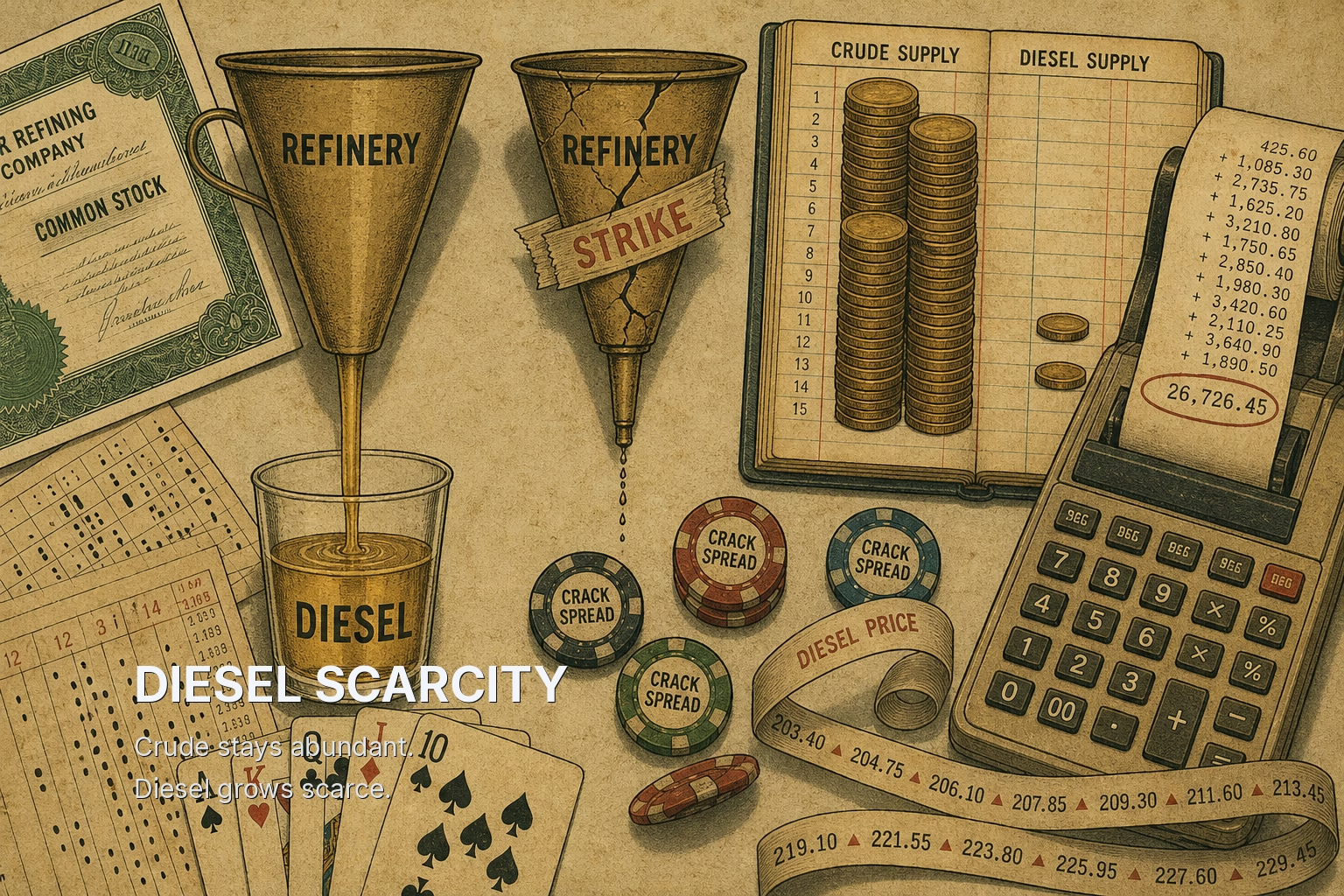
Attacking a refinery is a bet against the crude price. When a distillation tower burns, the barrels it would have processed do not vanish. They stay in the tank farm or move to an export terminal, while the gasoline, diesel and jet fuel the plant would have made simply never exist. The market's habit of reading energy-infrastructure risk through a crude benchmark gets this backwards. A campaign against refining capacity is bearish for crude on the margin and bullish for refined products. The investable constraint sits in the crack spread, the gap between what a barrel costs and what its products sell for.
Doomberg's recent note to its Pro members frames the starting point well. Crude oil, in its phrase, is "worthless and toxic goo" until a refinery transforms it, and the normalization of attacks on civilian energy infrastructure has now put those facilities "in the most recent crosshairs." Read through a commodities lens, the implication goes further than a security warning. The world's binding energy constraint is not the volume of oil in the ground. It is the scarce, slow-to-build industrial capacity that turns oil into something usable.
The Conversion Bottleneck
A refinery is a chain of units, not a single machine. Crude distillation separates the barrel by boiling point. Downstream units then do the expensive work: hydrocrackers and fluid catalytic crackers break heavy molecules into lighter fuels, hydrotreaters strip sulfur to meet diesel specifications, and cokers squeeze value from the residue at the bottom of the barrel. Simple plants produce a lot of low-value fuel oil. Complex plants produce a lot of diesel and gasoline. The complexity is the value.
That structure determines what a strike actually removes. Damage a crude distillation unit and the whole plant's throughput falls. Damage a hydrocracker and the plant can keep running crude but loses much of its ability to make on-spec middle distillates. In both cases the lost output is product, and the input crude finds another home.
The repair side is where the constraint bites. Large refining vessels, compressors and specialized catalysts are not stocked items. They come from a small set of Western and Asian fabricators, and a country under sanctions faces longer lead times or no access at all. Russian refineries hit by Ukrainian drones over the past two years have often restarted damaged units within weeks, but restarting a unit at reduced rates is not the same as restoring its full design capacity. When strikes repeat faster than repairs finish, the outage becomes a standing feature of the market rather than a series of discrete events.
Why Crude Can Fall While Diesel Rises
The mechanism that links a burning refinery to a market price runs through two different balance sheets.
On the crude side, a producer that loses domestic refining capacity has to do something with the oil it keeps pumping. Shutting in wells is costly and slow to reverse, so the rational response is to push more crude into the export market. That adds supply to the seaborne crude pool at exactly the moment the world has lost some ability to process it. The direct effect on the benchmark is mildly negative.
On the product side, the same event removes supply that buyers cannot easily replace. Russia has been one of the world's largest exporters of diesel and other middle distillates. Every barrel of diesel it fails to produce must be replaced by a refinery somewhere else running harder, and global refiners already operate near practical capacity during peak seasons. Spare refining capacity, unlike spare crude production, is thin and geographically scattered.
The result is a divergence that a crude-only view misses entirely. A trader watching Brent sees a quiet or softening market. A trader watching the diesel crack, the spread between gasoil futures and crude, sees tightness. The second view is the accurate one for anyone exposed to transport fuel, freight costs or refining margins.
There is a policy layer on top of this. Governments that lose refining capacity frequently restrict product exports to protect domestic supply, as Russia has done with gasoline export bans in recent years. Those restrictions convert a domestic shortage into an international one, because the export barrels the market had counted on disappear first.
Where the Margin Lands
If the constraint is conversion capacity, the beneficiaries are the owners of conversion capacity outside the conflict zone, specifically the complex, diesel-heavy plants with cheap inputs.
US Gulf Coast refiners fit that description better than most. They run sophisticated configurations built to process heavy and sour crudes, they sit next to abundant domestic crude supply, and they pay North American natural gas prices for the hydrogen and process heat their hydrotreaters consume. That last point matters more than it looks. Hydrogen is an input to making low-sulfur diesel, and European refiners competing for the same export cargoes pay considerably more for gas. A refinery that can make on-spec diesel cheaply is the one that captures a widening crack.
The link to specific listed names is an inference, not a verified attribution, and it should be treated that way. Independent refiners such as Valero, Marathon Petroleum and Phillips 66 carry the most direct exposure to product margins among large US-listed companies, but each has a different mix of Gulf Coast versus inland capacity, different diesel yields and different non-refining businesses that dilute the effect. Ownership of a refinery is necessary for the trade; it is not sufficient. The cleaner expression is the margin itself rather than any one balance sheet.
History offers a guide to how large that margin can get. In 2022, when sanctions on Russian products collided with already-thin global refining capacity, US refiners posted record earnings and diesel cracks reached levels rarely seen outside hurricane disruptions. That episode is the clearest recent demonstration that a product shortage hands pricing power to whoever still has working units.
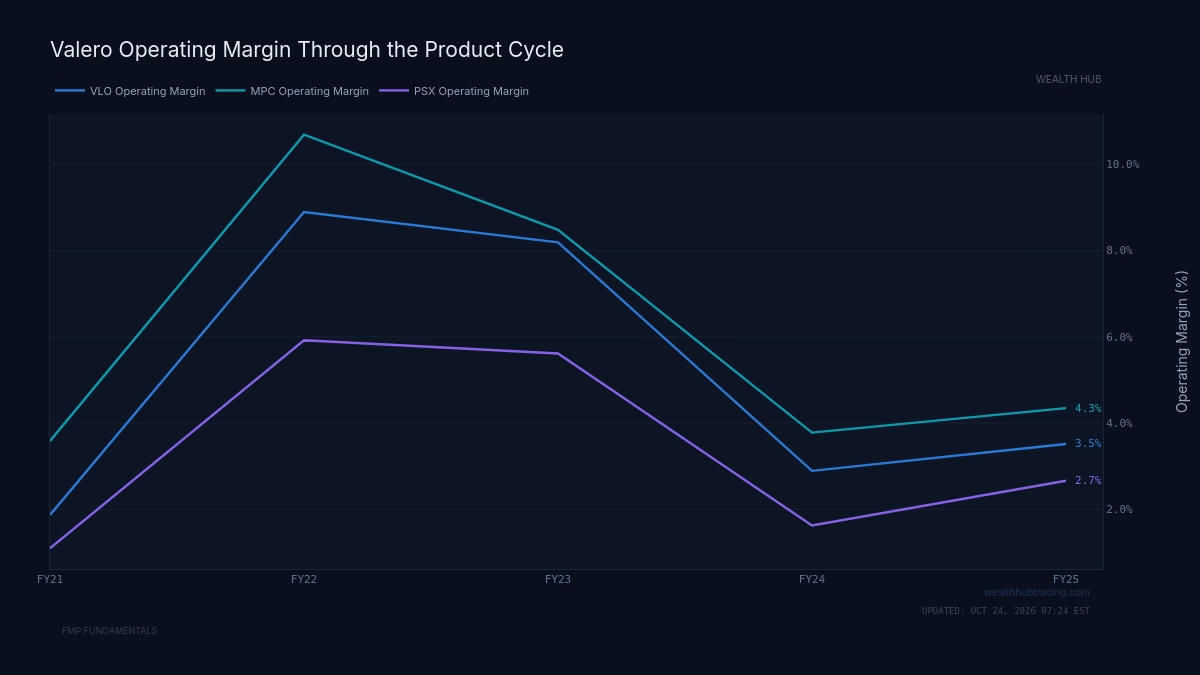
The same history carries a warning. Those margins were not permanent. They normalized as trade flows rerouted, Russian diesel found buyers in Asia, Africa and Latin America, and new capacity came online. Refining earnings are cyclical, and a strike campaign raises the ceiling on the cycle without abolishing it.
The Case Against a Durable Squeeze
The strongest counterargument is that refining capacity is less scarce than it was in 2022. Large new plants have started up in Nigeria, Mexico, the Middle East and China, and some of them are explicitly export-oriented. Nigeria's Dangote refinery, once fully running, is designed to supply much of West Africa's fuel demand that previously came from European refiners. If that capacity ramps on schedule, it absorbs a meaningful share of whatever a strike campaign removes.
Demand matters too. Chinese gasoline and diesel consumption has softened as electric vehicles and LNG-fueled trucks take share, freeing Chinese refiners to export more product when their government expands export quotas. Beijing controls that valve, and it has opened and closed it in response to margins before.
The third objection is repair speed. If damaged units return to service within weeks, as many have, the market can treat each strike as a temporary outage, and inventories plus rerouted cargoes cover the gap. On this view, the attacks generate headline volatility rather than a structural shift.
Each objection is real. None of them addresses the repeat-strike problem. New capacity offsets a one-time loss; it does not offset a loss that recurs every time repairs finish. Chinese export quotas are a political decision that can tighten as easily as loosen. And repair speed is only an argument for calm if the attacker stops. The policy direction Doomberg flags, the normalization of infrastructure strikes as an acceptable instrument of war, points the other way.
The Spread That Settles It
The decision variable is not the price of oil. It is the spread between oil and diesel, and the behavior of that spread around strike events.
If attacks are a genuine structural constraint, the diesel crack should widen after each wave of strikes while crude benchmarks stay flat or weaken, and the widening should persist rather than fade within a fortnight. Gasoil futures time spreads should hold in backwardation, signaling that buyers need product now rather than later. Russian seaborne crude exports should rise as product exports fall. Those three observations together would confirm that the market has lost conversion capacity, not oil.
The read breaks if diesel cracks fail to respond to sustained strikes, or if they spike and collapse within days as new Asian and African capacity fills the gap. That outcome would mean the world has more refining slack than the 2022 episode suggested, and the constraint has cleared.
Until that evidence appears, the cleaner reading is that a campaign against refineries is a campaign against the world's tightest energy bottleneck, and the price signal belongs in the crack spread rather than in crude.