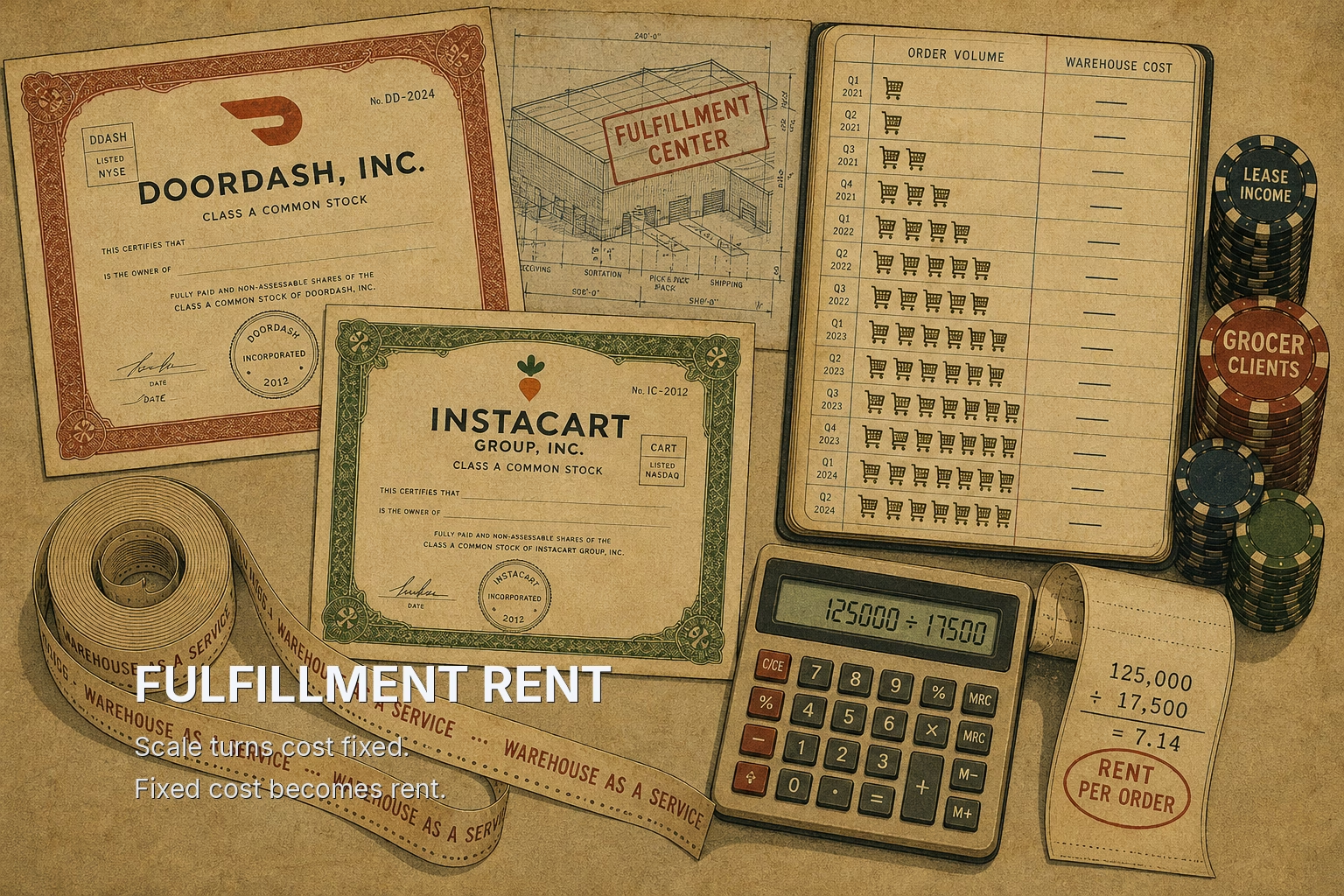
The most revealing line in DoorDash's 3Q'26 shareholder letter is not the $500 million synergy target. It is the admission that DashMart, DoorDash's network of closed-to-the-public warehouses, is "a fixed cost business" that needs scale DoorDash does not have on its own, and that this is "one of the reasons we're attracted to Instacart." The market is pricing the roughly $17 billion Instacart deal on the synergies the CFO listed first: cross-listing DoorDash restaurants on Instacart, advertising, and a denser grocery network from day one. Those are real. They describe a marketplace merger. The letter also describes something else: a company that has built a more accurate, faster grocery product and lacks the order volume to run through it. Instacart supplies that volume. If DoorDash can fill its buildings with other people's orders and other people's inventory, the deal starts to resemble Amazon's 2006 launch of Fulfillment by Amazon more than a consolidation of two delivery apps.
The Accuracy Gap Store Picking Cannot Close
The case for owning the shelf starts with a number DoorDash disclosed on its latest call. Orders fulfilled from DashMarts are more than 99% accurate. Orders shopped from third-party stores run in the "low 90s." DashMart orders also arrive more than 10 minutes faster on average.
Seven or eight points of accuracy sounds marginal until it is compounded across a habit. Instacart did 89.5 million orders in 4Q'25, and about 10 million customers ordered in December 2025, which implies an active customer places roughly three orders a month. At 92% accuracy per order, about 63% of customers hit at least one flawed order within twelve orders, and roughly half run into one every quarter. At 99%, the quarterly figure falls to about 9%. The arithmetic assumes errors are independent from one order to the next, which flatters neither model much, but the direction is unambiguous: the more often someone orders, the faster store-picking errors erode the premium they pay for delivery.
Tony Xu named the root cause on the 2Q'26 call. Grocers do not know their own inventory, partly because shoppers in the store move things around. No routing algorithm fixes a shelf that does not match the database. Instacart, after 14 years of shopping other retailers' stores, disclosed 300 million replacements in 2024 against 294 million orders, close to one substitution per order. That is the best store-picking operator in the US, and it still swaps something in nearly every basket.
A Ceiling Inside the Store, and Kroger's Lesson
The second pressure is capacity. McKinsey's June State of Grocery report found that surveyed grocers run 57% of e-commerce fulfillment through stores, 26% through third parties, and only 17% through centralized sites or dark stores. Only 46% said e-commerce is profitable. McKinsey also argued that manual in-store picking tends to hit a ceiling around 12 to 15% online penetration, because adding pickers to congested aisles stops working.
The obvious response, grocers building their own warehouses, has a poor recent record, and Kroger is the clearest case. Last November it said its automated fulfillment centers had not met financial expectations, closed three, took a roughly $2.6 billion charge, and expanded Instacart's role as its primary delivery fulfillment provider. Kroger's CEO explained the split on its September call: facilities in high-density areas performed better than those where density was lower and adoption slower. In December he said automation would be used only "in geographies where customer demand supports it."
The diagnosis matters more than the write-down. Kroger did not fail at warehousing; it failed to fill warehouses with one retailer's demand. If one of the three largest US grocers could not generate enough orders to run some of its own buildings, smaller chains will find it harder. A warehouse shared by many retailers and fed by more than one demand source attacks precisely the variable that broke Kroger's network. That is what DashMart Fulfillment Services, launched in September 2025, is built to be: the retailer supplies the goods, DoorDash stores, counts, picks and delivers them. CVS and Party City were first. DoorDash now cites thousands of products from Giant Eagle, Albertsons and others.
Why the Instacart Volume Changes the Fixed-Cost Math
Here the deal's mechanism becomes concrete. A gig shopper is a variable cost: pay shows up only when an order does. A DashMart carries rent, staff and inventory whether or not orders arrive. DoorDash learned this in 2022, when its CFO attributed about half the year-over-year rise in cost of sales, as a share of order value, to DashMarts and warned the company would slow investment if unit economics, retention and frequency stalled. By 4Q'23 the stated priority was holding the footprint and adding volume. DoorDash cited more than 100 DashMarts in 3Q'25. Its own grocery orders skew toward small fill-in baskets, about $50 on one independent estimate, which is a thin stream to amortize a building against.
Instacart did 91.4 million orders in 3Q'26, roughly a million a day, at an average basket near $115. McKinsey's 2022 benchmark for a manual dark store was 2,400 to 3,000 orders a week. Routing just 1% of Instacart's orders through 100 DashMarts would add about 700 orders a week per site, a quarter of benchmark throughput, from a sliver of the acquired base. The letter says it plainly: Instacart's scale "will help amortize the fixed cost of managing inventory on behalf of grocers," and the deal's efficiencies create "investment capacity to invest further in our fulfillment network."
There is also a cost line inside Instacart that a warehouse attacks directly. Instacart's S-1 showed shoppers earned 8.2% of GTV before tips in 2022. If that share held (it is no longer disclosed), the shopper bill runs near $3.5 billion a year, about $9.45 an order, which would exceed the roughly $8.60 of gross profit Instacart keeps per order. That estimate is likely high; Instacart's CFO said in 2025 it had driven "pretty meaningful leverage" on shopper pay. The S-1 also implied productivity of roughly one order per shopper hour in 2Q'23, with nearly half of shopper time spent inside the store, around 30 minutes in the aisles per order.
Hold hourly earnings constant and lift orders per hour by 10%, and shopper pay per order falls about 9%, worth roughly $315 million a year on a $3.5 billion bill. Instacart has achieved gains of that size before; its batch rate rose 11% year over year in 4Q'23. Two levers could get there: merged density, where DoorDash and Instacart orders from the same store go to one shopper, and DashMart, where a building designed for picking removes much of the in-aisle time. If the shopper-pay estimate is directionally right, one productivity lever alone could approach the $500 million net synergy target, a figure management frames around cross-listing and ads. That link rests on undisclosed figures and should be treated as an inference, not a forecast. It still reframes where the synergy upside may actually sit.
The Amazon Parallel, Run in Reverse
Amazon faced the same fixed-cost problem from the opposite direction. It started in 1995 as a first-party retailer, expanded warehouse space from about 300,000 square feet to over 5 million in 1999 alone, opened to third-party sellers in 2000, and launched FBA in 2006 so those sellers could send goods into Amazon's buildings for storage, picking and shipping. Other people's inventory filled Amazon's warehouses, and because FBA items shipped with Prime, sellers had every reason to join. By 2018, third-party sellers were 58% of physical gross merchandise sales, up from 3% in 1999. Bezos noted in his 2018 letter that their sales compounded at 52% a year against 20% for eBay, which stayed a pure marketplace.
DoorDash began with demand and couriers, and no warehouses. Owning inventory in DashMarts was the apprenticeship. Xu described DashMarts on the 3Q'24 call as infrastructure retailers could use to "forward deploy their inventory" once DoorDash proved it could run them. Fulfillment Services is functionally DoorDash's FBA. The difference is that Amazon launched FBA with shoppers and sellers already in hand. DoorDash is buying both at once: Instacart's order flow and its relationships with more than 2,200 retail banners across nearly 100,000 stores. The CFO listed offering Fulfillment Services to more retailers across both platforms among the deal's synergies.
The competitive asymmetry sharpens the point. On its own 3Q'26 call, Uber's CFO called dark stores "a fit-for-purpose sort of solution" and said Uber does "not want to get into this business everywhere." Uber has nothing comparable in US grocery. A marketplace-only strategy is a defensible choice, and eBay remained a large business. Amazon's history is sometimes cited as proof that owning fulfillment wins; a fairer reading is that it is one strong case where shared infrastructure let sellers outgrow a pure marketplace, worth watching rather than assuming.
Where the Warehouse Thesis Breaks
The strongest objection is assortment. A DashMart carries a few thousand items, about 2,000 per site at launch. Instacart's marketplace spans more than 22 million unique items. Today's DashMarts cannot serve a weekly shop, which is exactly the $115 basket Instacart brings. Xu's answer on the 3Q'26 call was that the square footage already exists in hundreds of thousands of grocery stores built for browsing rather than delivery, and that DashMart's vision is "a sequencing process" in which stores act as showrooms and DoorDash builds the back-of-house picking capacity. That end state looks less like thousands of DoorDash-owned dark stores and more like DoorDash running inventory and picking inside part of a grocer's footprint. It would need far less capital than Amazon's build. It also has not been demonstrated anywhere at scale.
The second objection is timing. DoorDash expects to reinvest more than 100% of synergies in the first year after close, with positive net synergies from year two. The 2022 episode showed how quickly DashMart can widen cost of sales when volume lags footprint. And almost nothing about DashMart's site-level economics is disclosed: not per-site throughput, not contribution margin, not Fulfillment Services revenue.
The thesis breaks if Fulfillment Services stays a handful of large logos while DashMart's share of grocery orders stays flat after Instacart volume becomes available to route. It holds if three disclosures start appearing: a growing count of retailers using Fulfillment Services across both platforms, a shopper-pay or orders-per-hour figure showing leverage beyond density alone, and positive net synergies arriving on schedule in year two despite continued fulfillment investment. The first of those is the one to read for. Retailers sending their own inventory into DoorDash's buildings would be the clearest sign the market is valuing this deal on the wrong page of the letter.