The most striking number in the KfW study on AI and US debt is not the debt ratio AI might avoid. It is how little of that improvement comes from the budget itself. In Stephan Bales's projections, a 0.2 percentage point annual boost to productivity trims the 2056 primary deficit from 2.8% of GDP to 1.5%, yet it pulls projected debt-to-GDP from 185% down to 143%. A 1.3-point gain in the annual primary balance cannot, on its own, explain a 42-point swing in the stock of debt. The rest comes from compounding: smaller deficits, a slower-growing debt base, and lower interest costs on that base.
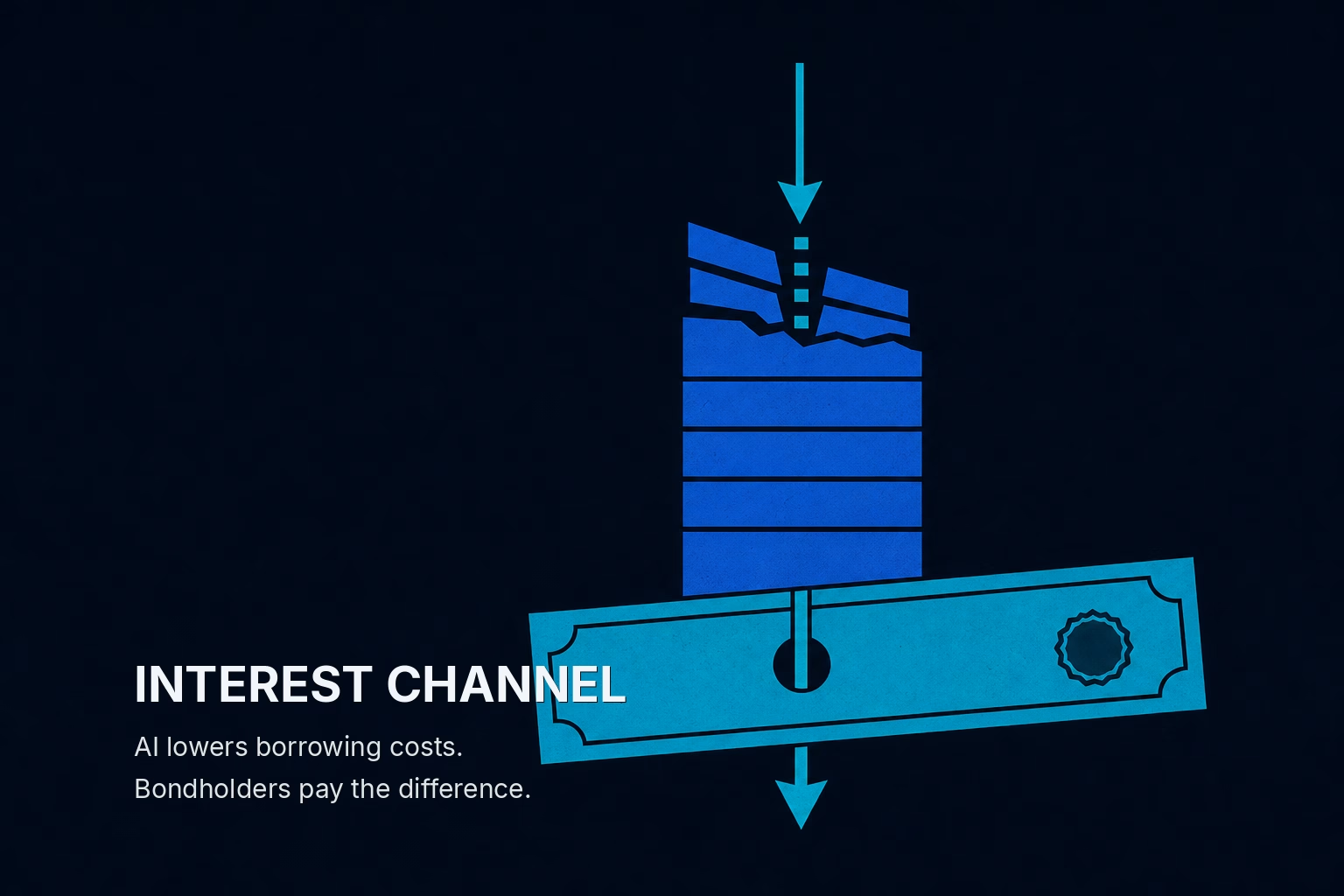
That is the right result. The catch is what it implies for bondholders. The channel that does most of the fiscal repair is the gap between the interest rate the Treasury pays and the growth rate of the economy. Faster productivity growth widens that gap in the government's favour only if interest rates do not rise alongside growth. Standard growth theory says they should. So the claim that buying 30-year Treasuries is an implicit bet on AI productivity is half right. It is a bet on AI raising growth without raising real rates by the same amount. That outcome is far more specific, and the historical record of transformative technologies suggests it may be the least likely sequence.
The Snowball Term Does the Heavy Lifting
Debt arithmetic has two moving parts. The first is the primary balance, which is spending minus revenue before interest. The second is the "snowball": the existing debt stock multiplied by the difference between the effective interest rate (r) and nominal GDP growth (g). When r exceeds g, debt grows on its own even with a balanced primary budget. When g exceeds r, the ratio shrinks even with a modest deficit.
The scale of that second term at current debt levels explains the outsized KfW results. At a debt ratio near 150% of GDP, every 0.1 percentage point narrowing of r minus g is worth roughly 0.15% of GDP per year in debt avoided. Run that for three decades and add the compounding from lower interest payments on a smaller stock, and a productivity boost of a few tenths of a point becomes a debt reduction of tens of points. This is why the 0.4% scenario, which in Bales's projections eliminates the primary deficit within 30 years, ends with debt at 113% rather than 185%.
The primary balance mechanism is the one most commentary describes: higher growth lifts tax receipts and reduces welfare outlays. It is real, but it is the smaller lever. The bigger lever is the assumption, embedded in the KfW framing and stated directly by the source note's author, that interest costs fall too. He expects "lower bond yields to add to the lower interest expense." That parenthetical carries most of the argument.
Why Faster Growth Is Not Free for Bondholders
The standard neoclassical result links the equilibrium real interest rate to trend growth. If households expect to be richer in the future, they save less today. If firms see higher returns on capital, they borrow and invest more. Both forces push the real rate up. In the simplest version, a one-point rise in productivity growth lifts the neutral real rate by about one point, which leaves r minus g unchanged and removes the snowball benefit entirely.
Under that frictionless case, an AI productivity boom improves the primary balance, which is the 2.8% to 1.5% channel, but leaves the interest-growth dynamics roughly where they were. The debt path improves, though by much less than 185% to 143%. Long-bond holders also take a mark-to-market loss as real yields reset higher across the curve. A 30-year bond is the most exposed instrument to that kind of shift in the real rate.
This is where intuition fails. Investors tend to treat "better fiscal outlook" and "lower long-term yields" as the same outcome. They come from different channels. The fiscal outlook depends on the level of debt. Long yields depend on the expected path of real short rates plus a term premium. An AI boom can improve the first while pushing up the second. If the term premium falls because solvency fears ease, it partly offsets the higher expected real rates. Whether it fully offsets them is an empirical question the KfW projections assume away rather than answer.
The empirical link between trend growth and real rates is loose in practice. The decade after 2008 combined weak productivity with very low real rates, which fits the theory. Real rates have also moved for reasons unrelated to growth: global savings imbalances, demand for safe assets, central bank balance sheets, and demographics. So the one-for-one pass-through is a ceiling, not a forecast. The KfW scenario needs pass-through well below one. That is plausible, but it is a separate bet from the productivity bet, and the bondholder is making both.
The Hype Years Are the Expensive Years
The second strand of the Bales study, on the timing of past technology waves, sharpens the problem. Steam, electricity and the computer each went through long stretches of heavy investment and enthusiasm with little measured productivity growth. The gains arrived only once complementary applications and organisational changes caught up. The source note's author takes the same view of AI: hype now, possible payoff in five, ten or twenty years.
Combine that timing with the rate mechanism and the order of events becomes unfavourable for duration. During the investment phase, demand for capital is high because data centres, power capacity and chips must be financed before they generate productivity. That investment demand pushes real rates up. Measured productivity, and therefore g, does not yet respond. In debt-dynamics terms, r rises before g does. The snowball term moves against the Treasury before it moves in its favour.
A bond bought today at a 30-year maturity therefore has to survive the expensive part of the J-curve before collecting the benefits of the cheap part. If the historical pattern holds, the holder may spend years in a regime of heavy capex, firm real rates and a deteriorating debt path. Only later does the productivity dividend start compounding. Past episodes are only a guide here. AI adoption costs may be lower than electrification costs, and diffusion may be faster. But the burden of proof belongs to the scenario that assumes the payoff comes first.
Where the Fiscal Arithmetic Leaks
Even the primary balance channel is less mechanical than "more growth, more tax" suggests. Several features of US fiscal plumbing absorb part of the gain.
- Wage-indexed entitlements. Initial Social Security benefits are calculated from wage-indexed earnings histories. If productivity raises real wages, future benefit awards rise too, with a lag. Part of the revenue windfall from higher wages is pre-committed to higher future outlays.
- Health spending that tracks income. Healthcare costs have historically grown with, and often faster than, national income. A richer economy does not automatically spend a smaller share of GDP on Medicare and Medicaid.
- Distribution of the gains. If AI productivity accrues mainly to capital and profits rather than labour income, the revenue response depends on corporate and capital-gains tax rates and on where profits are booked. The welfare-savings channel also weakens if displaced workers draw more support during the transition.
- Political absorption. A visibly improving deficit invites tax cuts and new spending. A projection that holds policy fixed for 30 years is a useful benchmark, not a prediction.
None of these breaks the KfW conclusion that AI productivity is good for US solvency. Each one shrinks the improvement in the primary balance. That matters because the primary balance is the channel bondholders can rely on regardless of what happens to real rates.
The Countercase, and What Would Settle It
The strongest argument against this read is that the bond market has repeatedly shown real rates can stay low despite strong growth narratives. If an AI boom raises output while also raising global savings, through corporate cash piles, wealth concentrated among high savers, and an ageing population in other advanced economies, the rise in the neutral rate could be small. A credible shift in the debt path could also compress the term premium enough to offset modestly higher real short rates. In that world, the source note's author is fully right. The long bond becomes a leveraged claim on AI succeeding, and the KfW debt paths are a fair map of the payoff.
There is also a magnitude issue that cuts the other way. The author's own central expectation is roughly 0.1% a year of AI productivity uplift, in line with Daron Acemoglu and the CBO rather than the more aggressive estimates from Goldman Sachs. That is half the KfW's lower scenario. On that baseline, the snowball benefit is small whatever happens to real rates. The 185% debt trajectory becomes the more relevant path, and the long bond is carrying fiscal risk with little offsetting dividend.
The variable that resolves this is not productivity alone. It is the joint behaviour of measured productivity and long-dated real yields. If productivity statistics begin to accelerate while real yields on long-maturity inflation-protected Treasuries stay flat, the low pass-through scenario is playing out. That is the version in which long nominal Treasuries are a good AI bet. If real yields rise in step with, or ahead of, the productivity data, the economy is following the textbook path. Solvency improves, and the people who lent at today's long yields fund that improvement through mark-to-market losses.
Until productivity data separates from the capex cycle, buying the 30-year is not a bet that AI works. It is a bet that AI works on schedule and that the bond market lets the Treasury keep the interest savings.