In March 2020, as the pandemic froze the global economy, something strange happened to the dollar. Risk assets were collapsing, which normally sends investors fleeing toward safety, and the dollar is the ultimate safe asset. But the dollar did not merely rise. It spiked violently against nearly every currency on earth, including the currencies of countries whose problems had nothing to do with a virus in Wuhan. The Brazilian real, the Norwegian krone, the Australian dollar, the Indian rupee all fell together against the greenback in a matter of days.
The Federal Reserve responded not by cutting rates alone but by opening emergency swap lines with foreign central banks, lending dollars to the Bank of Japan, the European Central Bank, and a dozen others. Central banks lending dollars to other central banks is an odd sight. It only makes sense once you understand what was actually breaking. It was not a currency panic. It was a funding panic. The world was short of dollars, and a shortage of dollars behaves like a margin call issued to every borrower simultaneously.
Why the world is short dollars in the first place
The dollar is the currency of global trade and global credit, but most of the world does not earn dollars. A Turkish construction firm, a Brazilian airline, a Chinese property developer, and a Korean shipbuilder all borrow in dollars because dollar debt is cheaper and deeper than debt in their home currency. Lenders are more willing to hold dollar claims, so dollar borrowing carries a lower interest rate. That is the appeal.
But the borrower's revenue arrives in liras, reais, yuan, and won. This creates a currency mismatch: debt denominated in one currency, income denominated in another. As long as exchange rates are stable, the mismatch is invisible and cheap. The firm earns in its home currency, converts a slice to dollars, and services the loan. Nothing feels risky.
The Bank for International Settlements, which tracks this exposure, estimates that dollar-denominated debt owed by borrowers outside the United States runs into the tens of trillions. Much of it never appears on standard balance sheets because it is booked through foreign exchange swaps, which are treated as off-balance-sheet instruments. The practical point is that a vast web of foreign borrowers has promised to deliver dollars they do not produce.
For you, the takeaway is that a rising dollar is not a story about American strength. It is a story about foreign borrowers being forced to buy something they are short.
How a stable arrangement becomes a squeeze
The mismatch stays harmless until two things move at once: the dollar rises and dollar funding gets more expensive. These two forces are linked, and their linkage is where intuition usually fails.
Consider a borrower with a $100 million dollar loan, funded by revenue in a currency that suddenly falls 20% against the dollar. The loan did not grow. The dollar amount owed is exactly the same. But measured in the borrower's home currency, the debt just grew 25%, because it now takes 25% more local currency to buy the same $100 million. The borrower's earning power did not change; the burden of the debt did.
Now add the second force. When the dollar rises, it is often because global funding is tightening: the Federal Reserve is raising rates, or investors are pulling money into dollar cash, or a shock is making lenders hoard dollars. So at the exact moment the debt burden inflates, the cost of rolling that debt over also climbs, and lenders become less willing to extend new dollar credit at all. The borrower must now find more dollars to service a heavier debt, in a market where dollars have become scarce and expensive.
This is the mechanical definition of a short squeeze. A short seller has promised to deliver an asset they do not own. When that asset's price rises, the loss grows, and the pressure to buy it back immediately grows with it. A foreign borrower who owes dollars they do not earn is, in economic terms, short dollars. A rising dollar is a rising price on the thing they are short.
What makes this a margin call on the world rather than on a single firm is that every dollar borrower is short the same asset at the same time. When they all rush to buy dollars to cover, their collective buying pushes the dollar higher still. The higher dollar deepens everyone's loss, which triggers more covering, which lifts the dollar again. The feedback loop is the danger.
The practical implication is that dollar strength can be self-reinforcing in a way that other currency moves are not, because the buyers are forced buyers, not speculators choosing to buy.
The place intuition gets it wrong
Most people assume a rising dollar helps the world by making American imports cheaper for foreigners and boosting foreign exporters, who earn more of their home currency per dollar of sales. That trade-flow logic is real but slow, and it is swamped by the funding logic, which is fast.
The trade channel operates over quarters as export orders adjust. The funding channel operates over days, because debt service is a fixed obligation with a calendar. When the dollar rises sharply, the funding channel dominates, and the net effect is contractionary, not stimulative. A stronger dollar tightens global financial conditions even when no central bank has done anything.
This is why the dollar is sometimes called the world's true policy rate. The Federal Reserve sets interest rates for the United States, but through the funding channel, the dollar's exchange rate sets financial conditions for everyone who borrowed in dollars. A 10% dollar rally can tighten conditions in Jakarta or Johannesburg more forcefully than a rate hike from their own central bank. 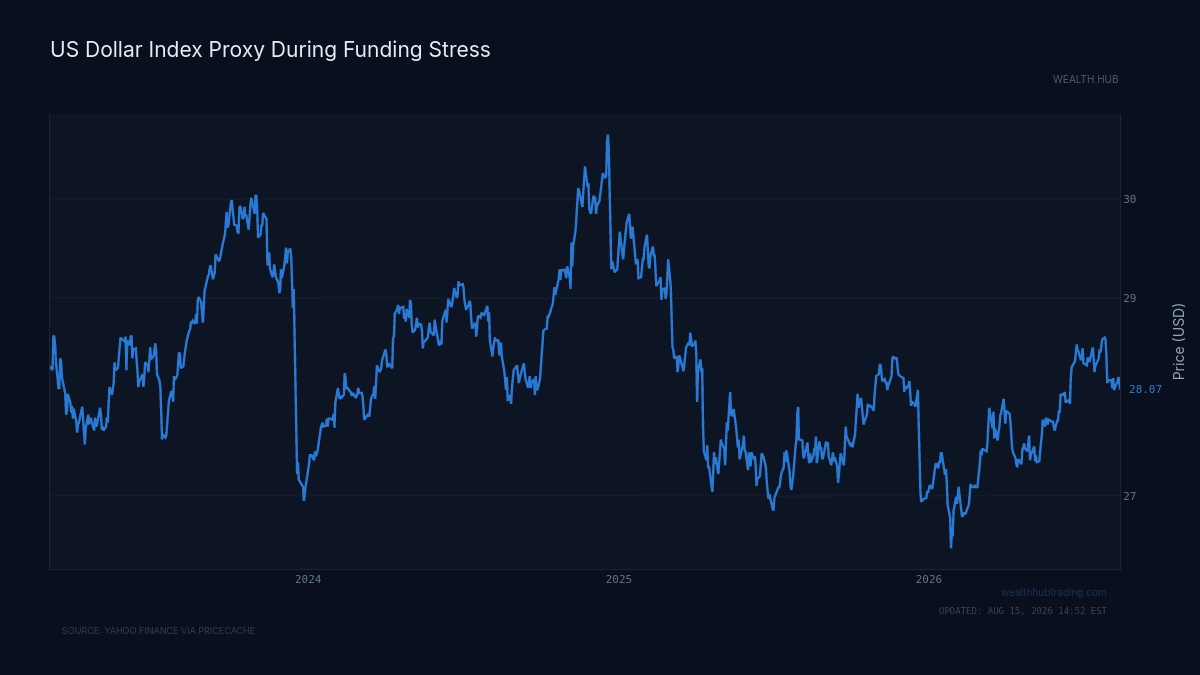
For you, this reframes what a strong dollar means. It is not a barometer of relative economic health. It is a measure of stress on the several trillion dollars of debt the world cannot print.
When the mechanism breaks down
The squeeze is not automatic, and it is worth being precise about when it fails to fire. Three conditions can defuse it.
First, if borrowers have hedged their currency mismatch, buying dollars forward to match their debt schedule, then a rising dollar does not squeeze them. The problem is that hedging costs money and eats the interest-rate advantage that made dollar borrowing attractive in the first place. So the borrowers most tempted by cheap dollar debt are precisely the ones least likely to have hedged it. The exposure concentrates in the least protected hands.
Second, if a lender of last resort supplies dollars, the loop is interrupted. This is exactly what the Federal Reserve's swap lines did in 2020 and again during the 2008 crisis. By lending dollars to foreign central banks, who then lent to their own banks, the Fed capped the price of the thing the world was short. The squeeze needs scarcity to function; remove the scarcity and it dissolves. The catch is that the Fed extends this facility only to a select group of trusted central banks, so borrowers in countries outside that circle get no relief.
Third, if the dollar's rise is gradual rather than sudden, borrowers have time to earn, convert, and adjust. The squeeze is a function of speed as much as magnitude. A slow 15% appreciation over two years is absorbable; the same 15% over three weeks is not.
The 1997 Asian financial crisis is the cleanest historical illustration of all three failures at once. Thai, Indonesian, and Korean firms had borrowed heavily in dollars, almost none of it hedged, on the assumption that their currency pegs to the dollar would hold. When the Thai baht broke its peg in July 1997, the mismatch detonated across the region. There was no adequate lender of last resort at the time, and the moves were violent and fast. The result was the mechanism running to completion: forced dollar buying, collapsing local currencies, cascading defaults.
What this means for reading the next crisis
The mechanism to watch is not the dollar's level but the combination of a rising dollar and tightening dollar funding, arriving together and arriving fast. When you see both, understand that a class of foreign borrowers is being forced to buy dollars they do not have, and that their buying will push the dollar higher before it resolves.
A dollar shortage is a margin call on the world because the world sold something short, dollars it promised but does not earn, and a rising dollar is the price of that promise coming due all at once.