In March 2020, the market for U.S. Treasuries, the deepest and most liquid market on earth, briefly stopped working. As the pandemic panic set in, investors did the one thing they are supposed to do in a crisis: they reached for cash by selling their safest asset. The selling was so large and so fast that yields on the 10-year note, which normally fall when investors flee to safety, actually rose. Prices dropped when they should have climbed. The Federal Reserve stepped in with hundreds of billions of dollars of purchases within days, and only then did the market steady.
That episode looked like a paradox. Safe-haven demand should push Treasury prices up, not down. The resolution to the paradox is a group of firms most investors never think about, and a limit on those firms that most investors do not know exists.
The buyer that has to be there
A primary dealer is a bank or broker authorized to trade directly with the Federal Reserve and, in exchange for that privilege, obligated to participate in every Treasury auction. As of this writing there are roughly two dozen of them, names like JPMorgan, Goldman Sachs, and Citigroup among them. When the Treasury sells new debt, these firms must show up and bid. They cannot sit out a weak auction because the market feels soft that day.
This obligation is the plumbing that makes the whole system predictable. The Treasury needs to fund the government on a fixed schedule regardless of mood, and the primary-dealer requirement guarantees a bid at every sale. Think of the dealers as the buyers of last resort at the auction itself: whatever real investors, pension funds, foreign central banks, mutual funds, do not absorb, the dealers take onto their own books.
What most people focus on is the guarantee. The auction always clears. The government always gets funded. The comforting conclusion is that a Treasury auction cannot fail.
The mechanism underneath that guarantee is where intuition goes wrong.
Why the obligated buyer has a limit
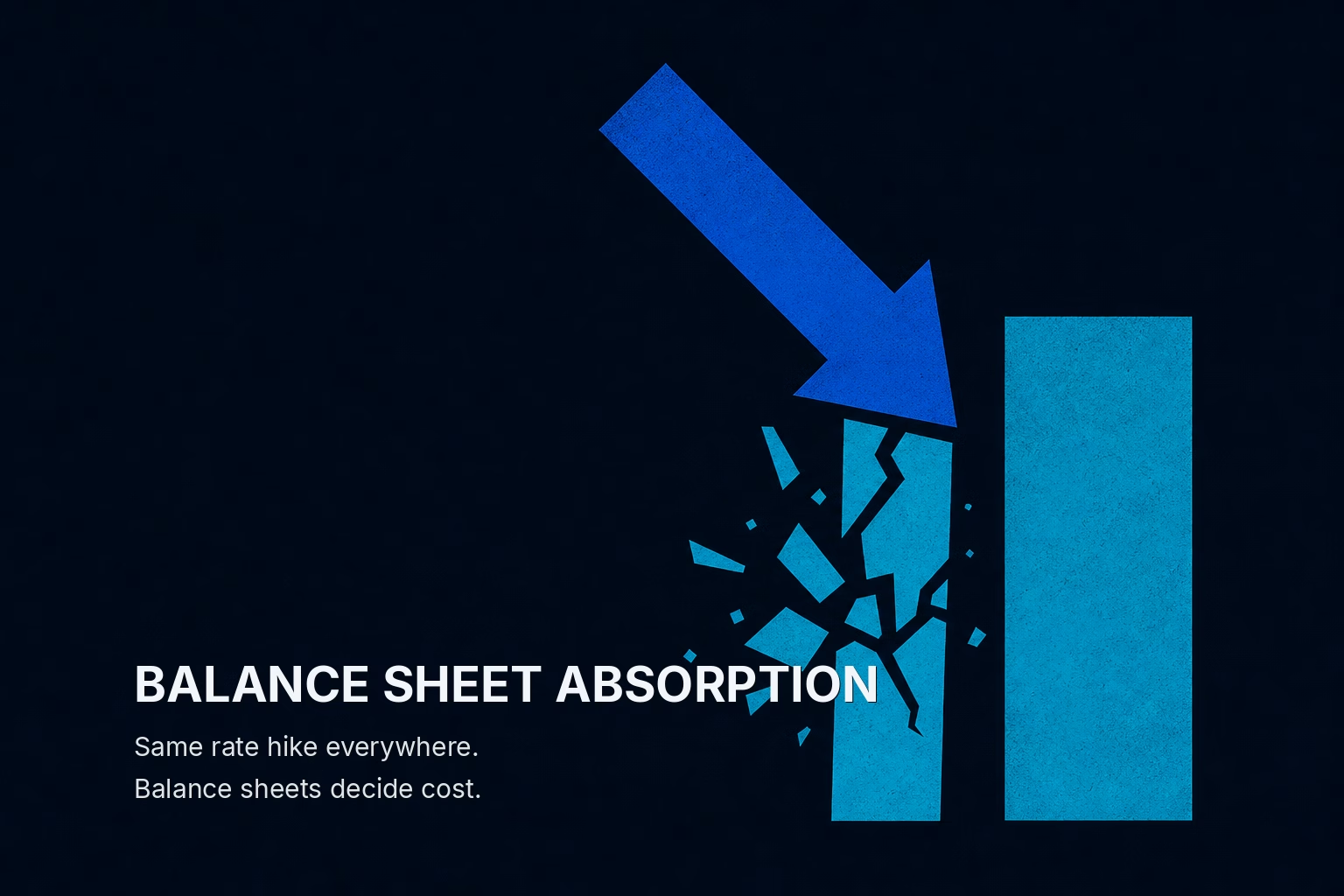
The dealers are required to bid, but they are not required, and not able, to hold unlimited inventory. Every bond a dealer buys and cannot immediately resell sits on its balance sheet, the ledger of what a firm owns and owes. Holding inventory costs the dealer money in two ways: it consumes regulatory capital, and it ties up financing that the dealer must roll over daily.
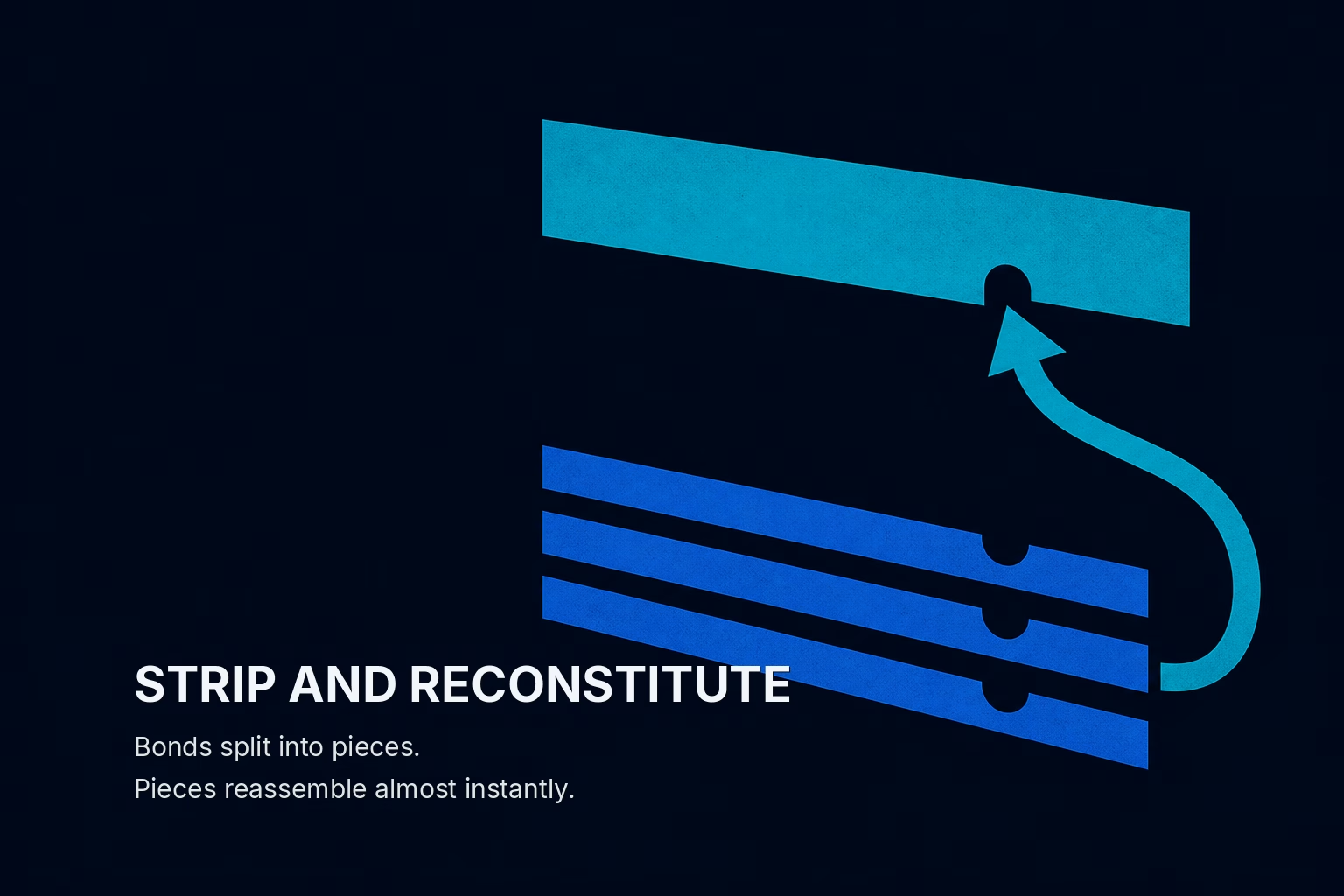
Here the causal chain matters. The Treasury issues a bond. Real end investors buy most of it. The dealers absorb whatever is left. If the leftover amount is small, the dealers warehouse it briefly, then sell it into the secondary market over the following days. The system breathes normally.
Now change one variable. Suppose issuance jumps, or real demand falls, and the leftover the dealers must absorb grows large. The dealers still bid, because they are obligated. But now their balance sheets fill with bonds they cannot offload quickly. Each additional bond they take on is more expensive to finance and eats more capital. At some point the dealer's willingness to add inventory does not gently taper. It hits a wall.
When that wall is reached, the marginal buyer, the one whose bid sets the clearing price at the edge, effectively disappears. There is still a bid, but it is much lower. The price required to move the last block of bonds drops sharply, and because price and yield move inversely, the yield gaps upward. A market that was orderly a moment earlier becomes disorderly, not because demand vanished, but because the shock absorber ran out of travel.
This is the point intuition misses. The obligated buyer is real, but obligation is not the same as capacity. A shock absorber with a hard limit still transmits the full force of the impact once you exceed its stroke.
The practical implication is that you should watch dealer balance-sheet capacity, not just auction results. A string of auctions that clear "fine" tells you nothing about how much room the dealers have left before the next one clears badly.
What actually happened in March 2020
The 2020 episode was this mechanism playing out at speed. A global dash for cash meant that instead of buying Treasuries, investors were dumping them, foreign central banks, hedge funds unwinding leveraged trades, funds meeting redemptions. The selling flooded the dealers with bonds precisely when the dealers had the least appetite to hold them.
Two regulatory realities made it worse. Post-2008 rules had increased the capital dealers must hold against their inventory, which shrank how much they could warehouse before hitting their internal limits. And the sheer velocity of selling gave dealers no time to distribute inventory before the next wave arrived. The dealers were bidding, but their bids were retreating fast, which is exactly why yields rose during a flight to safety. The absorber was full.
The Fed's response was not a bailout of any single firm. It was a decision to become the buyer beyond the dealers, purchasing Treasuries directly and in size, which drained inventory off dealer balance sheets and restored their capacity to intermediate. Once the dealers had room again, normal price behavior returned. A temporary suspension of certain capital rules that spring made the same point from another angle: relax the balance-sheet constraint, and the absorber gets more travel.
The lesson for a reader is concrete. When you see a supposedly safe market moving the "wrong" way in a crisis, do not assume the fundamentals have changed. Ask instead whether the intermediaries have simply run out of room.
Where this bears on today
The relevance now comes from arithmetic. Federal deficits are large, which means the Treasury must issue debt at a historically heavy pace. At the same time, two big non-dealer buyers of the past decade, the Fed during quantitative easing and foreign central banks, have pulled back. That combination puts more supply into a market where dealers carry a larger share of the residual than they used to.
None of this means an auction will fail; the obligation guarantees it will not. What it means is that the buffer between an orderly market and a disorderly one is thinner than it looks. The measure that matters is not whether auctions clear, but by how much dealer capacity clears them, and how much of that capacity is already committed.

You can watch the symptom directly. When issuance strains dealer capacity, longer-dated Treasury yields tend to grow more volatile and to jump on individual auction results, even absent any change in the inflation or growth outlook. That volatility is the shock absorber signaling it is near the end of its stroke.
The one thing to carry away
Primary dealers guarantee that every Treasury auction clears, but they cannot guarantee the price it clears at, because their balance sheets are finite and their willingness to hold inventory ends abruptly rather than gradually. The obligated buyer is a shock absorber, and the moment worth understanding is not when it works, which is almost always, but when the force exceeds its limit, which is rare, sudden, and exactly when it matters most.