The AI boom has filled the import ledger without moving the U.S. current account, and the reason is not that the spending is small. Since 2019 the deficit has widened by about 2.4 percentage points of GDP. The AI buildout accounts for almost none of that widening. Federal dissaving accounts for most of it. That is the main finding in Julian di Giovanni's analysis for the New York Fed's Liberty Street Economics. It also sets up a less comfortable implication. The fiscal position that absorbed private excess in the late 1990s is already spent. If AI investment starts to add to total investment instead of replacing other investment, nothing stands between it and the external balance.
Gross Imports Are Not the Deficit
The common intuition goes like this: AI hardware is imported, imports widen the trade deficit, so the AI boom must be widening the deficit. The first step is correct. AI-related imports (semiconductors, servers, computing equipment) reached a high of 23 percent of U.S. imports in 2025. That is a large share of gross trade flows.
The current account is a net figure, though. It equals national saving minus domestic investment. A country can import a large stock of capital equipment and still keep its external position steady, as long as the investment is paid for out of domestic saving. In that case the import surge is offset elsewhere in the accounts. Saving shifts from financial assets into imported servers, other spending declines at the margin, or other investment is postponed.
So the AI boom can widen the deficit in only two ways. It has to raise total investment relative to GDP, or it has to reduce saving. On saving there are two routes. One is a wealth effect, where equity gains lead households to spend more. The other is a drop in business saving, where firms finance the buildout by running down retained earnings. Both routes were active in the dot-com era. Neither has appeared in the current data.
Investment Shifted Between Sectors Without Growing
Investment is the clearest part of the evidence. Gross domestic investment averaged 21.3 percent of GDP in the five years before the pandemic. From 2023 through the first quarter of 2026, the period of fastest AI capex growth, it averaged 21.5 percent. Over the latest four quarters it averaged 21.1 percent, which is lower than the pre-pandemic baseline. At this level of aggregation the AI boom does not show up.
The explanation is substitution. AI's contribution to nonresidential investment has been substantial and rising. Other categories fell at the same time. The wave of factory construction that followed the 2022 industrial policy legislation has faded. Structures and equipment spending outside the technology sector has been soft. Residential investment has been declining. Data centers and information-processing equipment have made up for those declines but have not pushed the total above where it already was.
This is the mechanism behind the headline result. The economy did not add AI capex on top of everything else. It moved investment from factories, houses, and conventional equipment into GPUs and power infrastructure. The imported content of investment rose because servers are more import-intensive than poured concrete. The volume of investment relative to saving did not change. That combination explains how imports can surge while the balance stays roughly flat.
Business Saving Held Up Because the Buyers Have Cash
The more important contrast with 2000 concerns who is spending, more than how much.
The dot-com buildout was led by young telecom and equipment firms with thin or negative operating cash flow. Late in that boom, profits compressed while dividends stayed fixed. Retained earnings shrank, and business gross saving fell along with them, just as investment peaked. Corporate balance sheets were adding to private dissaving at the worst moment.
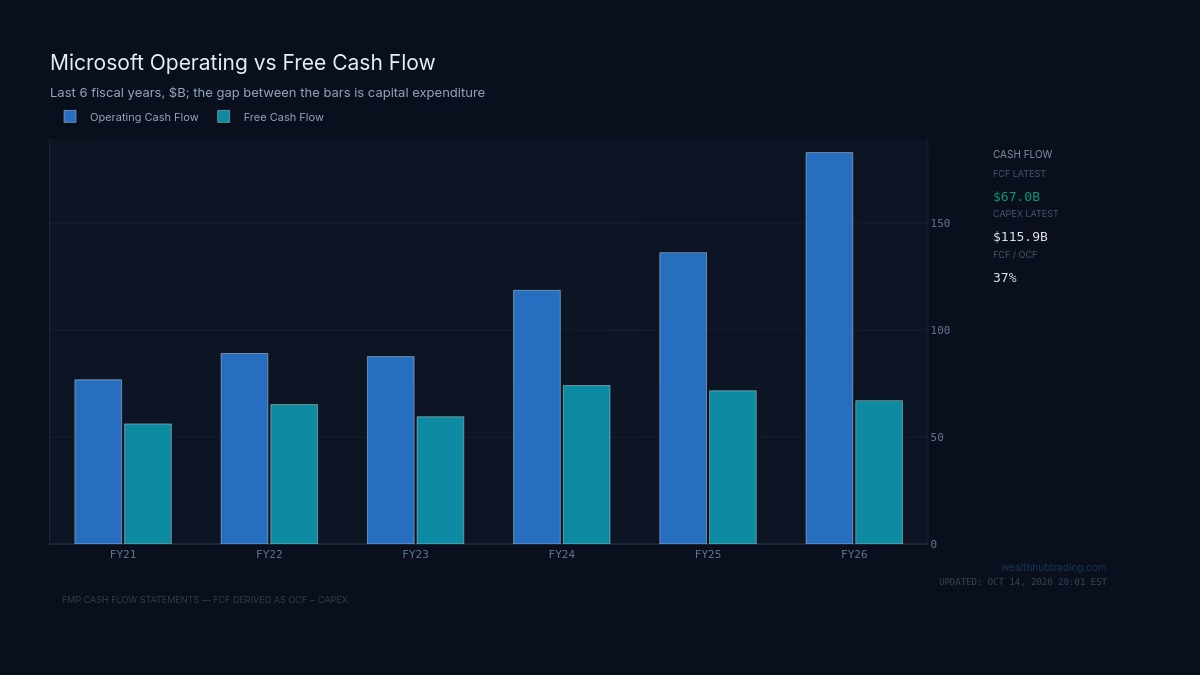
The AI buildout is concentrated in the most cash-generative companies in the economy. Business saving averaged 10.9 percent of GDP over the past four quarters, slightly above the roughly 10.5 percent pre-pandemic average. It is well above the dot-com trough of about 8.8 percent in late 2000 and early 2001. The large spenders are paying for data centers mostly from operating cash flow. In national accounting terms, that means the investment is financed by business saving and does not require borrowing from abroad.
Households have not behaved as they did in the 1990s either. From 1995 to 2000, private saving fell by nearly 3 percentage points of GDP as households spent out of rising equity wealth. Since 2023, private saving has averaged 20.8 percent of GDP against 21.3 percent before the pandemic. That half-point gap is as easily explained by the post-pandemic drawdown of excess savings as by any AI-driven wealth effect. Despite record equity valuations, the wealth effect that drove the late-1990s consumption boom has not appeared in the saving data.
Fiscal Dissaving Drives the Deficit
The current account has widened. It moved from about 2.2 percent of GDP on average in 2015 to 2019 to about 3.7 percent since 2023. The source of that widening is the government sector.
Government saving fell from about negative 2.2 percent of GDP in 2015 to 2019 to about negative 4.0 percent since 2023, a deterioration of roughly 1.75 percentage points. Measured against a 2019:Q4 baseline, the saving-investment gap widened by about 2.4 points:
- Government dissaving: about 1.75 points
- Lower private saving: about 0.5 points
- Higher investment: essentially zero
The policy implication is direct. Anyone who points to the external deficit as evidence that the AI boom is overheating the economy or drawing heavily on foreign capital has the cause wrong. Foreign capital is currently funding the federal budget gap. The data centers are mostly self-financed. The return of twin deficits is the more accurate description, and AI is a side issue in it.
The 1990s comparison makes this sharper. During the dot-com expansion, government saving rose by nearly 5 percentage points of GDP, from a deficit of about 1 percent in 1995 to a surplus of roughly 4 percent in 2000. Capital-gains tax receipts filled the Treasury. That fiscal swing offset most of the private dissaving, which is why the current account widened by only about 2.5 points even while households cut saving sharply. The bubble produced its own fiscal offset. Today the fiscal position is moving in the same direction as the pressure on the external balance, and it is the main source of that pressure.
How the Thesis Could Break
The strongest counterargument comes from the source itself, and it is substantial. The announced capital spending plans of the major technology firms for 2026 and 2027 are considerably larger than what has already been built. The declines in residential and non-technology investment that have offset AI so far cannot continue indefinitely. Factory construction cannot keep falling from a peak forever, and housing will eventually stop subtracting.
If those offsets end while AI capex keeps rising, the substitution mechanism stops working. AI spending then adds to total investment instead of replacing other investment. Both of the channels that have been quiet would turn at the same time. Investment would rise relative to GDP, and business saving would fall as the capex burden grows faster than operating cash flow. The second step is an inference, not something the data shows yet. If the largest spenders shift from internal funding toward bond issuance to finance the 2026 and 2027 plans, business saving would start moving toward the dot-com pattern.
This is where the fiscal comparison matters going forward. In 2000, a 4 percent of GDP surplus absorbed the shock. In 2026, the government is already running dissaving of about 4 percent. With no fiscal offset available, an AI-driven change in investment or business saving would flow almost entirely into the current account and then into the amount of foreign financing the United States needs to attract.
The current read is that AI has changed the composition of U.S. imports without changing the external balance, and the deficit is fiscal. That read holds until one of these conditions is met:
- Gross domestic investment rises clearly above its 21 to 21.5 percent range, showing that AI spending has become additive.
- Business saving falls from about 10.9 percent of GDP toward the 9 percent range, showing that the spenders have moved from cash funding to borrowing.
- The largest technology firms' capex exceeds their operating cash flow on a sustained basis.
The third condition is the earliest to show up, since it appears in corporate filings quarters before it reaches the national accounts. Until it does, a widening current account should be attributed to the federal budget.