The most important line in a consent decree is never the dollar figure. It is the clause telling the dominant company what it may no longer do. That clause tends to move more market share, create more competitors, and spawn more adjacent industries than any penalty, and it does so on a timeline long enough that most market participants have stopped paying attention.
The transistor that Bell Labs was not allowed to keep
In January 1956, the US Justice Department settled its antitrust case against AT&T and its manufacturing arm, Western Electric. The headlines treated it as a win for AT&T. The government had originally sought to split Western Electric off from the Bell System, and the company kept it.
The conduct terms told a different story. AT&T was confined to the regulated common-carrier business, which kept Western Electric out of the commercial computer market. The Bell System also had to license its patent portfolio to outside firms, with existing patents licensed royalty-free. That portfolio included the transistor, invented at Bell Labs less than a decade earlier.
AT&T absorbed the cost. Bell Labs kept producing foundational research, but the company that funded it was barred from commercializing much of that work outside telephony. The benefit went to the firms that took the licenses. The American semiconductor industry grew on technology that the most capable lab in the country could not keep to itself, and economists have since tied a measurable rise in follow-on US innovation to that compulsory licensing.
No fine changed that outcome. A behavioral covenant did, and the full effect took roughly twenty years to show up.
The practical point for you is that the market reaction on settlement day measured the wrong thing. AT&T avoided a breakup, so the decree looked benign. Its actual effect was to redirect an industry.
Regulation by settlement, and why companies sign
A consent decree is a court-approved settlement in which a company agrees to specific conduct obligations without admitting liability. In US antitrust cases brought by the Justice Department, the Tunney Act of 1974 requires a public comment period and a judicial finding that the settlement serves the public interest. Once entered, the decree carries the force of a court order. Violating it is contempt, not just a regulatory infraction.
Why does a dominant firm agree to bind itself? The answer is the alternative. A litigated loss produces a judicial finding of liability, and under Section 5(a) of the Clayton Act, a final judgment in a government antitrust case can serve as prima facie evidence in private lawsuits. A consent judgment entered before testimony is taken is excluded from that rule. Signing the decree closes the door on a wave of private treble-damages suits. That is a large, immediate, quantifiable benefit, and it is why boards accept conduct restrictions whose costs are diffuse and distant.
The economic trade is therefore lopsided in time. The leader pays an immediate certainty premium to avoid litigation risk, then pays an ongoing, compounding cost in foregone strategic options. Analysts tend to price the first part and ignore the second, because the second never shows up as a line item.
Three actors respond to that trade in predictable ways:
- The bound leader stops doing the prohibited thing and redirects capital toward whatever remains permitted, which often means slower growth in its strongest segment.
- Direct competitors gain room in exactly the conduct area the decree covers: pricing, bundling, distribution, or licensing.
- Adjacent entrants build businesses on whatever the leader was forced to open up, whether patents, interfaces, or distribution channels.
When you read a settlement, find the conduct clause first and ask which of those three groups it favors. The fine tells you almost nothing about that.
A balance sheet frozen in place
Behavioral covenants are not confined to antitrust. In February 2018, the Federal Reserve issued a consent order against Wells Fargo following its fake-accounts scandal. Like the AT&T decree, it was a negotiated settlement with conduct terms. The key term was an asset cap, which held the bank's total assets at their end-2017 level of roughly $1.95 trillion until the Fed was satisfied with its governance and risk controls.
The cap stayed in place for more than seven years. The Fed lifted it on June 3, 2025.
The cost compounds quietly. Take a hypothetical illustration, not a reported figure. Suppose an uncapped Wells Fargo had grown total assets by 4% a year from 2018 onward:
Uncapped assets after 7 years = $1.95T × (1.04)^7 = $1.95T × 1.316 ≈ $2.57T
That leaves a gap of roughly $0.62 trillion in balance sheet the bank could not deploy. Apply a 1% return on assets (net income as a share of total assets, a common rough benchmark for a large US bank):
Foregone annual net income ≈ $0.62T × 1% ≈ $6.2B
The growth rate and return are assumptions chosen for arithmetic clarity. The mechanism is not. A cap that never touches the income statement in year one can be costing billions a year by year seven, because the counterfactual balance sheet keeps growing while the real one stays fixed.
The deposits, loans, and trading balances Wells Fargo could not take on did not disappear. They went to banks without a cap.
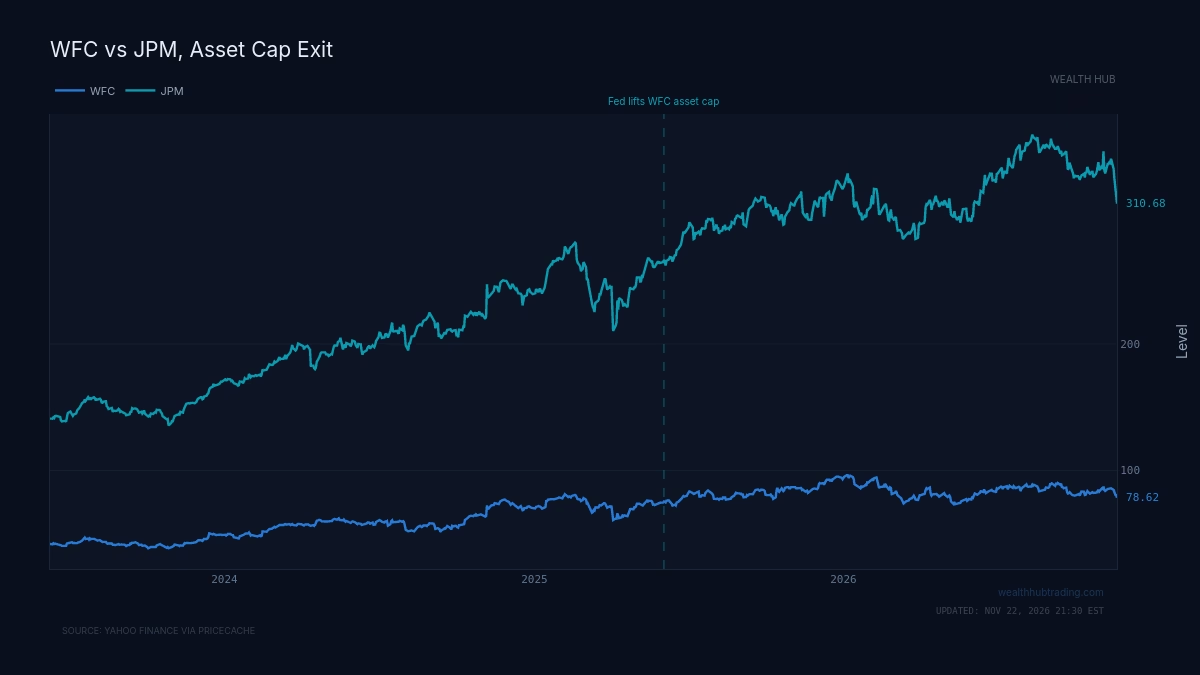
The repricing came at the exit, not at the 2018 announcement. A conduct constraint being removed is itself a catalyst, and it is one with a known trigger: the regulator's sign-off. For you, that means a bound company tends to carry two repricing events, one when the covenant is imposed and one, often larger and slower to be anticipated, when it ends.
Why the covenant outlasts the news cycle
The economic engine behind all three cases is the same. A dominant firm earns its position partly through conduct that smaller rivals cannot replicate: owning the patents, controlling distribution, bundling products, or deploying a larger balance sheet. A consent decree removes one of those levers while leaving the firm's other advantages intact. Competitors do not need to beat the leader outright. They only need to win in the specific lane the decree has opened.
The duration matters as much as the scope. Older antitrust decrees often had no expiration date at all. The Paramount decrees of 1948, which forced the major film studios to divest their theater chains and banned block booking (selling films only in bundles), stayed in force for over seventy years until a federal court terminated them in 2020. An entire independent theater and distribution ecosystem grew inside the space those terms protected.
The Microsoft settlement of 2001 shows a shorter version. Microsoft kept its Windows business intact but had to let PC makers install rival middleware and disclose certain interfaces to third-party developers. The terms ran until 2011. Over that decade, a competitive browser market reemerged and web-based applications that did not depend on Windows gained scale. The decree did not create those companies, but it removed some of the friction Microsoft could have imposed on them.
In each case the industry structure changed during the covenant's life, and competitors who used that window built positions that persisted after it closed. When you see a decree with a five or ten year term, treat that term as the window in which market share can move, and watch who is investing to take it.
When the covenant fails to bite
Consent decrees do not always reshape anything. Several failure modes recur.
The technology moves outside the scope. Decrees are written against the market as it existed at signing. The Microsoft terms governed desktop middleware. By the time they expired, the competitive frontier had shifted to search, mobile, and cloud, none of which the decree addressed. A covenant tied to a fading product constrains a business the leader was going to deprioritize anyway.
The leader can afford the constraint. If the restricted conduct was a small contributor to profits, the bound firm reallocates and grows elsewhere. The decree then reads as a reputational event, not a structural one.
Enforcement drifts. A decree depends on someone monitoring compliance. Monitoring budgets shrink, priorities change, and agencies turn over. In 2018, the Justice Department began a program to terminate hundreds of legacy antitrust judgments, many decades old, on the view that markets had changed enough to make them obsolete. That was a reasonable cleanup, and it also showed that a covenant has force only while an agency is willing to police it.
Competitors fail to show up. An opening is not a market. If no rival has the capital or capability to step into the space, the leader's share holds even under restriction.
The practical check is simple. Before assuming a decree will reallocate share, confirm that the constrained conduct is central to the leader's current economics, that a credible competitor exists to exploit it, and that the term runs long enough for the shift to compound.
Reading the next settlement
The pattern worth watching is not who paid the most, but who is forced to change behavior and who stands closest to the space that change opens. A consent decree is often a slow transfer of opportunity from a bound leader to its competitors and to adjacent builders, and it plays out over years that markets frequently treat as procedural noise.
When the next large settlement lands, read past the penalty to the conduct terms. Identify the lever being removed, estimate what the leader's business would look like with that lever compounding over the term, and mark the expiration or termination trigger as a second catalyst. The fine is settled the week it is announced. The covenant keeps working long after the story has dropped out of the news.