The most expensive thing that happens to a merger-arbitrage position is often not a lawsuit. It is a letter that adds a year, and the market tends to mark that letter as paperwork when it has already changed both terms of the spread.
The grocery deal the spread called early
In October 2022, Kroger agreed to buy Albertsons for $34.10 per share in cash. Part of that consideration was paid out early as a special dividend, which left a remaining cash price in the high twenties for anyone buying Albertsons stock afterward. On paper, that was a large, well-financed, strategic deal between two companies that each needed scale against Walmart, Costco and Amazon.
Albertsons stock never believed it. Through 2023 and into 2024 the shares sat well below the remaining cash consideration, a gross spread (the gap between the deal price and the target's market price) wide enough that no one could read it as a simple time-value discount. The Federal Trade Commission sued to block the deal in February 2024. Washington and Colorado brought their own suits. In December 2024, a federal judge in Oregon granted a preliminary injunction, and Albertsons walked away from the merger the next day.
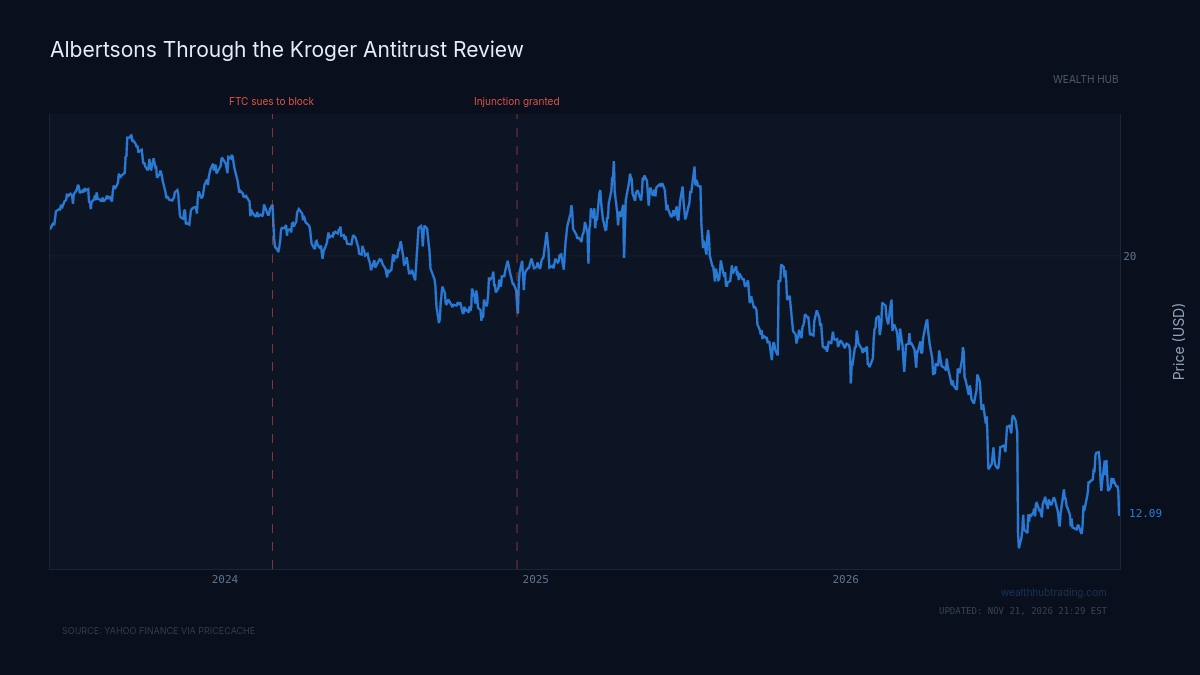
The striking feature of this episode is how little of the outcome was a surprise at the end. The court ruling was the event. The pricing of that event had happened more than a year earlier, when the deal entered extended review in an industry where the agency had both an established theory of harm and an openly stated appetite to litigate.
The practical reading: when a spread stays wide for a long time on a deal with no financing risk, the market is usually telling you something about the regulator, not the buyer.
What the spread is actually pricing
A merger-arb spread is a bet with two outcomes. If the deal closes, the target converges to the deal price. If it breaks, the target falls back toward its downside price, the level it would trade at with no deal on the table, usually estimated from the pre-announcement price adjusted for what the sector has done since.
The market price of the target sits between those two anchors, discounted for the time until resolution. The cleanest way to write it:
Target price = [p × Deal price + (1 − p) × Downside price] / (1 + r)^t
Here p is the probability the deal closes, r is the annual return the arb community requires for tying up capital, and t is the expected time to close in years.
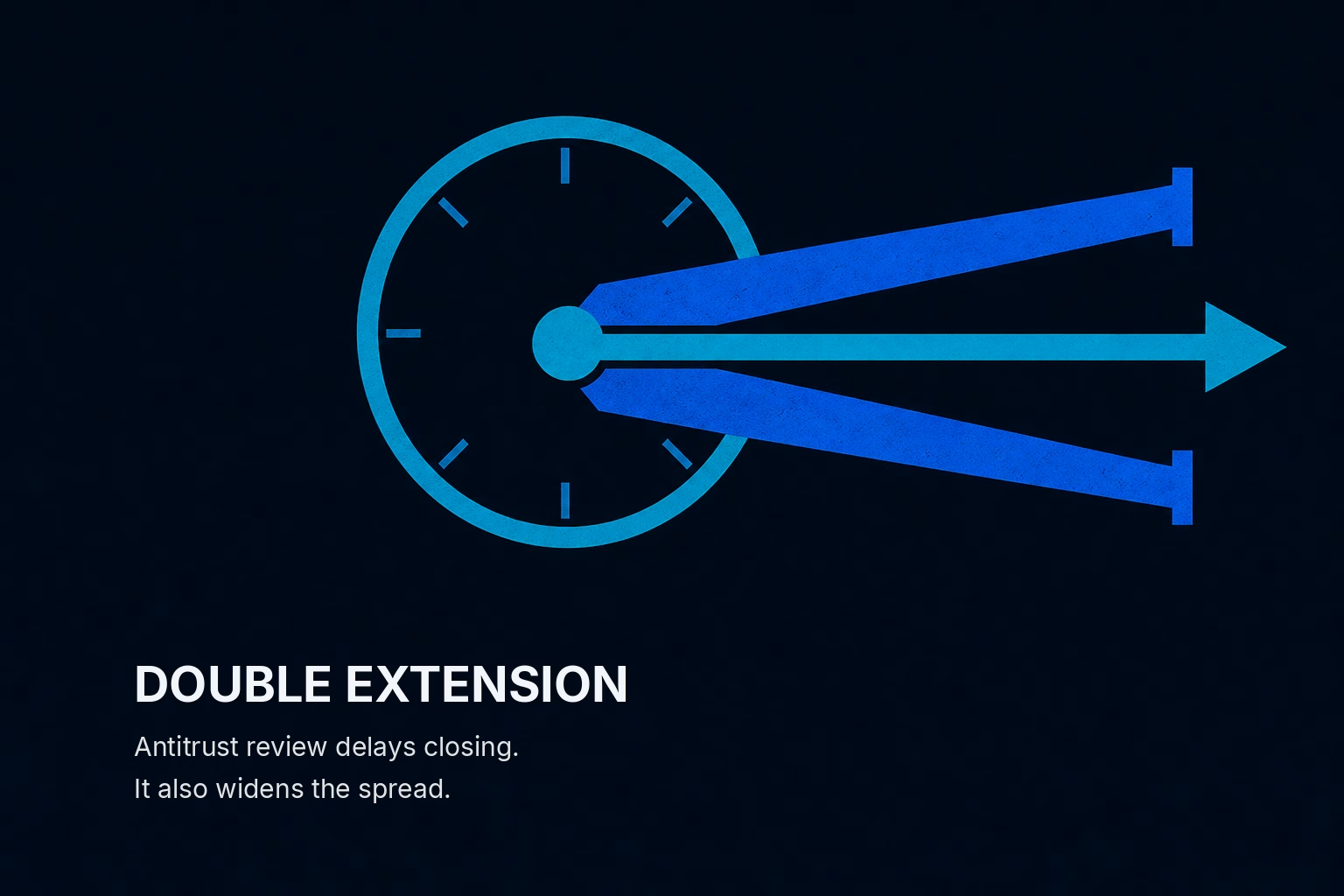
Most retail coverage of a deal collapses this into a single number: the probability. That is the misconception this mechanism corrects. Antitrust risk enters the formula twice, through p and through t, and the regulatory process tends to move both in the same direction at the same moment.
For you, this means a headline like "regulators open in-depth review" is not one piece of bad news. It is two, and they compound.
The second request moves two dials at once
Under the Hart-Scott-Rodino process in the United States, merging parties file with the FTC and the Department of Justice and then wait an initial 30-day period. Most deals clear inside that window. A second request is the agency's demand for a large volume of additional documents and data, and the waiting period does not restart its countdown until the parties certify substantial compliance. In practice, gathering, producing and negotiating over that material often takes many months, and the agency's actual decision comes after that.
So the second request shifts t immediately. It also shifts p, because the agencies do not send second requests at random. They send them when staff believe there is a plausible competitive problem worth investigating. A second request is selection: deals that receive one belong to a riskier population than deals that do not.
Take a worked example with round, illustrative numbers. A target is being acquired at $50 cash. Its downside price is $35. Arbs require 8% a year.
Before the second request, the market thinks p = 90% and t = 0.5 years:
Expected value = 0.90 × $50 + 0.10 × $35 = $48.50 Discount factor = 1.08^0.5 ≈ 1.039 Price ≈ $46.67
After the second request, the timeline stretches to 15 months and the market lowers p to 70%:
Expected value = 0.70 × $50 + 0.30 × $35 = $45.50 Discount factor = 1.08^1.25 ≈ 1.101 Price ≈ $41.33
The stock falls about $5.34, roughly 11%. Now decompose it. Hold p at 90% and change only the timeline: $48.50 / 1.101 ≈ $44.05. The time extension alone cost about $2.62. The probability cut cost the remaining $2.72. Nearly half the move had nothing to do with whether the deal would close. It was the price of waiting.
That split is the part most observers underweight. They treat the second request as "the deal got riskier" and debate the odds. Half the damage is arithmetic on the calendar, and the calendar is the part you can model with the most confidence.
Who is forced to sell when the clock extends
The policy read here is about who must act, not who wants to. A slow regulatory process looks like procedural noise from the outside. Inside the arb community it is a capital event.
Merger-arb desks are judged on annualized return, the return per unit of time capital is committed. A spread that offered 7% over six months is a 14%-plus annualized trade. The same 7% stretched over fifteen months is under 6% annualized, below what many funds require. Nothing about the deal's merits changed; the position simply stopped clearing the hurdle.
Funds running leverage or concentration limits then have a mechanical reason to cut. Capital locked in a long-dated, contested deal cannot be redeployed into the shorter spreads that open every month. That selling tends to arrive in a cluster right after the second request, from holders who are not expressing a view on the antitrust outcome at all.
Who absorbs the cost and who captures the benefit follows directly:
- The target's existing holders, including the arbs who bought early, absorb the timeline markdown immediately.
- The buyers of the wider spread capture a richer annualized return if the deal eventually closes, paid for by sellers who were constrained rather than pessimistic.
- The acquirer often carries a reverse termination fee, a payment owed to the target if regulators block the deal. That fee raises the effective downside price for target holders and is one of the few contract terms that genuinely changes the arithmetic.
The practical implication: forced selling after a second request can overshoot the change in true probability. That overshoot is where a patient buyer with a longer capital horizon is paid.
Handicapping the agency, not the contract
If the second request is the tell, the next question is what p should actually be. Arbs spend enormous effort on the merger agreement: the outside date, the efforts covenants, the divestiture commitments, the break fees. Those matter, but they are largely public and priced within hours of announcement. Everyone can read the same document.
What the contract cannot tell you is the agency's appetite in that specific industry. Appetite has three components you can study:
Precedent in the sector. Grocery had a documented history of FTC-required divestitures in supermarket mergers, so the agency arrived at Kroger and Albertsons with a ready theory of local-market harm and prior evidence that divestiture packages to weaker buyers can fail.
Stated enforcement priorities. Agency leadership publishes guidelines, gives speeches and picks cases. When leadership signals that it views a sector (labor markets, healthcare, consumer staples, technology platforms) as under-enforced, the p for deals in that sector should fall before any second request arrives.
Willingness to litigate rather than settle. Some regimes accept divestiture remedies readily. Others prefer to sue. A deal whose rescue plan is "we will sell some stores" is worth much less under a regime that treats remedies with suspicion.
This is the arb's real edge. The spread already contains the consensus reading of the contract. It often contains a lazier reading of the regulator, because regulatory appetite is slow-moving, sector-specific and expressed in policy statements rather than filings.
For your own reading of any pending deal: before you open the merger agreement, find the last three contested mergers the same agency reviewed in the same industry and note how each one ended.
Where the mechanism breaks
Agency appetite is not the same as agency success, and this is where the framework fails most visibly.
Microsoft's acquisition of Activision Blizzard is the counterexample. The FTC sued to block it, and the agency's appetite for challenging large technology deals was not in doubt. In July 2023 a federal judge denied the FTC's request for a preliminary injunction, and the deal closed that October after a restructuring that satisfied the UK competition authority. An arb who modeled p purely from agency hostility would have been too pessimistic. Courts apply legal standards, and a regulator eager to sue can still lose the case it brings.
Three other breakdowns deserve naming. Agency leadership can change with an election, which can raise p for every pending deal in a sector without any change in the facts. A foreign regulator can become the binding constraint, so a deal that clears Washington can still fail elsewhere. And the downside price is not fixed: if the target's business deteriorates during a long review, the break scenario gets worse even while p holds steady, which is one reason long reviews often hurt targets more than the probability math alone suggests.
The lesson from these failure modes is calibration. Agency appetite often predicts the second request and the lawsuit. It is a weaker predictor of the courtroom result, so p should be built from both the regulator's posture and the litigation record in that sector.
Reading the next second request
Antitrust risk enters a merger-arb spread as probability multiplied by timeline, and the second request is the moment both dials move together. The probability piece is a judgment about a regulator's appetite in one industry; the timeline piece is arithmetic that forces constrained holders to sell regardless of their view.
When the next deal you follow draws a second request, split the price drop the way the worked example does. If the timeline explains most of the move and the agency's sector record is mixed, the spread may be wider than the true odds justify. If the agency has litigated similar deals recently and the remedy on offer looks like the ones it has rejected before, the wide spread is not an opportunity; it is the market reading the regulator correctly, the way Albertsons stock did for more than a year before the judge ruled.