In 2011, AT&T agreed to buy T-Mobile USA for a fixed package worth about $39 billion. The spread between T-Mobile's implied deal value and the price arb...
In 2011, AT&T agreed to buy T-Mobile USA for a fixed package worth about $39 billion. The spread between T-Mobile's implied deal value and the price arbitrageurs could buy it at looked narrow at first, the market's way of saying the deal would likely close. Then the Department of Justice sued to block it, and the spread blew out. Anyone holding the trade for the "sure thing" completion learned what the gap had actually been pricing all along: not the probability the deal was announced, but the probability it would survive antitrust review. When the deal collapsed, AT&T paid T-Mobile a $3 billion breakup fee plus spectrum, and the arbitrage spread had told the story weeks in advance for those who read it correctly.
That episode is the cleanest way to understand what a merger-arbitrage spread is. It is not a discount. It is a posted odds line.
What the spread actually is
Merger arbitrage is the strategy of buying a target company's stock after a deal is announced and capturing the gap between the current price and the price the acquirer has agreed to pay. If a target agrees to be bought for $50 a share and trades at $48, the $2 gap is the arb spread.
Why does the gap exist at all? Because the deal is not done. Between announcement and closing sits a gauntlet: shareholder votes, financing conditions, and above all regulatory approval. The spread is the market's compensation for standing in that gauntlet.
Two forces set the size of the gap. The first is time value, the return an arbitrageur demands for tying up capital until the deal closes, which might be six months or eighteen. The second is break risk, the probability the deal fails and the target's stock falls back toward where it traded before the bid, often 20% or 30% lower.
Write the relationship plainly:
Spread ≈ (Break probability × Downside if it breaks) + (Time to close × Required return)
Assume a target offered $50, trading at $48, with a pre-deal price of $38 (so $12 of downside if it breaks) and an expected six-month close.
If the market demanded only the time-value piece, say 4% annualized over six months, the spread would be about $1 on a $48 stock. The extra dollar in the actual $2 gap is the market pricing roughly an 8% chance of a break: 0.08 × $12 ≈ $0.96. That is the odds line. The spread is not saying "$50 is worth $48 today." It is saying "there is an 8% chance you get $38 instead of $50."
The practical takeaway: when you look at an arb spread, decompose it. Strip out the time-value component and what remains is the market's implied probability of failure. That number, not the headline dollar gap, is the trade.
The one place intuition gets it wrong
Most people treat a widening spread as a discount getting more attractive, a bargain opening up. That is the exact inversion of what is happening.
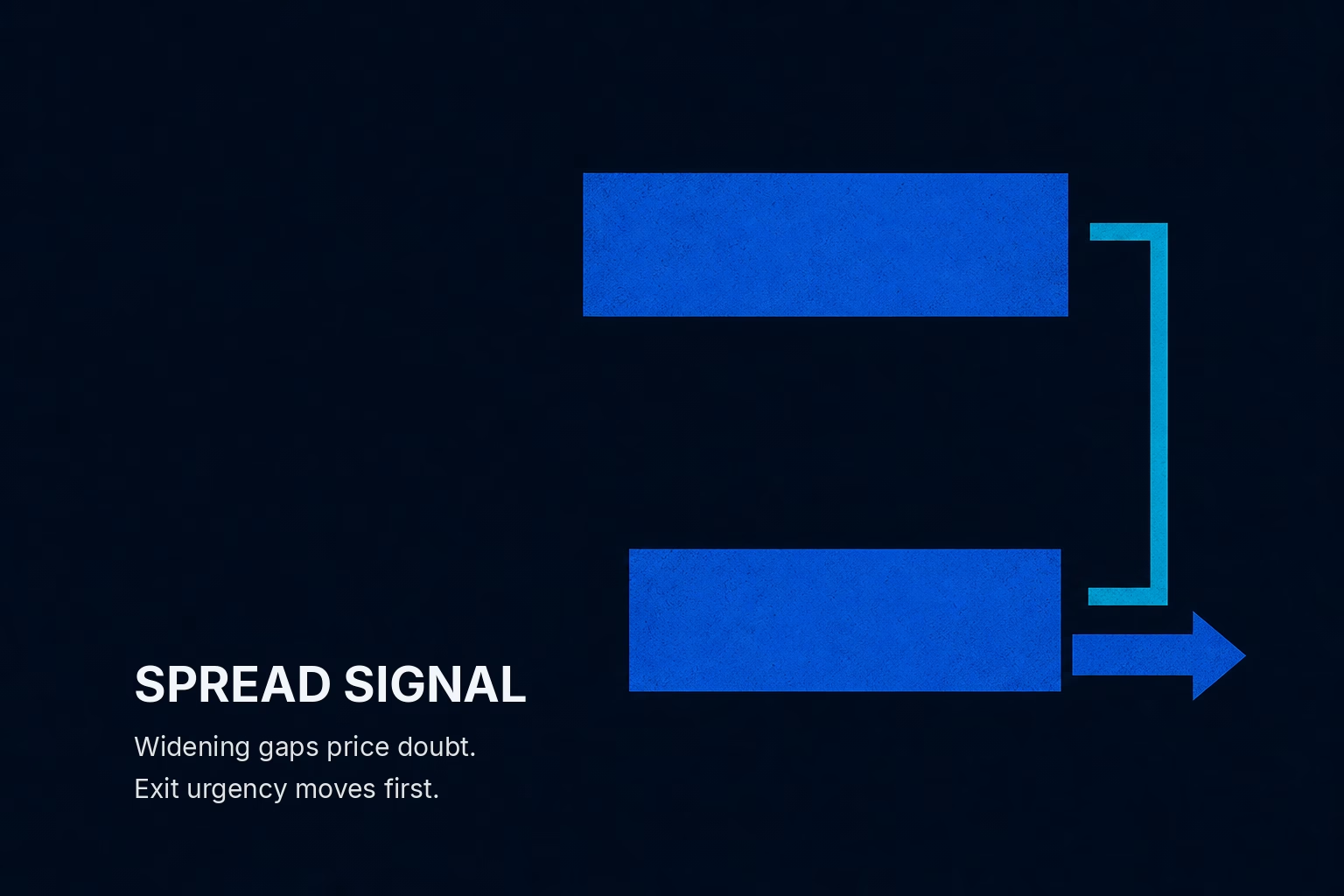
A spread widens for one of two reasons, and neither is good news for the holder. The first is that the market's estimate of break risk just rose. Someone with a sharper read on the regulator, a specialist antitrust lawyer, an industry insider, a fund that models Hart-Scott-Rodino timelines for a living, revised their probability of completion downward and sold. The spread is wider because the odds of failure are genuinely higher. You are not being handed a bargain. You are being handed the other side of a better-informed opinion.
The second reason is a forced unwind. A large arbitrage fund facing redemptions, a margin call, or a risk-limit breach has to liquidate a concentrated position regardless of its view on the deal. Their selling pushes the target's price down and the spread wider, even though nothing about the deal's actual odds changed. This is mechanical, not informational.
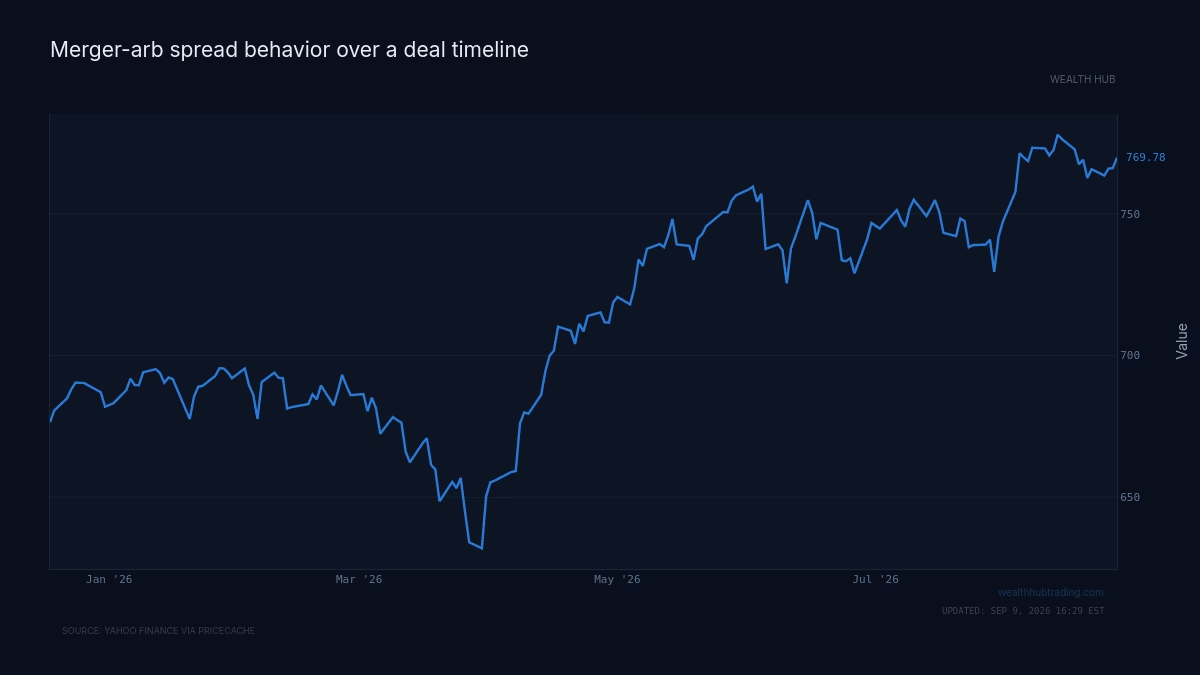
Here is the problem: from the outside, on a day with no news, these two look identical. The spread gapped wider. You cannot tell from the price alone whether you are buying from someone who knows something or from someone who is being carried out on a stretcher.
That ambiguity is the whole game. When a merger-arb spread gaps wider on no news, someone with better regulatory judgment or a bigger forced unwind is on the other side of your trade. Your edge, if you have one, is in distinguishing which.
Reading the widening
How do you tell an informed seller from a forced one? You look at what moves alongside the spread.
An informed repricing tends to be deal-specific and sticky. The spread on that one target widens and stays wide, often accompanied by unusual options activity, a downgrade from a merger-focused analyst, or press reports of a second regulatory request. The information is in the name, not the market.
A forced unwind tends to be broad and mean-reverting. Multiple, unrelated deal spreads widen on the same day because the same stressed fund holds all of them. The spreads gap together, then partially retrace over the following sessions as other arbitrageurs step in to absorb the supply at now-attractive levels. The 1998 collapse of Long-Term Capital Management produced exactly this pattern across arbitrage strategies: correlated, indiscriminate widening driven by one giant deleveraging, not by any change in the underlying fundamentals of the positions.
The practical distinction: if one spread moves and the rest of the deal universe is quiet, assume information and respect it. If the whole complex moves together, assume forced selling and consider whether you are the arbitrageur who should be stepping in.
Why regulators are the real counterparty
The deepest source of break risk in large deals is not financing and not the shareholder vote. It is antitrust and, increasingly, foreign-investment review. This is where the market's collective judgment is weakest and where an informed seller has the most edge.
Regulatory outcomes are lumpy and political. A deal can sail through for months and then die on a single agency decision, as the AT&T and T-Mobile combination did. The arbitrageurs who consistently win are the ones who model the regulator's behavior, the composition of the reviewing agency, the precedent in the specific industry, the political salience of the merger, more accurately than the crowd. When they change their estimate, they sell, and the spread carries their revised odds before any press release confirms them.
This is why merger-arb spreads are, in effect, a real-time prediction market on regulatory decisions. The gap is the crowd's posted probability, and the sharpest participants are constantly correcting it.
What this means for you: if you cannot form an independent view on the regulatory outcome, you have no business estimating whether the spread is mispriced. The dollar gap is easy to see. The regulatory probability that sets it is the hard part, and it is the only part that matters.
The practical implication
A merger-arbitrage spread is a posted odds line on deal completion, built from time value and break risk, and a widening spread with no news means either a better-informed seller or a forced one is opposite your bid.
So do three things before you treat a wide spread as opportunity. Decompose it, separating the time-value return from the implied break probability, and ask whether that probability looks too high or too low given your own read on the regulator. Check whether the widening is isolated to one deal or shared across the arb universe, because the first suggests information and the second suggests forced flow. And be honest about whether you have any edge on the regulatory question, because that single variable drives most of the break risk in the deals large enough to matter.
The gap is never just a discount. It is a number someone chose to sell at, and understanding why they sold is the entire trade.