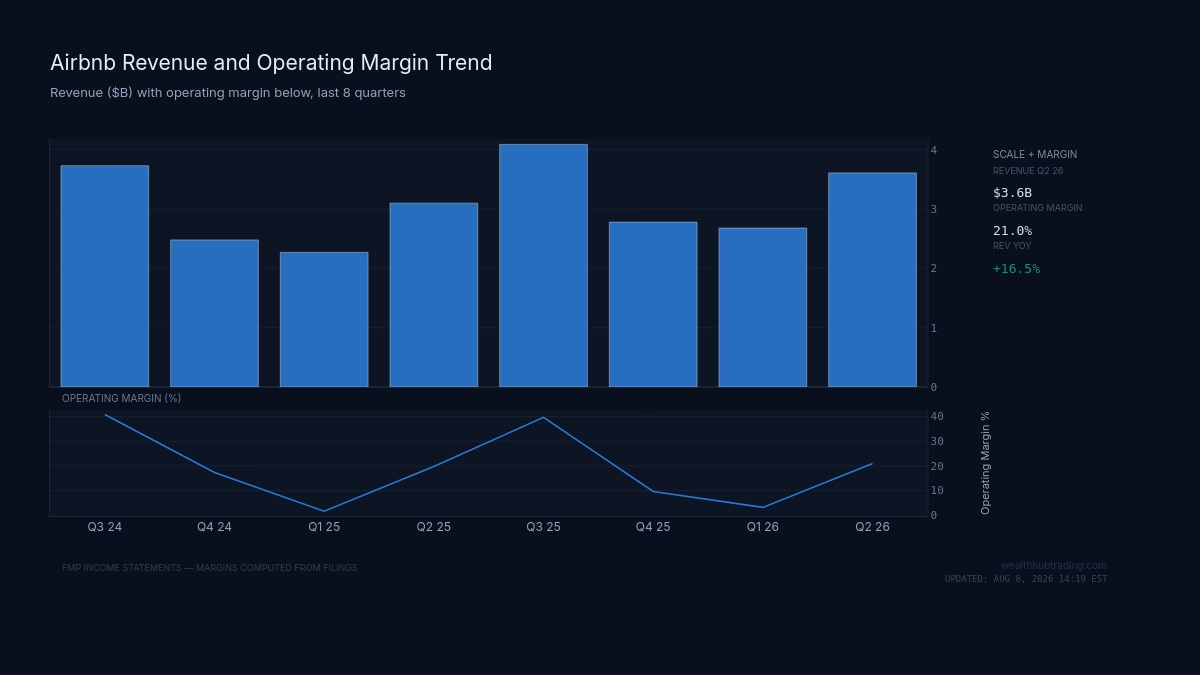
Airbnb is deliberately underpricing its own marketplace to accelerate volume, and the second quarter shows the trade working: 14 million incremental nights and seats booked, up 10% year over year, the fastest pace since the third quarter of 2023, paired with guidance for low-double-digit growth into the third quarter of 2026. The instinct is to read a falling take rate as a weakening business. Here it is the opposite. The take rate is falling because management chose to fund volume, and the volume is now compounding in the two markets that matter most.
The Acceleration Is Concentrated, Not Broad Noise
Headline growth of 10% in nights and seats is the sort of number that invites a shrug from anyone who watched Airbnb decelerate through 2024 and 2025. The composition is what makes it a signal rather than a bounce.
North America is the tell. After six quarters stuck in low-to-mid-single-digit nights growth, the region printed high-single-digit growth for a second consecutive quarter, with foreign-exchange-neutral average daily rate up 7%. EMEA moved from mid-single-digit to high-single-digit nights growth over the same stretch. These are the mature, core markets that were supposed to be structurally slow. When the slow book of business reaccelerates, the explanation is usually product and pricing rather than a cyclical travel wave, because the cyclical wave would lift the expansion markets more than the mature ones. It did not. Expansion markets are still growing roughly twice as fast as core, exactly as they have been.
Two sub-signals sit underneath the North American number and both argue for durability rather than a one-quarter pull-forward. First-time bookers accelerated to plus 11%, the strongest in four years, with Gen Z the fastest-growing cohort. App nights grew 23% year over year and now represent 64% of total nights, up from 59% a year earlier. New users at the top of the funnel and migration onto the owned app channel are the two inputs that determine whether a marketplace keeps its acquisition costs down over the following year. Both are moving the right way at the same time the mature regions are turning.
Why the Take Rate Fell While the Business Strengthened
This is the place intuition gets it wrong. Trailing-twelve-month take rate fell about 31 basis points year over year, and management, which as recently as the first quarter expected full-year 2026 take rate to rise, now guides it flat. That reversal happened despite two genuine tailwinds pulling the other way: the single-service-fee model and insurance-related revenue, which grew 45% and 60% in the first and second quarters respectively. So the underlying pressure pushing the take rate down had to be large enough to absorb those tailwinds and still leave a decline.
Management named the mechanism directly. Two decisions account for it.
Reserve-Now-Pay-Later reached roughly 20% of gross booking value. When a guest reserves now and pays later, the reported take rate on that booking compresses, but the feature does something structurally valuable: it lets a host lock in calendar share earlier than a competing platform can. That is the quiet part. RNPL is not a consumer-finance gimmick; it is a mechanism for winning the host's inventory ahead of the other online travel agencies. Airbnb is expanding it precisely because the results were strong, which means the take-rate drag from RNPL is a headwind that grows before it fades.
The second decision is customer incentives, specifically credits issued to seed the newer verticals, experiences, services, and hotels. Airbnb is handing guests future spend to build liquidity in categories that do not yet have it. Every dollar of credit against gross booking value in those verticals lowers the reported take rate while it grows the marketplace. This is the same playbook that built the core homes business, applied to the categories management intends to launch on roughly an annual cadence.
Put those together and the falling take rate is a purchase, not a loss. The company is buying earlier calendar lock-in and new-vertical liquidity, and paying for both with reported yield. Over the medium term the take rate should recover as RNPL finishes rolling out and the early investment phase in new verticals passes. The honest revision is on timing: with a new vertical launching almost every year, the incentive spend looks more like a sustained line item than a one-time investment, so the recovery in take rate is likely to be more gradual than a clean bounce.
What Flows Through to the Numbers That Are Reported
The reason the take-rate story does not damage the thesis is that gross booking value and revenue are still compounding in the mid-teens, and management expects that pace to hold into the third quarter. Low-double-digit nights growth plus mid-single-digit foreign-exchange-neutral ADR growth mathematically produces mid-teens gross booking value growth, and revenue is tracking it. A flat take rate on a mid-teens-growing booking base still delivers mid-teens revenue. The yield gave up ground; the base grew faster than the yield gave up.
The ADR strength deserves its own note because it is not what it looks like. The chief financial officer attributed part of it to the continued outsized popularity of larger homes: bedroom nights grew faster than nights booked and accelerated more on a year-over-year basis. That framing matters. It means the ADR appreciation is mix, larger properties carrying more value, rather than pure price inflation on a like-for-like stay. Mix-driven ADR is more durable than price-driven ADR because it does not depend on the consumer tolerating a higher price for the same product; it reflects the consumer choosing a bigger product.
Geographically the reported revenue growth was balanced, North America up 15.8%, EMEA up 15.6%, Latin America up 26.0%, APAC up 16.9%, but foreign exchange distorts those figures enough that nights growth and foreign-exchange-neutral ADR are the cleaner lens, and both point the same direction.
The Case Against, Stated Plainly
The thesis rests on a bet that the volume Airbnb is buying converts into durable, higher-yield gross booking value later. There is a version of these facts where that does not happen.
If RNPL and vertical credits become a permanent structural feature of the model rather than a transitional investment, the take rate does not recover, it just sits flat or drifts lower, and the mid-teens revenue growth becomes entirely dependent on volume and mix continuing to compound. In that world Airbnb has traded a higher-margin business for a larger, thinner one. Management's own guidance revision, from expecting a higher 2026 take rate to guiding it flat inside a single quarter, is the fact that supports this reading. Guidance that moves against you within three months is not a rounding error; it is management updating on something real, and the something real is that the incentive spend is stickier than they first modeled.
The other soft spot is the new-vertical cadence itself. Launching a vertical every year is a permanent reason to keep issuing credits. If experiences, services, and hotels do not reach self-sustaining liquidity, the incentive line never gets to step down, and the "early investment phase passes" premise never arrives.
What Would Confirm or Break the Read
The thesis confirms if take rate stabilizes and then turns up while nights growth stays in the low double digits, because that is the sequence that proves the volume purchase converted into yield. It confirms faster if RNPL penetration flattens near its current fifth of gross booking value rather than climbing further, since a stable RNPL mix stops adding fresh drag.
The thesis breaks if nights growth decelerates back toward mid-single digits while the take rate stays flat or falls, because that combination means Airbnb paid for volume that did not stick. Until one of those two things shows up in the numbers, the cleaner reading is the one the composition of this quarter supports: a company deliberately lowering its reported yield to accelerate volume in its most important markets, and getting the acceleration it paid for.