In 2018, Apple spent roughly $73 billion buying back its own stock. Reported earnings per share climbed sharply that year, and much of the climb had not...
In 2018, Apple spent roughly $73 billion buying back its own stock. Reported earnings per share climbed sharply that year, and much of the climb had nothing to do with selling more iPhones. The company earned more per share partly because there were fewer shares to divide the earnings among. The business grew; the denominator shrank faster. Understanding which of those two forces is doing the work in any given buyback is the whole game, and most readers watch the wrong one.
What a buyback actually changes
A share buyback, also called a repurchase, is a transaction in which a company uses cash to buy its own shares in the open market and retire them. Retiring a share means removing it from the count of shares outstanding, which is the float available to trade.
Start with the accounting identity that drives everything downstream. Earnings per share (EPS) = Net income / Shares outstanding. EPS is a fraction. A buyback does not touch the numerator; net income is a property of the business, of products sold and costs paid. A buyback shrinks the denominator by pulling shares out of circulation.
Here is the worked version. Assume a company earns $100 million in net income and has 100 million shares outstanding.
EPS = $100M / 100M = $1.00 per share.
Now the company repurchases 10 million shares and retires them, leaving 90 million.
EPS = $100M / 90M = $1.11 per share.
Earnings per share rose 11% while the company earned not one additional dollar. Nothing about the underlying business improved. The reported number improved because the arithmetic changed.
The practical implication is direct: when you read that a company grew EPS, your first job is to check whether net income grew or the share count fell. Those are different achievements, and only one of them reflects a better business.
Why the float matters beyond the arithmetic
Float is not just the denominator in an EPS calculation. It is the supply of shares the market must absorb every day. Reducing float reduces supply, and supply reduction, holding demand constant, supports price.
This is where a buyback stops being an accounting event and becomes a market event. When a company runs a repurchase program, it places a large, recurring buy order into the market. That order is often price-insensitive, meaning the buyer is not trying to time a good entry; it is executing a mandate to retire a set dollar amount over a set period. A pension fund buys when it thinks the stock is cheap. A corporate buyback program frequently buys because the calendar says to buy.
A price-insensitive bid changes the character of trading. It puts a floor of demand under the stock that appears on schedule rather than in response to news. Sellers who want out on a given day find a ready counterparty who is not negotiating on price.
The signal summary framed this precisely: the question is not whether management is bullish, but whose sell orders that steady bid is quietly absorbing. Insiders selling into a buyback, employees exercising options, early investors distributing positions, all find a deep and indifferent buyer. The buyback can be a genuine vote of confidence or a mechanism that lets informed sellers exit without moving the price against themselves. The transaction looks identical from the outside.
What this means for you: when a buyback is announced, ask who is selling. If insider sales and option exercises are rising alongside the repurchase, the buyback may be transferring shares from informed hands to the company's balance sheet, not signaling undervaluation.
The signaling layer and where intuition fails
Buybacks carry a signal because of what they imply about management's alternatives. A company can do several things with a dollar of cash: invest in the business, pay a dividend, pay down debt, or repurchase stock. Choosing repurchase signals that management sees no higher-returning use for the cash and believes the shares are worth buying at current prices.
That is the textbook signal, and it is where intuition gets it wrong. The intuitive read is that a buyback means "management thinks the stock is cheap." Sometimes it does. But a buyback also mechanically inflates EPS, and EPS is frequently a component of executive compensation targets. A management team can hit a bonus threshold by shrinking the share count rather than growing the business. The same action that looks like a confidence signal can be a compensation-engineering signal.
Consider the mechanism from the compensation angle. If an executive's bonus vests on reaching $5.00 in EPS, and the business is tracking toward $4.80, a buyback that retires enough shares can close the gap without a single additional sale. The signal and the incentive point in the same direction, which is exactly why the signal is unreliable on its own.
The failure mode is treating the buyback announcement as sufficient evidence of undervaluation. History supplies the caution. Many companies that repurchased aggressively near cyclical peaks, spending record amounts when their own shares were most expensive, later saw those repurchases destroy value when prices fell. Buying high with shareholder cash is the opposite of the value the signal is supposed to convey.
The practical takeaway: read a buyback alongside three other facts. What price is the company paying relative to its own history? Is management compensation tied to EPS? And what is the business doing organically, absent the share-count effect? A buyback at a low valuation, funded by real free cash flow, with insiders holding rather than selling, is a strong signal. A buyback at a rich valuation, funded by debt, alongside heavy insider selling and EPS-linked pay, is closer to financial engineering.
When the mechanism inverts
The float-and-EPS mechanism runs in reverse when the assumptions break. Two break most often.
The first is debt-funded repurchases. A company can borrow to buy back stock, which retires shares and lifts EPS while adding interest expense that lowers net income. The denominator falls, but so does the numerator, and the balance sheet carries more risk. In a downturn, the added leverage that funded the buyback becomes a liability precisely when the business can least support it.
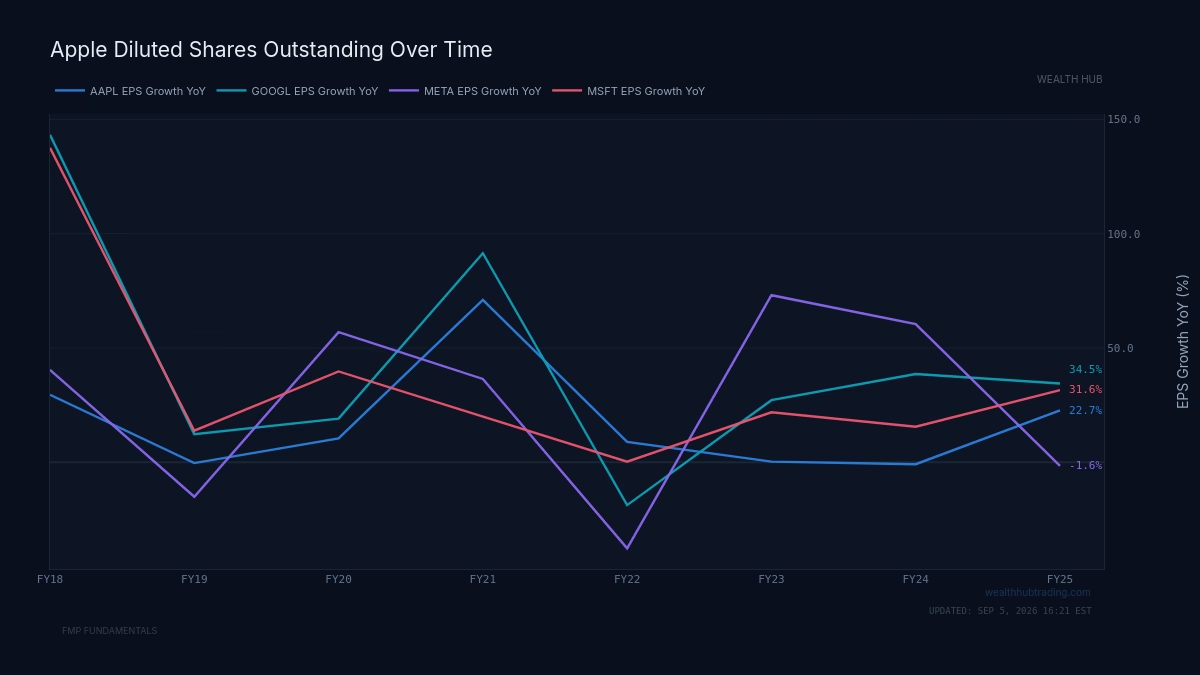
The second is dilution running underneath the buyback. Many companies repurchase shares with one hand while issuing shares to employees as stock compensation with the other. The reported buyback might retire 10 million shares while option exercises add 8 million back. The net float reduction is far smaller than the headline repurchase suggests, and EPS barely moves. You have to net the issuance against the repurchase to see the real change in shares outstanding.
What this means for you: never trust a gross buyback figure. Find the net change in diluted shares outstanding across several years. If the share count is falling steadily, the buyback is real. If it is flat despite years of announced repurchases, the buybacks are offsetting dilution, not rewarding you.
The one thing to carry forward
A buyback changes the denominator, not the business, so a higher EPS after a repurchase tells you about the share count first and the company second. The steady, price-insensitive bid a buyback creates is real and supports the stock, but it is worth asking whose exit it is financing before reading it as a signal of confidence. Check the price paid, the funding source, the net share count, and the insider behavior, and the buyback stops being a headline and becomes a piece of evidence you can actually weigh.