The credit market has already written the memo that equity is still refusing to read: the 10-year at 4.79% is not the problem. The two full percentage p...
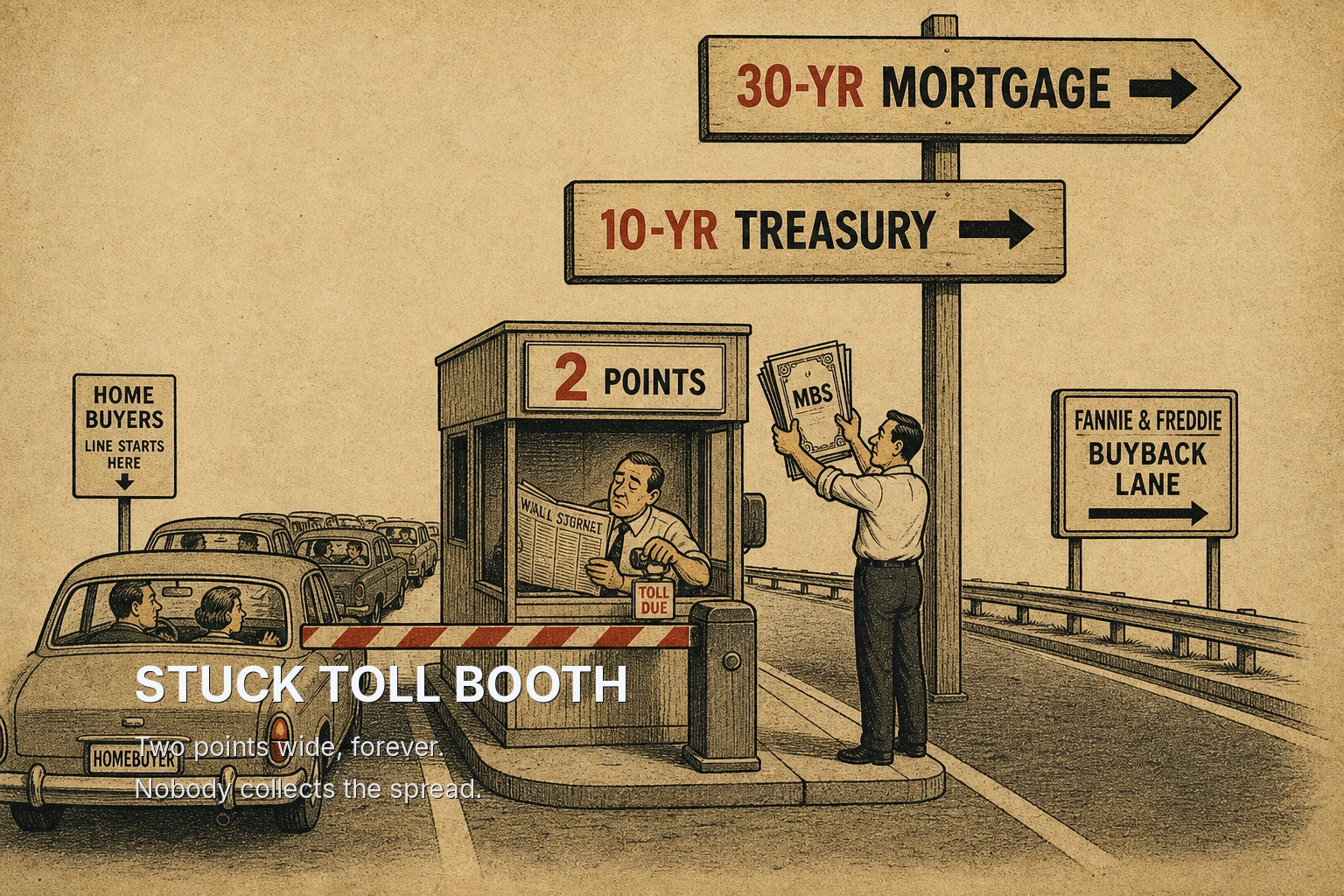
The credit market has already written the memo that equity is still refusing to read: the 10-year at 4.79% is not the problem. The two full percentage points sitting between that yield and the 30-year mortgage rate is the problem, and it has not budged despite Fannie and Freddie hoovering up their own mortgage-backed paper. That spread is the tell. It says the marginal buyer of mortgage risk is demanding to be paid for something the equity market has not priced.
Consensus reads a 7% mortgage rate as a rate story. Higher for longer, the Fed's fault, wait for the cuts. That framing is not wrong about the direction. It is wrong about where the pressure sits. The pressure is not in the Treasury curve, which is doing exactly what a lightly inverted-then-normalized curve does at a +0.40% 2s10s. The pressure is in the spread, and the spread is a credit signal wearing a rates costume.
Why won't the spread compress?
The historical rule of thumb puts the primary mortgage rate roughly 1.7 to 1.8 points above the 10-year. We are stuck at two, and it will not move. The buybacks were supposed to help. When the agencies retire their own MBS, they remove supply, and less supply should mean a tighter spread. It has not happened.
The reason is prepayment risk, or rather the collapse of it. When rates were at 3%, a mortgage was a bond that could be called away from you the moment the borrower refinanced. Now nobody refinances. Every mortgage originated in 2021 at sub-3% is a bond that will never, ever be prepaid. The investor holding new 7% paper is not being compensated for prepayment optionality, because there is no prepayment. He is being compensated for something worse: the possibility that he is buying duration into a housing market where the collateral cannot transact.
That is the part consensus misses. The spread is wide not because supply is heavy but because the buyer has quietly re-underwritten what mortgage credit is worth in a frozen market. Buybacks cannot fix a spread that reflects a repricing of the collateral, not a glut of the paper.
What is the refi wall actually saying?
Here is the number equity has not metabolized. The overwhelming share of American mortgage debt is locked at rates below 4%. Those loans are not refinanceable at 7%. They are also, functionally, non-transferable, because the homeowner who sells surrenders a 3% loan to buy at 7%. The result is a housing market where existing inventory is entombed and the credit that finances it has stopped turning over.
A refi wall usually means a cliff: a wall of maturing debt that must roll at higher rates on a date certain. Residential mortgages do not mature on a date certain the way corporate paper does, so the wall here is stranger. It is not a cliff. It is a swamp. Nothing is forced to roll, so nothing does, and the entire market sits still while the spread quietly tells you the clearing price of new credit is punitive.
The credit signal is this: when the marginal transaction requires the marginal buyer to accept a 7% rate that sits two full points above a benchmark going nowhere, the marginal transaction does not happen. Volume dies before price does. And a market where volume dies first is a market whose price discovery is a fiction until something forces a print.
The 2022 analog is instructive precisely because of where it differs. That episode was a duration massacre: the fastest Fed tightening in four decades, CPI peaking at 9.1%, 425 basis points of hikes, long bonds suffering their worst annual losses in decades and equities down roughly 20%. That was a rates shock, clean and violent, and it repriced in a single year. What we have now is not a shock. It is a slow strangulation of transaction volume that never produces the cathartic print, and so never forces equity to look.
Where has equity mispriced this?
Equity looks at homebuilders, sees them near highs, and concludes the housing consumer is fine. This is first-level thinking. The builders are fine because they can buy down mortgage rates as a sales incentive and because they are the only source of transactable inventory in a frozen resale market. Their health is a symptom of the freeze, not a refutation of it.
The second-level read runs through credit, and credit spreads are where the stress will surface first. Watch investment-grade and high-yield option-adjusted spreads and the MOVE index for the tell. If the mortgage-to-Treasury spread is signaling that the marginal buyer of housing credit has re-underwritten the collateral, that re-underwriting does not stay contained in agency MBS. It leaks into anything that touches the consumer balance sheet, into regional bank held-to-maturity books stuffed with low-coupon mortgages that cannot be sold without crystallizing the loss, into the funding cost of every institution that assumed housing credit would keep turning over.
I do not know the timing. Nobody does. A frozen market can stay frozen far longer than a levered one can stay levered, because the freeze itself removes the forcing mechanism. The base case is that this grinds slowly, cross-asset positioning repricing only as the signal confirms itself quarter by quarter. But the asymmetry is not symmetric. The scenario where second-order effects reach earnings revisions and credit availability before anyone repositions is the one nobody is hedged for, and it is not a tail. It is a live minority outcome.
The instruments that express this read are credit, not equity. Long high-yield and investment-grade credit, EMB for the reach, with TLT and VIX as the hedge against the duration leg going wrong. The point is not a directional bet on rates. The point is that the spread has told you something the equity tape has not, and the cheapest place to be right is where the signal originated.
What breaks the stalemate?
Three things could thaw the swamp, and only one is benign. Rates fall far enough that refinancing reawakens and the locked-in homeowner is freed to transact. Or the labor market cracks and forced sellers appear, which prints a clearing price nobody wants to see. Or the agencies and the funding system absorb the frozen credit indefinitely, socializing the cost until the spread's warning becomes someone else's problem.
Charles Kindleberger described in "Manias, Panics, and Crashes" how the distress phase of a cycle arrives quietly, in the interval between the peak and the panic, when volume dries up and participants sense that the exits are narrowing before any price confirms it. That interval is where housing credit sits now. The spread is the sensation of the narrowing exit. It has been stuck at two points not because the buybacks failed at their mechanics but because the buyers are pricing a market that has stopped clearing.
Equity is watching the wrong instrument. The two-point spread is not a rates artifact waiting for the Fed. It is credit telling you the collateral has been re-underwritten and the transaction has died.
The freeze is the story, and the spread is how you read it.