In the third week of March 2020, a strange thing happened to some of the largest bond exchange-traded funds. The biggest investment-grade corporate bond...
March 2020, and the day bond ETFs stopped tracking
In the third week of March 2020, a strange thing happened to some of the largest bond exchange-traded funds. The biggest investment-grade corporate bond ETF traded several percentage points below the stated value of the bonds it held. On paper, this looks like free money: buy the ETF cheap, and you own a claim on assets worth more. In practice, almost nobody stepped in fast enough to close the gap. For a few days, the mechanism that normally welds an ETF's price to the value of its holdings simply loosened.
That episode is the clearest window into how ETFs actually work, because it shows the machinery failing. When something works invisibly, you learn the most from the moment it stops. The gap in March 2020 was not a pricing error. It was the market telling you that the glue holding ETF price to underlying value is made of profit motive, and profit motive has a temperature at which it melts.
The trade that keeps price near value
An ETF holds a basket of securities. That basket has a net asset value, or NAV, which is simply the market value of everything the fund owns divided by the number of shares outstanding. The ETF also has a market price, the number you see quoted on the exchange all day. There is no law of physics forcing those two numbers to match. They match because a specific group of firms makes money by forcing them together.
Those firms are authorized participants, or APs, large broker-dealers with a contractual right to create and destroy ETF shares directly with the fund. This right is the entire mechanism, so it is worth stating precisely what they do.
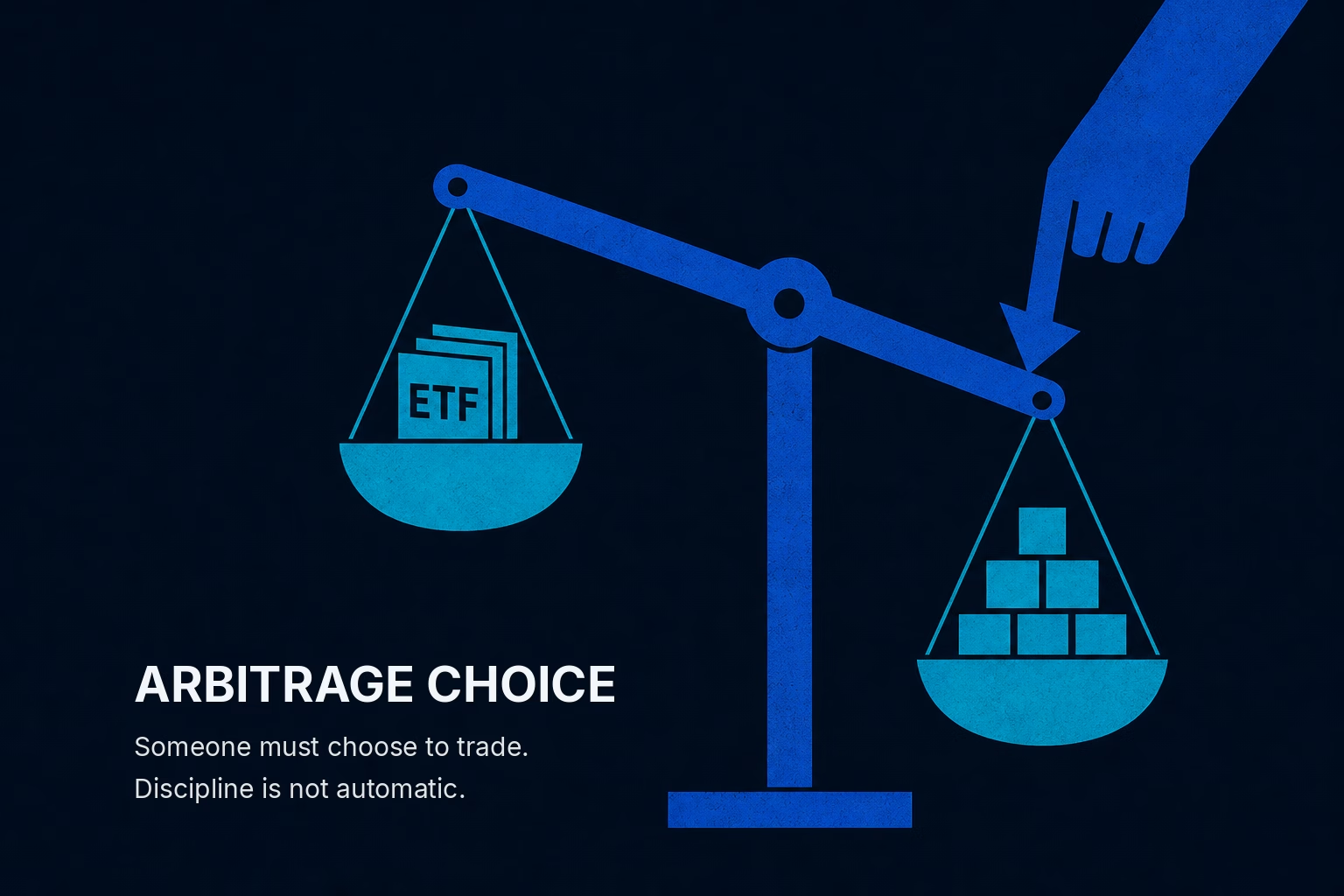
When the ETF's market price rises above its NAV, the fund is trading rich, meaning the wrapper costs more than the assets inside it. An AP buys the underlying basket of securities in the open market, delivers that basket to the fund, and receives newly created ETF shares in return, a bundle usually called a creation unit. The AP then sells those fresh shares on the exchange at the higher market price. Buying the cheap basket and selling the expensive wrapper pockets the difference. That selling pressure pushes the ETF price back down toward NAV.
When the ETF trades cheap, below NAV, the AP runs the trade in reverse. It buys ETF shares on the exchange, hands them back to the fund through redemption, and receives the underlying basket of securities, which it sells for more than it paid for the shares. Buying the cheap wrapper and selling the richer contents closes the gap from the other side. That buying pressure lifts the ETF price back up toward NAV.
Notice what is not in this description: no promise, no guarantee, no regulator standing by to enforce the match. The price tracks value because a profitable trade exists to make it track. Remove the profit, and you remove the tracking.
Why the gap is usually a rounding error
For most large equity ETFs on a normal day, the gap between price and NAV is a fraction of a percent, often smaller than the bid-ask spread. This is the part that surprises people who assume the fund company is doing the work. The fund company is not managing the price at all. Competition among APs is.
Several firms hold creation and redemption rights on a popular ETF. The moment the wrapper trades even slightly rich, whichever AP moves first captures the spread. That competition compresses the profit to nearly nothing, which is exactly why the tracking is so tight. The gap you can observe is roughly the smallest gap at which the fastest AP still finds the trade worth doing, after accounting for the cost of trading the underlying basket.
This tells you where to look when tracking is good and where to worry when it is not. The tightness of an ETF depends on how cheap and easy it is for an AP to trade the underlying basket. An S&P 500 ETF holds five hundred deeply liquid stocks; assembling that basket costs almost nothing, so the arbitrage is nearly frictionless and the gap stays microscopic. The mechanism is strongest precisely where the underlying market is deepest.
When the underlying is hard to trade
The mechanism weakens as the underlying basket becomes harder, slower, or more expensive to trade. This is the single place where intuition most often gets ETFs wrong. People treat the ETF share and its NAV as two names for the same thing. They are two different instruments trading in two different markets, linked only by an arbitrage that has to be physically executable.
Corporate bonds make the problem concrete. Unlike stocks, most corporate bonds do not trade on a continuous exchange. Many individual bonds change hands only a few times a week, negotiated between dealers over the phone or on request-for-quote systems. An AP that wants to redeem a bond ETF receives a basket of hundreds of these bonds and must actually sell them to complete the arbitrage. If those bonds are barely trading, the AP cannot be sure what price it will get, or whether it can sell at all.
That uncertainty is a cost, and the AP demands compensation for bearing it. The compensation shows up as a wider tolerated gap between ETF price and NAV. The AP will only step in once the discount is large enough to cover the risk of getting stuck with bonds it cannot offload. So the ETF is allowed to drift further from NAV before anyone corrects it. The wrapper stays tightly bound to value only as long as the contents can be traded on demand.
March 2020 again, with the mechanism in view
Return to the bond ETFs trading below NAV. In that week, the corporate bond market seized. Dealers, facing their own balance-sheet stress and a flood of sell orders, pulled back from quoting prices. The underlying bonds became nearly impossible to trade at any confident level.
Now trace the effect through the mechanism. The redemption arbitrage requires the AP to sell the underlying bonds. If those bonds cannot be sold at a known price, the AP cannot size the trade, so it stands aside. With the APs stepping back, nothing was pushing the discounted ETF price back up toward NAV. The gap widened and stayed wide.
There is a subtler reading available here, and it is the more useful one. The stated NAV in those days was itself questionable, because it was computed from bond prices that were stale or purely theoretical, marks on bonds that were not actually trading. The ETF, which did trade continuously in a liquid market, may have been giving the more honest real-time estimate of what the bonds were worth. On this reading the ETF was not broken. It was pricing the illiquidity of its own holdings faster than the slow bond marks could. The discount was information, not error.
Either way, the lesson is the same. The link between ETF price and NAV is only as reliable as the arbitrage that enforces it, and that arbitrage is only as reliable as the tradability of the underlying basket at the exact moment you need it.
What this means when you own an ETF
Judge an ETF's tracking reliability by the liquidity of what it holds, not by the fund's size or brand. An ETF on large-cap stocks, developed-market currencies, or on-the-run Treasuries sits on top of markets deep enough that the AP arbitrage almost never fails. The wrapper and its value stay glued because the trade that glues them is always available and always cheap.
An ETF on high-yield bonds, thinly traded small caps, emerging-market debt, or bank loans sits on a shallower market. On calm days the gap will still look tight and you will see no problem. The risk is not visible in normal conditions; it appears in the exact moment you most want to sell, when the underlying freezes and the APs demand a wider discount before they act. Structure your expectations around the stressed day, not the calm one, because the calm-day gap tells you nothing about how the mechanism behaves under load.
The one durable idea to carry away is this. The price of an ETF tracks the value of its holdings because a profitable arbitrage trade exists to make it happen, and that trade can vanish precisely when arbitrage capital gets scarce and the underlying market gets hard to trade. The tracking is a behavior, not a promise, and knowing the difference is the whole of understanding how these instruments work.