In September 2008, a German bank in Frankfurt could not get dollars. Not euros, which its national central bank could supply. Dollars, which it needed to roll over short-term loans it had made in the American currency. The interbank market where it normally borrowed those dollars overnight had simply stopped functioning. Lenders who had rolled the funding a thousand times without a second thought now wanted their money back and would not lend fresh.
The German bank had no dollar deposits from the Federal Reserve to draw on, because it had never had an account there. It held dollar-denominated assets and dollar-denominated liabilities, and when the liabilities came due faster than the assets, it faced default in a currency its own central bank could not create. This scene repeated across Europe and Asia through the autumn of 2008. The dollar shortage did not originate in the United States. It originated in a system of dollars created entirely outside it.
What the offshore dollar actually is
The term Eurodollar is a historical accident, not a reference to the euro. It means any US dollar held on deposit at a bank outside the United States, and it predates the euro currency by four decades. A dollar deposit at a London branch is a Eurodollar. A dollar loan booked in Tokyo or Singapore is part of the same system. The "Euro" prefix just meant "offshore," because the market first grew in Europe in the 1950s.
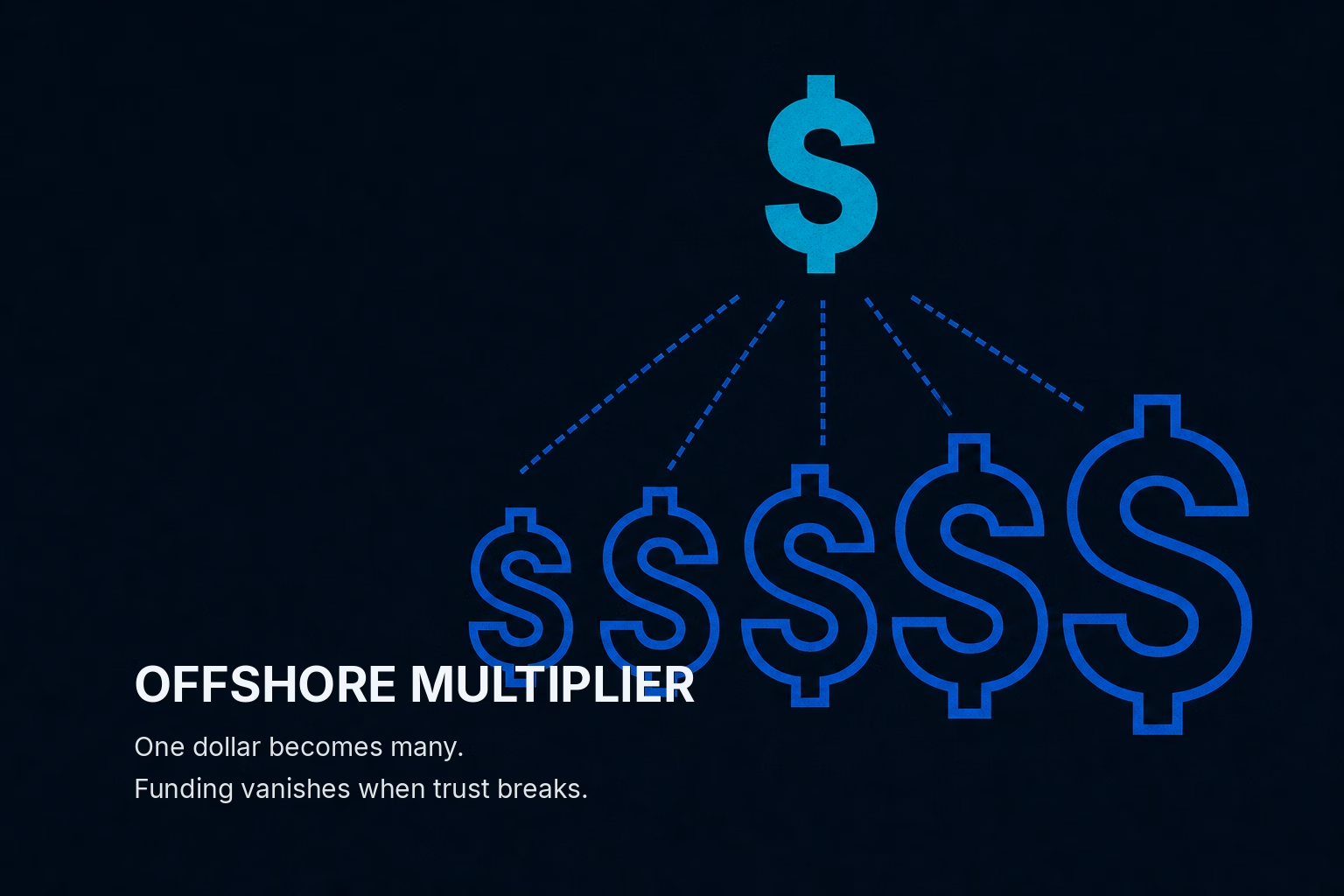
Here is the part that breaks most people's intuition. These offshore dollars are not dollars that were shipped abroad from America. They are dollars that were created abroad, by non-US banks, through the ordinary act of making a loan.
When a bank makes a loan, it does not lend out money it already holds. It creates a new deposit by expanding both sides of its balance sheet at once: a new asset (the loan) and a new liability (the borrower's deposit). This is how bank money works everywhere. A dollar loan made by a Japanese bank to a Korean shipping company creates a new dollar deposit that never touched the US banking system. No Federal Reserve dollar was moved. A new dollar claim simply came into existence offshore.
The practical consequence is that the quantity of dollars in the world is not controlled by the Fed. The Fed controls the monetary base, the reserves and physical currency it issues directly. The far larger stock of dollar credit is created by thousands of commercial banks, most of them foreign, responding to demand for dollar funding in global trade and finance.
Why no one is standing behind these dollars
Every domestic banking system has a backstop. When a US bank cannot roll its short-term funding but is otherwise solvent, it can borrow from the Federal Reserve's discount window. The Fed is the lender of last resort. It can create reserves without limit, so a temporary funding freeze does not have to become an insolvency.
The offshore dollar system has no such backstop, because the institution that can create dollars without limit, the Fed, has no obligation to a bank in Frankfurt or Seoul. That foreign bank is not a member of the Federal Reserve System. It has no account, no discount-window access, no claim on emergency dollar liquidity. Its own central bank can print domestic currency in unlimited quantity but cannot print the currency the bank actually owes.
This is the structural fault line. A foreign bank running a large dollar book is borrowing short in a currency it cannot manufacture and lending long in that same currency. In calm markets, it rolls the short-term borrowing continuously and the mismatch is invisible. The moment lenders stop rolling, the bank must find dollars it has no domestic source for.
The visible symptom of this stress is a widening in short-term dollar funding rates and a jump in the cost of swapping other currencies into dollars. What actually drives the crisis is the absence of a lender of last resort for a currency created outside the jurisdiction of the only entity that can create it freely. Most commentary watches the symptom. The mechanism is the missing backstop.
How the Fed became the world's lender of last resort
The Fed solved the 2008 dollar shortage by inventing a workaround: central bank swap lines. A swap line is a reciprocal agreement. The Fed lends dollars to a foreign central bank, the European Central Bank or the Bank of Japan, and takes that central bank's currency as collateral at the current exchange rate, with an agreement to reverse the trade later.
The foreign central bank then lends those dollars onward to the banks in its own jurisdiction that cannot get them in the market. The chain runs cleanly. The Fed creates dollars and lends them to the ECB. The ECB lends them to the Frankfurt bank. The Frankfurt bank rolls its funding and does not default. The Fed carries no direct credit risk to the German bank, because its counterparty is the ECB, and it holds euros as collateral against the dollars it advanced.
Trace the causal chain plainly. Offshore banks create dollar liabilities with no Fed backstop. A shock makes lenders refuse to roll those liabilities. The banks scramble for dollars, driving up funding costs worldwide. The Fed, seeing dollar stress threaten to seize global trade and feed back into US markets, extends swap lines to foreign central banks. Those central banks distribute the dollars locally. The shortage eases.
The 2008 swap lines peaked at roughly $580 billion outstanding in December of that year, an enormous sum lent to institutions the Fed does not regulate and to which it owes nothing under its domestic mandate. The Fed reactivated the same lines in March 2020 when the pandemic triggered an identical dash for dollars. The playbook is now permanent. Five central banks hold standing swap arrangements with the Fed, and others can be added within days.
The Fed did not choose this role from ambition. The offshore system built a global dollar dependency the Fed cannot see on its own balance sheet and cannot regulate directly, yet must ultimately backstop, because a dollar-funding freeze abroad transmits straight back into US money markets and asset prices.
When the mechanism fails to save the day
The swap-line backstop is not automatic and does not reach everyone. It works through central banks the Fed chooses to lend to. A country whose central bank is not on the swap list, or whose banks are already insolvent rather than merely illiquid, gets no relief.
The 1997 Asian financial crisis showed the earlier version of this failure. Thai, Korean, and Indonesian banks and corporations had borrowed heavily in dollars because dollar rates were low and their pegged exchange rates made the borrowing look safe. When the pegs broke, the local-currency cost of their dollar debt exploded overnight, and no swap-line facility existed to supply emergency dollars. The result was mass insolvency, IMF programs with harsh conditions, and deep recessions. Swap lines as a systematic tool came later.
The mechanism also fails when the problem is solvency, not liquidity. A lender of last resort can cure a funding freeze at a solvent institution by bridging it to calmer markets. It cannot cure a bank whose assets are worth less than its liabilities. Lending more dollars to an insolvent borrower postpones the loss without preventing it. The distinction between illiquid and insolvent is easy to state and brutally hard to judge inside a crisis, when asset prices are collapsing and no one knows where the true value sits.
What this means for you
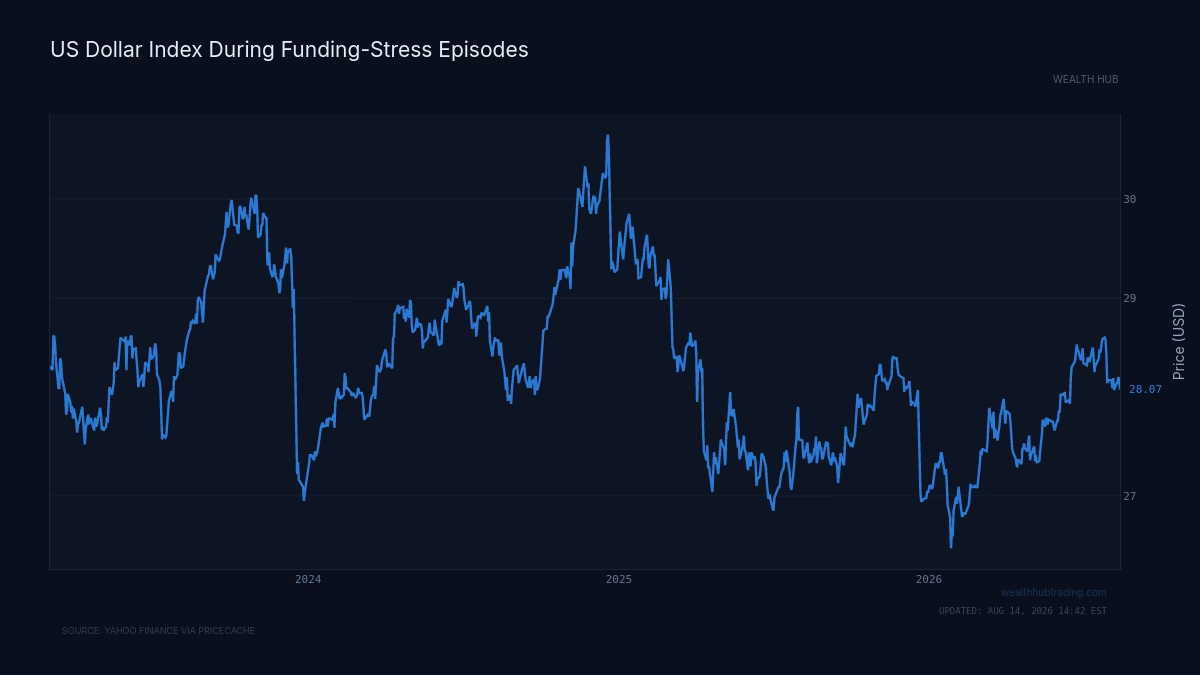
The dollar's exchange rate tends to rise during global crises, which confuses people who expect a currency to weaken when its home country is in trouble. It rises because the world is short dollars it did not create through the Fed and must buy them, at any price, to service debts it can no longer roll. A crisis anywhere in the global financial system tends to become a dollar-funding crisis, and a dollar-funding crisis pushes the dollar up.
Watch the price of borrowing dollars against other currencies, not just the headline exchange rate, when stress appears. When that funding cost spikes, the offshore system is straining, and the Fed's swap lines are the mechanism that determines whether the strain resolves quietly or breaks something. The dollar you cannot see on the Fed's balance sheet is the one most likely to move markets.