The most dangerous moment in an options position is not the expiration close. It is the ninety minutes after it. Price gets dragged toward a heavily traded strike by dealers who are paid to keep it there. The short who ends up sitting on that strike is the one left holding a position that cannot be hedged until Monday.
What the expiration Friday record shows
Researchers studying listed equity options in the late 1990s and early 2000s, most prominently Ni, Pearson and Poteshman, documented something traders had long suspected. On expiration dates, stocks with listed options closed near a strike price noticeably more often than chance would predict. Stocks without listed options showed no such clustering. The pattern appeared only on expiration Fridays and faded on ordinary days.
That asymmetry is the tell. If closes clustered at round numbers for psychological reasons, optionless stocks would cluster too. They did not. Something tied to the options themselves was pulling price toward the strike, and only on the day those options died.
The researchers pointed to two sources. The first was delta hedging by market makers. The second was the possibility that some traders with large positions pushed price deliberately. The second explanation draws the headlines. The first is the one that operates every month without anyone intending it, and it is the one that matters for understanding pin risk, the hazard of an underlying settling so close to a strike that nobody knows whether the option will be exercised.
What this means for you: when you see a stock trading within cents of a large strike late on expiration day, the stillness is not a coincidence. Someone's hedging book is producing it.
The hedging flow that holds price at the strike
Start with delta, the amount an option's value changes for a $1 move in the underlying, and gamma, the rate at which delta itself changes. A dealer who is long gamma owns options and hedges them with stock. Picture a dealer who bought calls and puts at the $100 strike from customers writing covered calls and cash-secured puts. To stay neutral, that dealer sells shares when price rises (call delta climbs) and buys shares when price falls (put delta deepens). They lean against every move.
Gamma does not stay constant. For an at-the-money option it scales roughly with the inverse of the square root of time remaining. A worked example makes the size visible.
ATM gamma ≈ 0.4 / (S × σ × √T)
Take a $100 stock with 25% implied volatility.
- One week left: T = 1/52, √T ≈ 0.139. Gamma ≈ 0.4 / (100 × 0.25 × 0.139) ≈ 0.115 per dollar.
- One hour left: T ≈ 1/1638 (one hour of a 6.5-hour session across 252 days), √T ≈ 0.025. Gamma ≈ 0.4 / (100 × 0.25 × 0.025) ≈ 0.65 per dollar.
Gamma is about 5.6 times larger with an hour to go. Now attach size. Suppose dealers are net long 10,000 contracts at the $100 strike, which is exposure to 1 million shares. A $0.50 move in the final hour shifts their delta by roughly 0.65 × 0.50 × 1,000,000, or about 325,000 shares. They must sell that much into a rally or buy that much into a dip, and they must do it almost immediately.
That is the pin. A large, rule-bound counterparty is forced to fade every move away from the strike, and the force gets stronger the closer price sits to it and the closer the clock runs to zero.
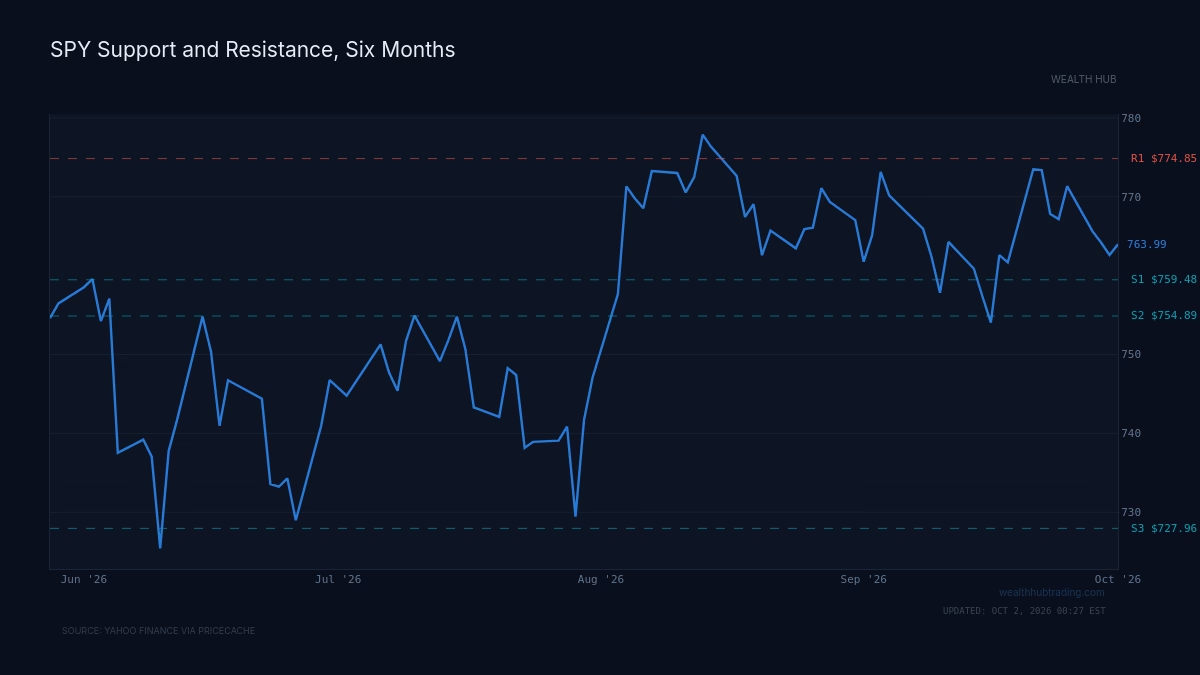
What this means for you: the flow that moves the tape on expiration afternoon is the hedge, not the news. Read the open interest at nearby strikes before you read the chart.
Why dealers are on that side of the trade
The pin depends on dealers being long gamma at the relevant strike, so the obvious question is why they so often are. The answer sits in who is selling options to them.
Overwriting programs, retail covered-call strategies, cash-secured put sellers and yield-enhancement funds all sell options systematically. Their incentive is income: they collect premium month after month and accept capped upside. Market makers take the other side, and because they run delta-neutral mandates with capital charged against unhedged inventory, they cannot sit on the directional exposure. They hedge mechanically. When the customer base is net short options at a strike, the dealer base is net long gamma there, and mechanical hedging becomes a stabilizing force.
The mechanism breaks when that ownership flips. If customers are net long options at a strike, dealers are short gamma. They must buy rallies and sell dips to stay neutral, which pushes price away from the strike instead of toward it. Expiration then produces acceleration, not stillness. The same arithmetic that produced 325,000 shares of stabilizing flow produces 325,000 shares of destabilizing flow.
The mechanism also fails under information shocks. A dealer hedging flow of a few hundred thousand shares can hold a stock in the face of ordinary order flow. It cannot hold price against an earnings pre-announcement or a guidance cut that brings in tens of millions of shares. Pinning is a low-volatility phenomenon. It describes what happens when nothing else is happening.
What this means for you: a pin requires a net short-option customer base at the strike and a quiet tape. If either condition is missing, expect the strike to repel price rather than attract it.
The short who cannot know
Here is where pinning turns into a genuine risk rather than a curiosity. Suppose you sold 50 of the $100 calls and the stock closes at $100.02 on Friday.
For physically settled US equity and ETF options, the Options Clearing Corporation automatically exercises any contract in the money by $0.01 or more at expiration, a process called exercise by exception. On those terms your calls get exercised. Holders, though, can submit contrary instructions until the exercise cutoff, which falls after the 4:00 p.m. close (brokers typically set 5:30 p.m. Eastern for customers). A holder can decline to exercise a contract that is one penny in the money. A holder can also exercise one that closed one penny out of the money, if after-hours trading has moved the stock higher in the meantime.
The closing price, in other words, does not settle the question. The holder decides with information you do not have, and you find out about assignment over the weekend or on Monday morning.
Put numbers on the bind. Fifty contracts is 5,000 shares. If you are assigned, you wake up Monday short 5,000 shares, about $500,000 of notional. A 3% weekend gap higher costs $15,000 on a trade that was meant to collect a few hundred dollars of remaining premium. Hedging in advance does not solve it either. If you buy 5,000 shares after hours to cover a possible assignment and then are not assigned, you are now long $500,000 of stock you never intended to own. Either guess leaves an unhedged position over a 64-hour window, and the market is closed for most of it.
Scale that to a dealer book with thousands of contracts at one strike and the problem becomes structural. The same hedging that pinned the stock has left a large population of shorts sitting precisely at the point of maximum uncertainty. The stability of the afternoon gets paid for with the ambiguity of the weekend.
What this means for you: a short option within a few cents of the strike at the close is not a winning trade. It is an open position with an unknown size.
Where pin risk lives today
Two structural features determine whether a given contract carries this hazard.
Settlement style comes first. Cash-settled index options such as SPX deliver a cash amount rather than shares, so no one wakes up with an unexpected stock position. Their price can still pin, but the assignment ambiguity disappears. Physically settled products, SPY, single stocks and most ETFs among them, carry the full problem. Traders who treat SPY and SPX as interchangeable around expiration are taking on a risk in one that does not exist in the other.
Expiration frequency comes second. Daily and weekly expirations have spread gamma concentration across far more dates than the old monthly cycle. That gives more chances for a pin and smaller open interest at each one. A thin strike rarely generates enough hedging flow to hold price, so in today's market the strikes most likely to pin are the large monthly and quarterly ones, where open interest has built up over weeks. Crowding at a single strike is what gives the hedging flow its weight, and the monthly and quarterly cycles still concentrate it.
What this means for you: check how the contract settles before you hold a short strike into the close. The answer tells you whether you face a price risk or an assignment risk as well.
What a disciplined short does differently
The practical response follows from the mechanism. If you are short a physically settled option and the underlying is trading within roughly half of one percent of the strike in the final hour, close or roll the position before 4:00 p.m. The remaining premium is small and the tail is large, so you are paying very little to remove a weekend of unknown exposure. Do not treat the closing print as a verdict. Treat the after-hours tape and the exercise cutoff as the real expiration. And before expiration week begins, look at where open interest is concentrated and who likely owns it. A stock sitting on a strike where customers sold heavily is being held there. A stock near a strike where customers bought heavily can be thrown away from it.
Pin risk, in one sentence: long-gamma hedging pulls price toward heavily traded strikes as expiration approaches, and anyone left short at that strike inherits a position whose size the holder decides after the market closes. You cannot hedge that position, but you can avoid holding it.