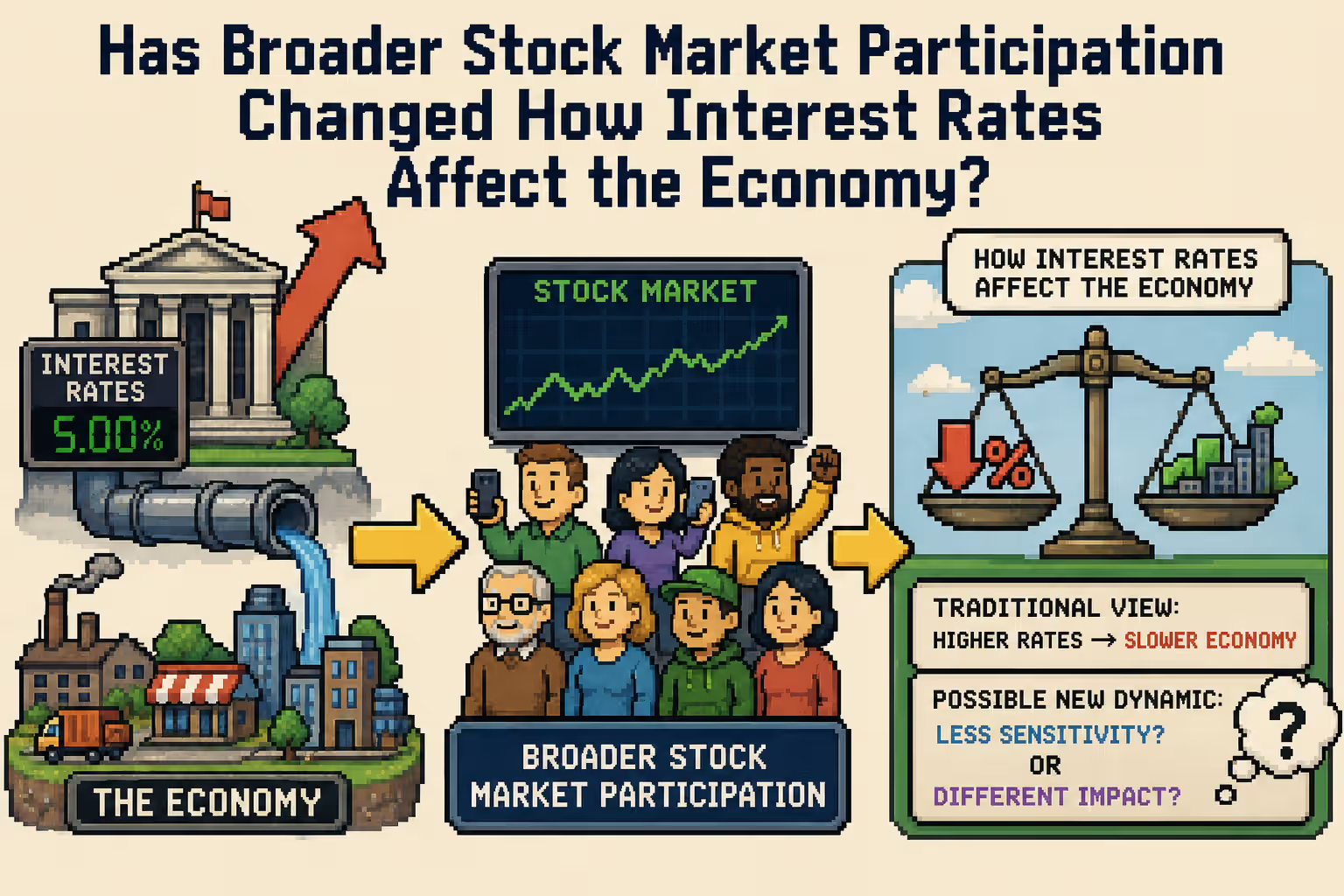
A "domestic" equity fund can carry a large China position without owning a single Chinese share, and the investors who absorb that risk worst are holding passive index funds. Research from the Federal Reserve Bank of New York and the University of Massachusetts Amherst, published on Liberty Street Economics on October 1, 2026, shows this. Export controls work like a tax on a supply-chain network rather than on individual companies. Index funds cannot step out of that network after a shock, and active managers can. The same study finds the market pays roughly 1 percent a month in abnormal returns to whoever holds the exposure anyway. Geoeconomic risk is therefore not a tail event to diversify away. It is a priced factor, and investors face a choice: hold it and collect the premium, or rebalance away from it and give the premium up.
How a Chinese Blacklisting Reaches a U.S. Portfolio
The transmission mechanism is plain once it is laid out. The Bureau of Industry and Security, part of the Commerce Department, can bar U.S. firms from selling specified technologies to named foreign entities. Since 2014 that tool has been used repeatedly in the U.S.-China technology contest, with semiconductors, telecommunications, artificial intelligence and advanced computing at the center.
When a Chinese customer is added to the list, its U.S. suppliers lose a revenue relationship, or at least the confidence that the relationship will last. The authors, Matteo Crosignani, Lina Han and Marco Macchiavelli, hand-collected the targeted Chinese entities. They then used FactSet Revere supply-chain data to identify the U.S. firms selling to them, and matched those suppliers to the monthly holdings of more than 5,000 domestic equity mutual funds in the CRSP database from 2010 to 2023.
The stock-level damage is clear. U.S. suppliers to newly targeted Chinese customers post a cumulative abnormal return of negative 3.6 percent around the announcement, measured against a Fama-French five-factor benchmark. Most of that decline comes in the first five trading days, which means the market reprices quickly and the loss is mostly locked in before a quarterly review could catch it.
The Diversification Intuition That Fails Here
The usual reasoning runs like this: international links help a domestic portfolio, because a shock in one foreign market hits only the few firms tied to it. The paper agrees that this holds for shocks specific to one country or one market. It fails when the shock is a policy aimed at a relationship many U.S. firms share.
An export-control action against one Chinese telecom or chip buyer can hit a set of U.S. suppliers that, on a sector map, look like separate businesses. Their shared exposure is the customer, not the industry code. Adding more domestic names does not dilute that exposure if the new names sell into the same Chinese demand. A fund can hold 150 stocks and still be making one concentrated bet.
The exposure is large. On average, 20.3 percent of domestic equity fund assets sit in U.S. firms with at least one Chinese customer. In science and technology funds the figure is 43.3 percent. Within those China-connected holdings, suppliers to newly targeted customers account for 8.4 percent of assets. Growth, industrial and mid- and small-cap styles all carry meaningful exposure as well, so this is not limited to technology-sector funds.
At the fund level, a one standard deviation increase in exposure to new controls (2.5 percent of the portfolio) is associated with a 22 basis point decline in monthly returns in the month of an event, along with higher volatility. That comparison is made within the same investment style and the same month, controlling for fund characteristics. It is not a technology-versus-value artifact. Funds that look alike on paper diverge because of a supply-chain variable their style label does not show.

The chart above shows broad context, not the study's own data. Semiconductors are where export controls have been aimed most often, and the chip complex is where a shared foreign-customer factor would be expected to separate from the broad market. The paper's figures come from its own supplier-level sample, and no claim is made here that the ETF path isolates the export-control effect.
Why Index Funds Take the Larger Hit
This is the most counterintuitive result in the paper. For the same one standard deviation exposure, passive funds lose 31 basis points a month against 22 basis points for active funds. In the following month, passive funds see outflows of about 0.35 percent of assets. Outflows from active funds are statistically insignificant.
The mechanism is structural. A passive fund tracks its benchmark, so it keeps holding the affected supplier through the selloff, and nothing in its mandate lets it reduce China-linked names before the next announcement. All of the rebalancing in the sample comes from active funds. Investors in passive funds appear to respond by leaving, which turns a return shock into a flow shock.
This changes a common assumption about passive exposure to policy risk. Index investing is usually described as giving up alpha in exchange for neutral market exposure. Here, "neutral" means fully exposed to a factor that active managers are trimming. The benchmark contains the supply-chain network, and the index fund has to keep all of it.
What Active Managers Gain, and What They Take On
Active managers do two things after an export-control announcement. They sell the directly affected suppliers, and that selling is still visible three months later. They also sell other China-linked U.S. firms that the current action did not touch.
The second behavior is the more informative one. Selling unaffected names means managers treat the announcement as information about the whole network, not as a one-off hit to a single company. The authors describe export controls as a possible wake-up call: managers find exposure buried in supply-chain links they had not mapped and reprice the entire cluster. A manager who expected the 3.6 percent drop to reverse would have held or added. The persistent selling indicates they did not expect a reversal.
That protection has costs. Exposed active funds later run more concentrated portfolios and tilt toward "lottery-like" stocks. The authors read this as managers taking extra risk to make up a performance gap and head off redemptions. A fund that sidesteps the geoeconomic loss can end up with a different and less transparent risk profile.
Skill also shows up in an unexpected place. Specialist managers and higher-fee funds suffer smaller declines after export-control shocks. Traditional market-timing and stock-picking ability does not predict better outcomes. The authors' interpretation is that the useful skill is the ability to map a policy action onto a firm's position in a global value chain. That is a research capability, built from supplier and customer data, and it differs from the factor-timing or valuation work that most active-management evaluation measures.
The Countercase: A Premium That May Not Survive
The pricing result points in the opposite direction from the rebalancing result, and the two need to be reconciled.
A long-short portfolio that buys firms previously exposed to export controls and shorts unexposed firms earns about 1 percent per month in abnormal returns after standard risk-factor adjustment. The authors read this as compensation: the market treats geoeconomic exposure as a lasting, priced risk and not a one-time headline.
Taken together, the findings say active managers sell exposed and China-linked names after shocks, and the exposed names then outperform. One possible link, which the paper does not establish and which is offered here as inference, is that the active selling helps create the premium by depressing prices of the exposed cluster below what its cash flows justify. If that is right, the managers protecting this month's returns may be giving up the next several months' returns.
Three points argue for caution about the premium before it is treated as harvestable:
- Sample period. The data end in 2023. Most of that window predates the broader tariff and export-control environment of 2025 and 2026. A premium measured in one policy regime may not hold in a more aggressive one, especially if controls broaden from individual entities to whole technology categories.
- Publication decay. Return anomalies in the academic literature often shrink after publication, once capital moves to exploit them. A 1 percent monthly spread is large enough to attract that capital.
- Risk versus mispricing. If the premium is true compensation for a non-diversifiable factor, it should show up as painful drawdowns when policy shocks cluster. A long-exposed book would earn the premium mostly in quiet periods and give much of it back in escalation phases. That is a reason for the premium, not evidence against it, but it makes the strategy difficult to hold for anyone with a short evaluation horizon.
The thesis that geoeconomic exposure is a priced, hidden factor in domestic portfolios is well supported by the stock, fund and sorting evidence together. It would weaken if a post-2023 sample showed the long-short spread falling toward zero while supplier announcement returns stayed near negative 3.6 percent. That combination would mean the risk remains but compensation for it has disappeared.
The Variable That Matters for Allocators
The authors' practical point is to look past where a stock is listed to where its revenue is earned. For allocators, that becomes a specific test: what share of a domestic fund's assets is in suppliers to Chinese customers, and does the fund's mandate allow it to respond when a customer is blacklisted?
For an index investor, the answer to the second question is no. The holder should know that the fund carries the full shock and does not rebalance. For an active fund, the useful diagnostic is not past alpha but evidence of supply-chain mapping, together with whether concentration and lottery-like holdings rose after past export-control events. Such an increase would indicate the manager covered the loss by taking on other risk.
The development to track is the breadth of future control actions. Entity-by-entity additions produce the clustered but manageable shocks the paper measures. Category-wide restrictions would hit the shared exposure across many suppliers at once, which is the case where domestic diversification gives the least protection.