The reason software multiples keep collapsing while the Rule of 40 holds steady is that the Rule of 40 is measuring a number that has quietly stopped me...
The reason software multiples keep collapsing while the Rule of 40 holds steady is that the Rule of 40 is measuring a number that has quietly stopped meaning what it used to mean. The median software company's Adjusted EBITDA margin and its actual operating margin have diverged to a record 12 percentage points, almost all of it stock-based compensation that gets added back to make the profitability number look intact. The market is not being irrational in derating these names from 4.7x sales in March to 3.2x now. It is repricing a margin structure that the headline metric was designed to hide.
What the Rule of 40 Stopped Measuring
The Rule of 40 works as a heuristic because it forces a trade-off: a company growing 40% can lose money and still clear the bar, while a slow grower has to be genuinely profitable. The number that carries the profitability half of that equation is usually Adjusted EBITDA margin. And Adjusted EBITDA has two escape hatches built into it.
The first is capitalized R&D. Companies have discretion over whether development spend runs through the income statement as an operating expense or gets capitalized onto the balance sheet and depreciated later. Anything capitalized never touches EBITDA, because EBITDA is earnings before depreciation by construction. That is why EBIT or EBITDA minus capex is the honest denominator for cross-company comparison. On this front, software is roughly clean. Median capex-to-sales sits slightly above the 2% to 2.5% range of the mid-2000s but well below the 5% peak of 2015 and 2016. Capitalized R&D is not where the distortion lives.
The second escape hatch is stock-based compensation, and this is where the story is.
Why the SBC Add-Back Is the Distortion
Adjusted EBITDA adds SBC back on the logic that it is not a cash cost. That logic is technically true and economically wrong. Stock compensation is one of the most reliable recurring costs a software company carries, and it resolves into cash one of two ways. Either the company issues the shares and existing holders absorb the dilution, or the company buys the shares back to hold the count flat and spends real cash to do it. There is no third door. The expense does not disappear because it did not clear the checking account in the period it was granted.
It also is not a one-time item. Granting equity to employees is an annual exercise, priced into the compensation package the same way salary is. Treating it as an adjustment to strip out is treating payroll as an adjustment to strip out.
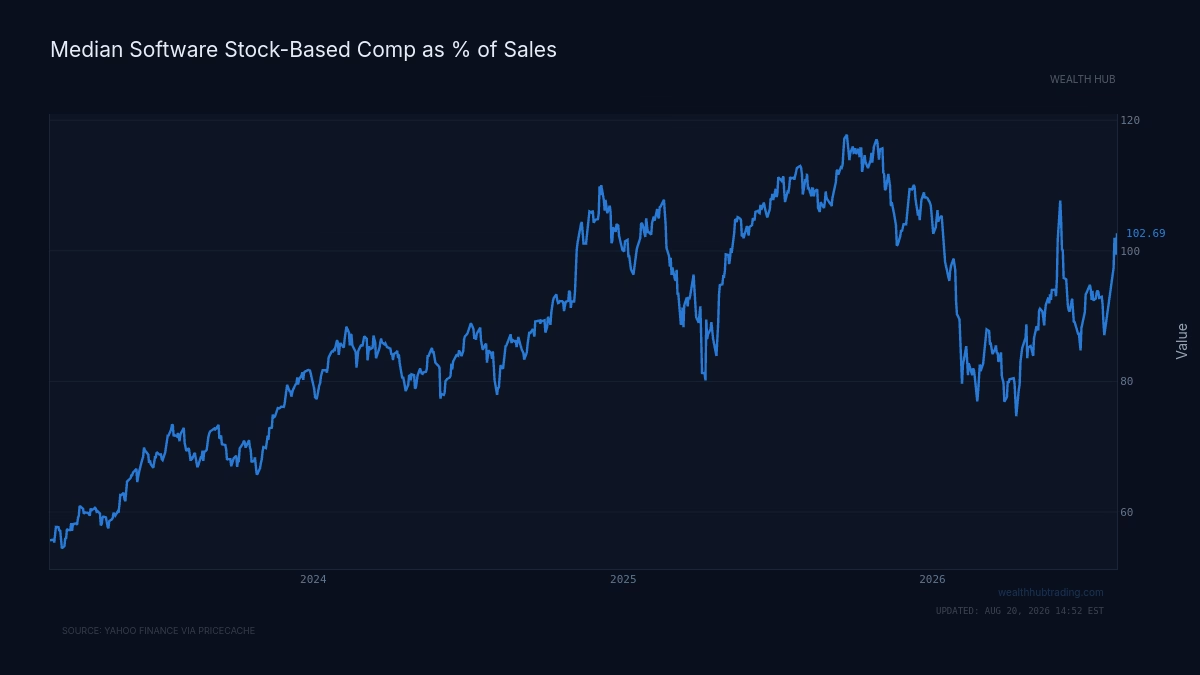
Here is the shift that matters. Since 2016, the median software company has raised its SBC rate from roughly 4% of sales to 9%. That is 500 basis points of margin that the Adjusted EBITDA line simply does not see. It is not that companies got less profitable in some abstract sense; it is that a growing share of the compensation bill migrated into a form the headline metric was built to ignore.
The 12-Point Gap and the 1% Truth
Put the two honest adjustments together, subtract capex and SBC from Adjusted EBITDA, and you get what is fairly called True Operating margin. Two things fall out.
Both the Adjusted number and the True number have been declining for years, so the derating is not purely a multiple story. But the gap between them has widened from as little as 4 points historically to a record 12 points today. The reported margin and the real margin are drifting apart, and the drift is accelerating.
The blunter fact: the median software company's True Operating margin is 1%. Not 15%, not the mid-single digits the Adjusted line might imply after you net out capex. One percent. The typical software business, measured on what it actually earns after paying its people in stock, is running at roughly breakeven.
Rebuild the Rule of 40 on True Operating margin instead of Adjusted EBITDA and the line gets steeper. Even after crediting these companies for their still-elevated growth, the profitability half of the score has deteriorated faster than the Adjusted version admits. The 34 that looks stable is stable because the metric anchoring it has been quietly inflating.
Where This Read Could Be Wrong
The cleanest objection is that SBC expense is not the same as SBC grants. The expense that hits the income statement is an amortized figure tied to grants made in prior periods, and it moves with the stock price through the way awards are valued and re-measured. A company whose shares ran hard will book a larger SBC expense without necessarily having handed out more equity. So some portion of that 4-to-9 climb since 2016 reflects a decade of rising software equity values rather than a genuine increase in the economic cost of new grants.
That is a real limitation, and the precise fix is to study actual new share issuance and grant activity rather than the amortized expense line. Doing that per name would sharpen the picture. But the direction survives the objection. Dilution and buybacks are the ultimate settlement of SBC regardless of how the expense is amortized, and a 500 basis point climb concentrated in the post-2016 window is too large and too persistent to be an artifact of valuation math alone. The read is directionally sound even if the exact magnitude wants a second pass.
What Would Change the View
The multiple compression from 4.7x to 3.2x reads less like a sentiment cycle and more like the market slowly refusing to pay for margins it has decided are partly fictional. If that is right, the derating does not end when growth reaccelerates. It ends when the reported margin and the real margin converge, which happens either when SBC as a share of sales stops climbing and starts falling, or when the gap between Adjusted EBITDA and True Operating margin narrows back toward its historical 4 points.
That is the observable condition to track. Watch the SBC-to-sales trend at the median, not the Rule of 40 headline. The names worth separating out are the ones whose True Operating margin already sits well above 1% and whose stock comp is flat or shrinking as a share of revenue, because those are the businesses the derating is mispricing rather than correctly punishing. Until the gap starts closing, a 34 on the Rule of 40 is a number to distrust, not a floor to buy.