Europe's rearmament is being scored on the wrong axis. The headline number in every capital is the budget, the share of GDP pledged to defence. A readiness framework developed by D'Artis Kancs of the Latvian National Armed Forces shows why that number can mislead. In his framework, readiness is the minimum of four capacities, not their total. Fiscal space is one of the four. A country that triples its budget while its factories, supply chains or logistics stay fixed will mostly buy higher prices, not more fighting power.
The point matters because Europe's political commitment is now large and dated. At the June 2025 Hague summit, NATO allies agreed to move toward 5% of GDP by 2035, with 3.5% for core defence and 1.5% for wider security spending. That target is entirely a demand-side instrument. Whether the continent becomes more prepared depends on whether supply can respond. The Kancs index is built to ask that question.
Four Capacities, One Chain
Kancs scores European countries on four dimensions:
- Macroeconomic capacity: can a country finance and absorb a defence expansion?
- Sectoral resilience: can its economy keep producing under disruption?
- Defence-industrial capability: can higher demand become higher output, or do capacity and supply-chain limits get in the way?
- Logistics and sustainment: can it replace usable capacity once that capacity is damaged or destroyed?
The analytical move that makes the index useful is the idea of a binding constraint. The framework does not just average the four scores. It asks where the chain breaks first. Production economists call this a Leontief structure. Output is capped by the scarcest input, and adding more of an input that is already plentiful raises cost without raising output.
Intuition fails here. The public debate treats defence spending like a dial: turn it up and readiness rises in proportion. Under a weakest-link structure, that holds only for countries whose binding constraint is fiscal. Elsewhere, extra money flows into a bottleneck. It shows up as order backlogs, longer delivery times and unit-price inflation for the same shells, vehicles and air-defence interceptors.
Kancs groups the countries into five blocs: the Nordics (Denmark, Finland, Iceland, Norway, Sweden); the Baltic-Polish Flank (Estonia, Latvia, Lithuania, Poland); the Industrial Core (Belgium, Czechia, France, Germany, Luxembourg, the Netherlands, Slovakia, the UK); the South-West Med (Italy, Portugal, Spain); and South-East Europe (Albania, Bulgaria, Croatia, Hungary, Montenegro, North Macedonia, Romania, Slovenia). His table assigns a binding constraint to each bloc. The underlying scores are not reproduced here, so the regional reading below is an inference from the framework and from public facts about each bloc, not a restatement of his results.
Why the Constraint Moves Across the Map
The useful insight is that the binding constraint differs by bloc, and a single GDP target treats every bloc the same.
Take the Baltic-Polish Flank. On spending, it is Europe's most committed bloc. Poland has pushed defence outlays above 4% of GDP, and the Baltic states have pledged levels well above the old 2% floor. For these countries, the fiscal link looks like the least likely place for the chain to break. The more plausible constraints sit downstream. Their domestic defence-industrial bases are thin relative to their purchases, so much of the money goes to foreign suppliers whose order books are already full. Their position on the front line also makes logistics and sustainment, the ability to replace losses under fire, the dimension a real test would hit first. For the flank, another percentage point of GDP may do less for readiness than a guaranteed production slot at a German or Korean munitions plant.
The Industrial Core faces close to the reverse problem. Germany, France, the UK and Czechia hold much of Europe's defence-industrial capacity, so the conversion link is comparatively strong. The pressure falls on public finances and the political willingness to use them. Germany changed its constitutional debt brake in March 2025 to exempt defence spending above 1% of GDP, in effect admitting that the fiscal link had been binding. France, with a large deficit and fragile parliamentary majorities, lacks that room. For parts of the Core, then, money really is the scarce input, and the GDP target is the right lever.
The South-West Med bloc is furthest from the threat and has been the most openly reluctant. Spain publicly resisted the 5% target in 2025. That reluctance reads as a political ceiling on the macroeconomic link rather than a capacity shortfall, which is a different binding constraint from the flank's industrial one and needs a different remedy.
The Nordics and South-East Europe complete the picture. Finland and Sweden kept conscription-based territorial defence through the post-Cold War drawdown, which suggests sustainment depth that most of the continent lost. South-East Europe combines smaller economies, lighter industrial bases and long supply lines. That bloc is the most likely to be constrained on several links at once, and spending alone cannot fix that.
Evidence That Money Hits a Bottleneck
Europe has already run a live test of the weakest-link mechanism. The EU pledged to deliver one million artillery shells to Ukraine by March 2024 and fell well short of that deadline. Political will was present and the funding was approved. What failed was the conversion link: propellant, explosive filler, shell casings and qualified labour could not be scaled on a political timetable. Budgets moved within months. Factory output took years.
Equity markets have priced the demand side of this story, not the supply side. European defence shares rerated sharply once rearmament became policy, as the trajectory of the main US-listed European aerospace and defence fund shows.
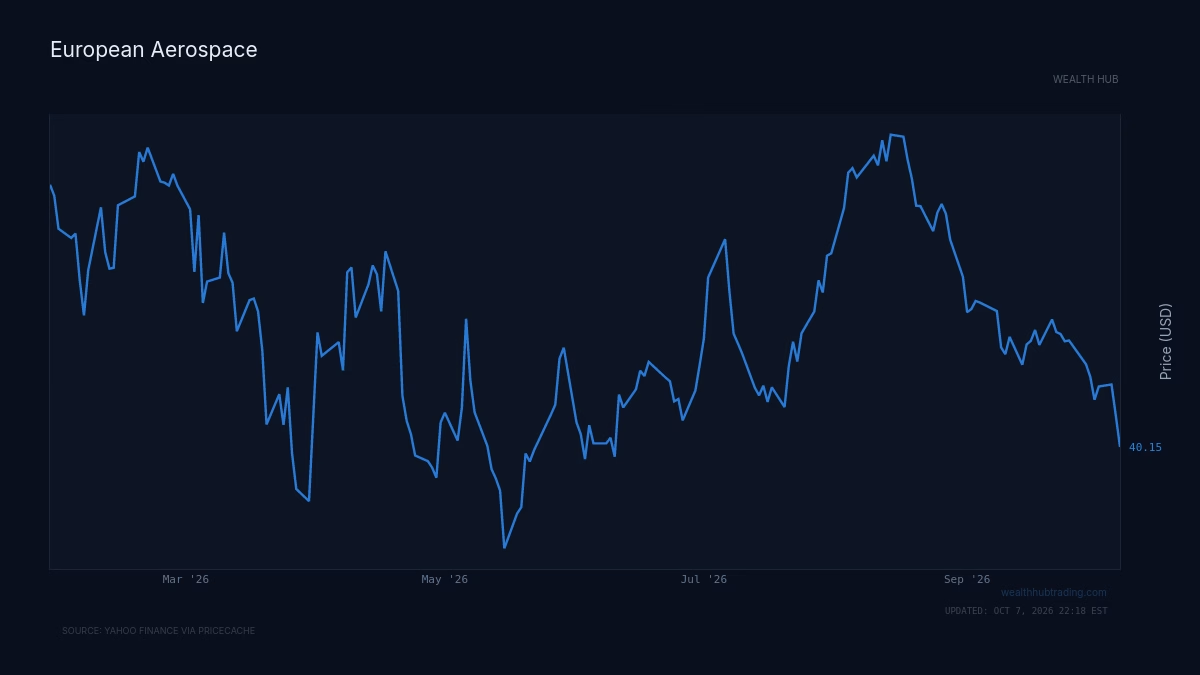
The Kancs framework adds a nuance to that rerating. If the binding constraint for much of the continent is industrial or logistical, the gains from higher budgets go mainly to whoever owns the bottleneck, not to defence contractors evenly. A firm with spare propellant or energetics capacity gains pricing power. A firm whose limit is a single-source subcomponent gains a longer backlog and little more. The market has largely treated defence as one theme. The framework suggests it should be treated as a set of distinct supply chains, with the scarcest one capturing the economics. This read is ours. It extends the framework's logic and is not one of its stated findings.
There is also a second-order cost. When demand rises against a fixed supply, real readiness per euro falls. A government that doubles its procurement budget into a market already at capacity may see delivered volumes rise much less than the headline figure suggests. Parliaments measure inputs, but deterrence depends on outputs. The gap between the two is the procurement inflation the weakest-link structure predicts.
The Case Against Reading the Index Too Literally
Three objections deserve a direct answer.
First, binding constraints are not fixed. Sustained spending is precisely what relaxes an industrial constraint over time. Rheinmetall's new munitions plant at Unterlüß, opened in 2025, is the textbook case: budget certainty financed capacity that did not exist two years earlier. On a horizon of five to ten years, money does reach the other three links. The weakest-link critique is strongest over the next few years and weakens over the decade-long schedule of the NATO target. A Russian test of resolve, though, would not wait for the factory schedule.
Second, composite indices embed judgment. Choosing four dimensions, grouping 28 countries into five blocs, and weighting indicators within each dimension are all modelling decisions. A different grouping, for instance Poland separate from the Baltics or the UK outside the Industrial Core, could change which constraint binds. The index tells you where to look. It does not prove where the chain will break.
Third, the threat is not continental. The most plausible Russian test is limited and local: hybrid pressure, a border incident, or a contested move against a Baltic state. In that case, Europe's aggregate readiness matters less than how fast the Industrial Core's capacity can be moved to the flank. That makes logistics and sustainment, the fourth dimension, the decisive link for the scenario the source itself treats as most likely. This objection does not weaken the framework. It sharpens it, by naming which link matters most.
What Would Show the Chain Is Strengthening
The thesis comes down to one measurable gap: delivered military output against appropriated money. If Europe's readiness is improving, the continent's delivered volumes (shells per year, air-defence interceptors per year, armoured vehicles accepted into service) should grow roughly in line with budgets, and unit prices for standard munitions should stabilise. That would mean the industrial and logistics links are keeping pace with the fiscal one.
If budgets rise while delivered volumes lag and unit prices climb, the weakest-link reading holds. Europe would then be using money to bid against itself for fixed capacity, and the flank countries spending the most would be among those gaining the least readiness per euro.
How prepared Europe is for war is therefore not a single question. For the Industrial Core, the answer depends on fiscal will. For the Baltic-Polish Flank, it depends on factory slots and supply lines. For the continent as a whole, it depends on whether output, rather than the budget line, starts to move.