The Megawatts Are Not the Scarce Asset
Ottawa's C$10 billion commitment to Churchill Falls and Gull Island is being read as a clean-energy megaproject. The better reading is that the federal government is paying for a negotiating position. Labrador's binding constraint has never been water, turbines, or capital in the abstract. It is the lack of a realistic path to market that does not cross Québec, a province whose governments still do not formally recognize the 1927 boundary that put Churchill Falls in Newfoundland's hands.
The strongest observation is the asymmetry built into the existing station. Churchill Falls has 5.4 gigawatts of nameplate capacity, in a region whose onshore population is about 27,000. Local demand is a rounding error against that output. Electricity that cannot leave Labrador is worth almost nothing, and that fact, more than any failure of negotiating skill in 1969, explains why the majority of the station's output still flows to Hydro-Québec at 0.2 Canadian cents per kilowatt-hour under a contract that runs to 2041.
Newfoundland signed that deal because it had no other exit. Québec declined to grant transit rights across its territory, so the only buyer for Labrador power was the province that owned the only route out. Five decades later, the geography is unchanged. A C$70 billion program to upgrade Churchill Falls and build Gull Island adds generation on the same side of the same chokepoint. Unless the transmission question is settled alongside the price question, the expansion enlarges the asset Hydro-Québec can bargain over rather than the leverage Newfoundland can bargain with.
A 1969 Price on a 2026 Service
The contract looks absurd measured against wholesale power prices. It looks more absurd measured against what the power actually does.
Impoundment hydro is not just cheap energy. It is dispatchable energy: reservoirs can hold water when wind and solar output is high and release it when output collapses. That balancing function is the scarcest commodity in a grid that is adding intermittent supply, and it is exactly what the Northeast US buys when it imports Québec hydro. The source makes the point directly: solar and wind installations in the US Northeast rely on the dispatchability of the dams to their north. Part of what New England and New York are buying, then, is firming capacity that traces back, through Hydro-Québec's system, to a reservoir priced at a 1969 cost.
That reframes who the counterparties to a renegotiation really are. Raising the Churchill Falls price is not only a transfer from Québec to Newfoundland. It compresses the margin Hydro-Québec earns between what it pays for Labrador output and what it charges export customers, and over time some of that compression has to land somewhere: in Québec's provincial dividend, in export contract pricing, or in the value Northeast buyers assign to imported firming power. The new lines designed to carry Québec hydro into New York City and New England make that exposure more concrete, because they deepen the US dependence on a supply chain whose cheapest link is now openly contested.
This is why the spot-price frame misses the story. The market consequence of Churchill Falls is not a change in the marginal megawatt-hour in Ontario or New England next quarter. It is the repricing of a balancing service that has been effectively subsidized for half a century, with 2041 as a hard deadline that ends the subsidy whether anyone negotiates or not.
Why Québec Holds the Switch
The December 2024 memorandum of understanding between the two provinces was the closest they came to a fix. It did not become a binding agreement and expired in April 2026, stalled by politics. Carney's intervention is an attempt to change the arithmetic that killed it: if the pie grows large enough, each side can claim a win, and Newfoundland can secure a fairer price while Québec secures a share of new output.
The federal money matters because it targets the part of the problem neither province can solve alone. Newfoundland cannot easily finance a project of this size on its own balance sheet, and Québec has little reason to pay up for a price reset on power it already receives cheaply until 2041. Federal backing lowers the cost of capital for the new build and gives both provincial governments political cover to accept terms they could not defend on their own.
What the federal money cannot do is move the border or the wires. Any Gull Island output destined for large markets still needs a route, and the high-capacity route runs through Québec's grid. The smaller southern path, from Labrador to the island of Newfoundland and onward to Nova Scotia, exists but was built around the far smaller Muskrat Falls project and is not sized for multi-gigawatt exports. So the decision variable in this file is a transmission and access agreement with Hydro-Québec, written into binding terms, not the size of the cheque.
The source's paywalled section goes on to argue that Carney's broader energy and minerals push reveals a deeper agenda. The details of that argument are not available here, and the terms of any federal arrangement with the provinces have not been published in what is quoted. The constraint-first reading does not depend on them.
The Muskrat Falls Problem
The strongest counterargument comes from Labrador's own recent history. Muskrat Falls, the province's last hydro megaproject on the lower Churchill River, saw its cost roughly double from the figure at sanction to more than C$13 billion, and the overrun became a fiscal crisis for Newfoundland and Labrador and a source of electricity-rate pressure for its residents. A C$70 billion program is about five times larger, in the same harsh terrain, with labour, equipment, and transmission supply chains that are tighter now than they were a decade ago.
That history cuts in two directions. It is the best evidence for the critics, cited in the source, who are convinced none of this will come to pass. It also explains why the federal government is putting its own capital at risk: no provincial treasury that lived through Muskrat Falls can absorb another overrun of that scale.
Capital intensity is visible even in the province's listed utility layer. Fortis, the parent of Newfoundland Power and the most liquid listed name tied to the province's electricity system, has spent its recent fiscal years investing more than it generates from operations. To be explicit about the link: Fortis has no disclosed role in Churchill Falls or Gull Island. The chart below is offered as context for how capital-hungry regulated grid investment already is in this market, not as a proxy for the project's economics.
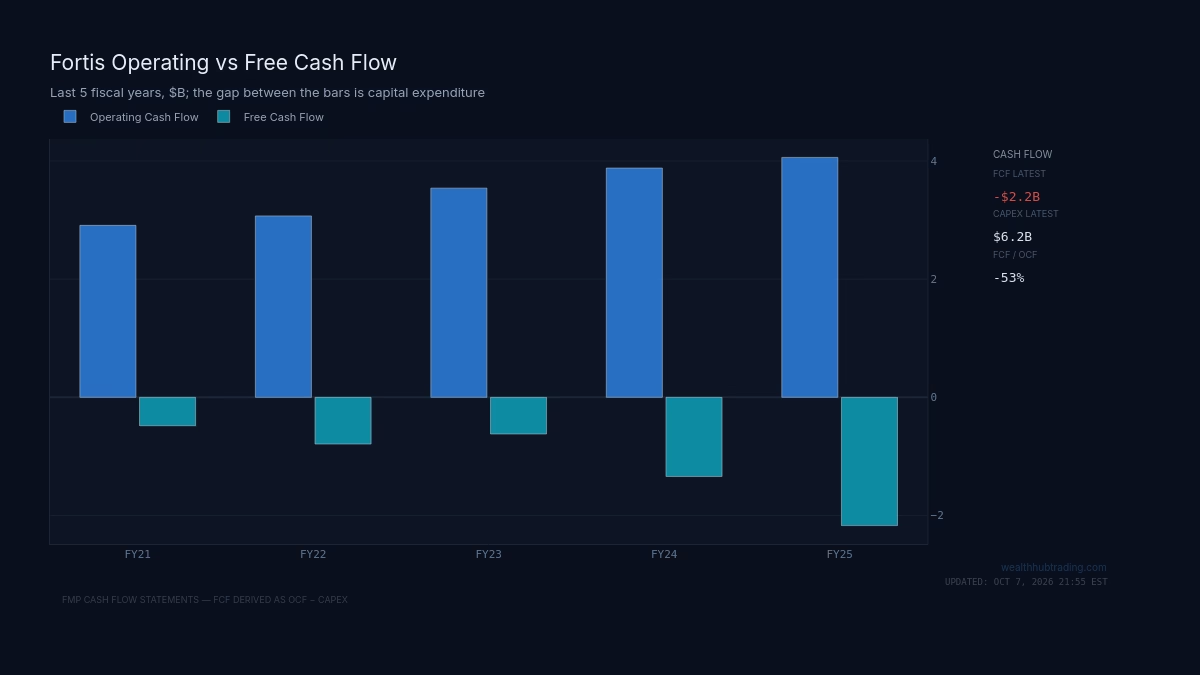
The direct equity route into this story is thin. Hydro-Québec and Newfoundland and Labrador Hydro are Crown corporations, and Churchill Falls (Labrador) Corporation is owned by the two of them. Investors looking for exposure are left with second-order bets on construction, high-voltage transmission equipment, and Northeast power buyers, and each of those links would need project-level confirmation before it carries a position.
What Would Prove the Skeptics Right
The thesis breaks in three identifiable ways.
The first is time. The 2041 expiry gives Newfoundland the option of simply waiting for the contract to lapse, at which point it reclaims the output without conceding anything. If St. John's concludes that waiting beats any deal Québec will offer, the federal money becomes an expensive gesture. Québec's incentive runs the other way, since its cheap supply ends in 2041 regardless, which is precisely the pressure a good negotiator on Newfoundland's side would exploit by slowing down.
The second is Québec's politics. A government in Québec City that treats the Labrador border as unsettled, and that has electoral reasons to resist anything resembling a federal intervention in provincial energy, can block the access agreement indefinitely. Carney's framing of the project as a national response to US trade threats helps in Ottawa and may hurt in Québec.
The third is execution. A binding deal that then runs years late and billions over budget would repeat Muskrat Falls at larger scale and discredit the broader resource agenda the source describes.
The Signal Is in the Wires
The confirmation that this is real will not arrive as a funding announcement. It will arrive as a binding agreement between Newfoundland and Labrador Hydro and Hydro-Québec that covers three things together: a reset Churchill Falls price before 2041, a defined split of Gull Island output, and transmission or access terms that let new Labrador power reach markets on predictable conditions. An agreement that settles price without settling access would leave the original 1969 asymmetry intact on a bigger asset.
If that document appears, the more important market consequence lands south of the border, where the cost of Québec-sourced firming power for New England and New York would begin to reflect a price that has been suppressed for more than fifty years. Until it appears, the C$10 billion is best understood as Ottawa buying a seat at a negotiation that geography, not money, will decide.