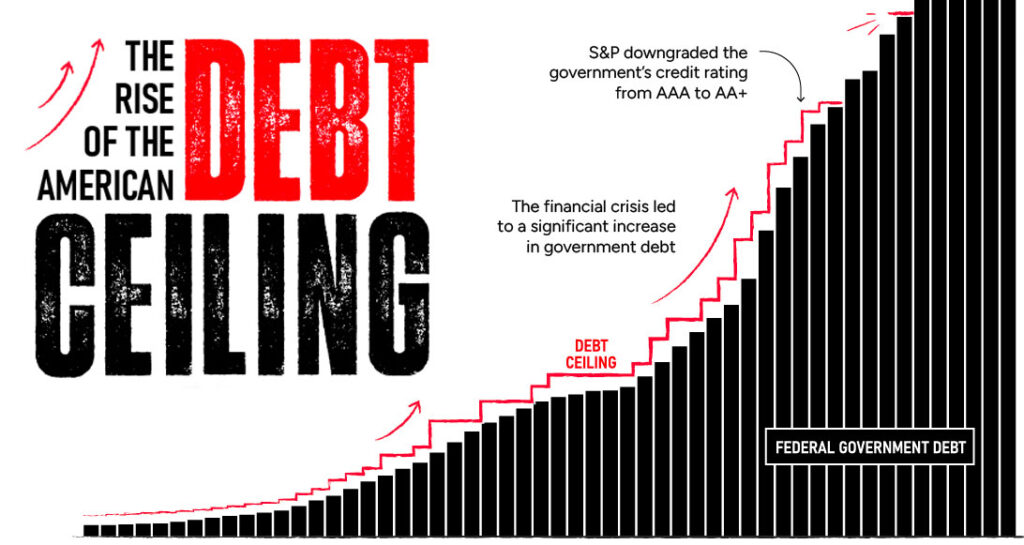
In the summer of 2023, the United States came within days of exhausting its ability to pay bills, and the resolution that everyone cheered as a relief actually set up the tighter part of the episode. Once Congress suspended the ceiling in early June, the Treasury did not simply relax. It rushed to rebuild its checking account, issuing over a trillion dollars in new bills within a few months. That rebuild pulled cash out of the financial system faster than most investors expected, and it happened right after the standoff that had dominated headlines was declared over.
The lesson from that episode is the one most people invert. The dangerous phase for market liquidity is often not the standoff itself. It is the aftermath.
The account at the center of it all
The Treasury General Account, or TGA, is the federal government's checking account, held at the Federal Reserve. Every dollar the government collects in taxes and every dollar it raises by selling debt flows into this account, and every dollar it spends flows out of it. Think of it as the single balance from which all federal payments are drawn.
The critical detail is where this account sits. Because the TGA is held at the Fed rather than at a commercial bank, moving money into or out of it changes the total amount of reserves in the banking system. Reserves are the cash that commercial banks hold at the Fed, and they are the raw fuel for lending, market-making, and short-term funding.
When the TGA balance falls, that cash leaves the government's account and lands in the banking system as reserves. When the TGA balance rises, reserves drain out of the banking system and into the government's account. The total pool of money is roughly fixed in the short run, so the TGA and bank reserves move like two ends of a seesaw.
What this means for you: watching the weekly TGA balance tells you whether Treasury is adding liquidity to the private system or pulling it away, independent of anything the Fed is doing with its own policy rate.
Why the debt ceiling reverses the flow
A debt ceiling is a statutory cap on how much the Treasury can borrow. When the government bumps against that cap, it loses the ability to issue net new debt, and this is where the mechanism gets counterintuitive.
Blocked from borrowing, Treasury still has to pay for everything Congress has already authorized: Social Security, defense contracts, interest on existing debt. It funds these obligations by drawing down whatever cash it already holds. So the TGA balance falls, sometimes sharply, over the weeks and months of a standoff.
Recall the seesaw. A falling TGA means cash flowing out of the government's account and into the banking system. During the tense weeks when the ceiling is binding, bank reserves are actually rising. Liquidity is being injected into the private financial system precisely while the news cycle is fixated on the risk of default.
This is the first place intuition fails. The market's mood during a standoff is dominated by fear of a missed payment, an event that has never actually occurred and would be resolved politically within hours if it ever threatened to. Meanwhile, the mechanical reality underneath is a steady liquidity tailwind. Asset prices often grind higher through the worst of the rhetoric, and commentators struggle to explain why stocks seem to ignore the crisis.
What this means for you: the liquidity backdrop during a binding debt ceiling is usually supportive, not threatening, because Treasury is spending down its cash buffer into the banking system.
The rebuild is the real event
The resolution flips everything. Once Congress raises or suspends the ceiling, Treasury is legally free to borrow again, and it does so with urgency because its cash cushion has been run down to an uncomfortably low level.
The rebuild works by issuing a wave of Treasury bills, which are short-term government debt securities. Investors, money market funds, and banks buy those bills, and the cash they pay flows straight into the TGA. On the seesaw, a rising TGA drains reserves out of the banking system. The liquidity that was quietly supporting markets during the standoff now reverses, often over a compressed window of weeks.
The 2023 case makes the scale concrete. After the June suspension, the TGA was rebuilt from a few tens of billions toward roughly $750 billion by autumn, a swing that required issuing an enormous volume of bills in a short period. Much of that drain was absorbed by the Fed's reverse repo facility rather than by bank reserves directly, which cushioned the blow that year. That cushion is not guaranteed to exist in the next episode.
The danger, when it materializes, is not default. It is a sudden tightening of funding conditions right after the political all-clear, when investor attention has already moved on.
What this means for you: the window to watch for a liquidity headwind opens the day the ceiling is resolved, not the day it becomes binding.
When the mechanism does not bite
The TGA drain does not always translate into market stress, and understanding the exception is as important as understanding the rule.
The effect on markets depends on where the system starts. When bank reserves are abundant, a TGA rebuild pulls cash from a large surplus and funding markets barely notice. When reserves are already scarce, the same rebuild can push short-term funding rates sharply higher and force awkward selling. The September 2019 repo spike, when overnight rates briefly jumped toward 10 percent, showed how quickly a reserve shortage can turn into a funding accident, though that episode had multiple causes beyond the TGA.
The reverse repo facility is the other release valve. When money market funds hold large balances at the Fed's reverse repo window, a bill-issuance wave can be absorbed by draining that facility instead of bank reserves. That is exactly what dampened the 2023 rebuild. As reverse repo balances shrink toward zero, that buffer disappears, and the next rebuild lands more directly on reserves.
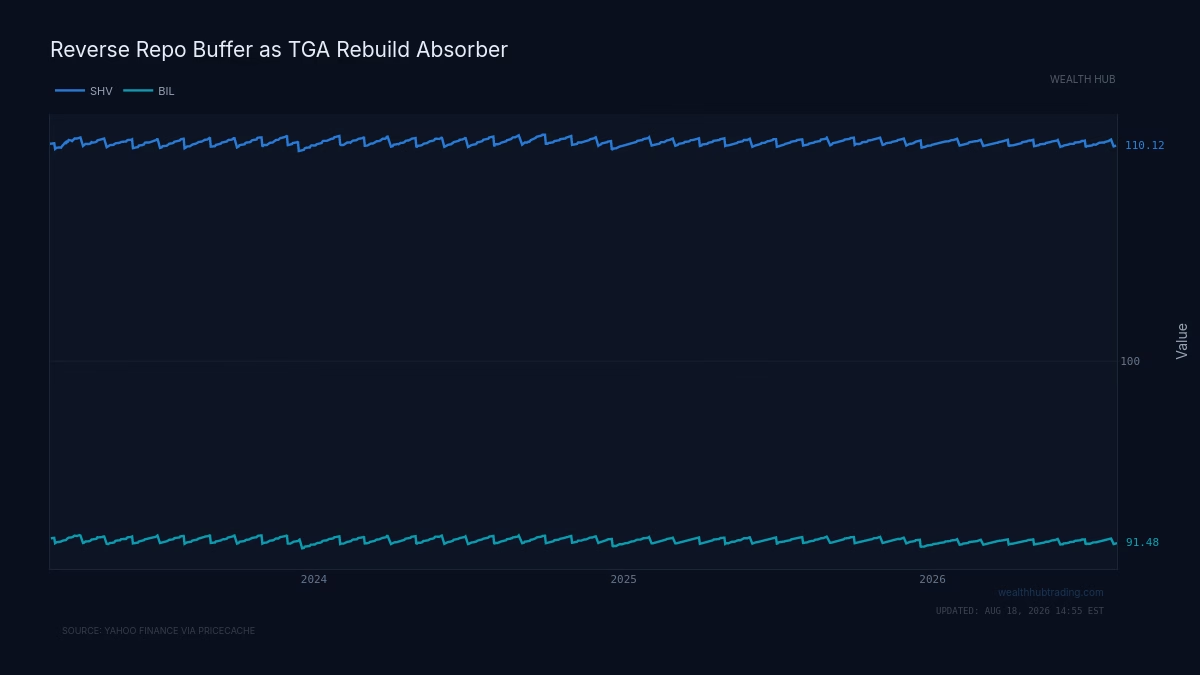
What this means for you: the same TGA rebuild is nearly harmless in a high-reserve, high-reverse-repo environment and genuinely disruptive in a drained one, so you must check the starting conditions before assuming the outcome.
Reading the next standoff
The mechanism connects three balances that most coverage treats as unrelated: the TGA, bank reserves, and the reverse repo facility. Money moves between them in a closed loop, and the debt ceiling is simply the switch that determines the direction of flow.
During a binding ceiling, cash flows from the TGA into reserves, and the liquidity backdrop supports risk assets even as the headlines scream default. After resolution, cash flows from reserves back into the TGA through a flood of bill issuance, and the liquidity backdrop turns hostile even as the headlines celebrate the deal. The market's genuine vulnerability sits on the far side of the resolution everyone was waiting for.
The debt ceiling whipsaws liquidity because it forces Treasury to first spend down and then rapidly refill the single account that sits opposite the entire banking system on the liquidity seesaw; the practical edge comes from watching the cash mechanics rather than the default odds.