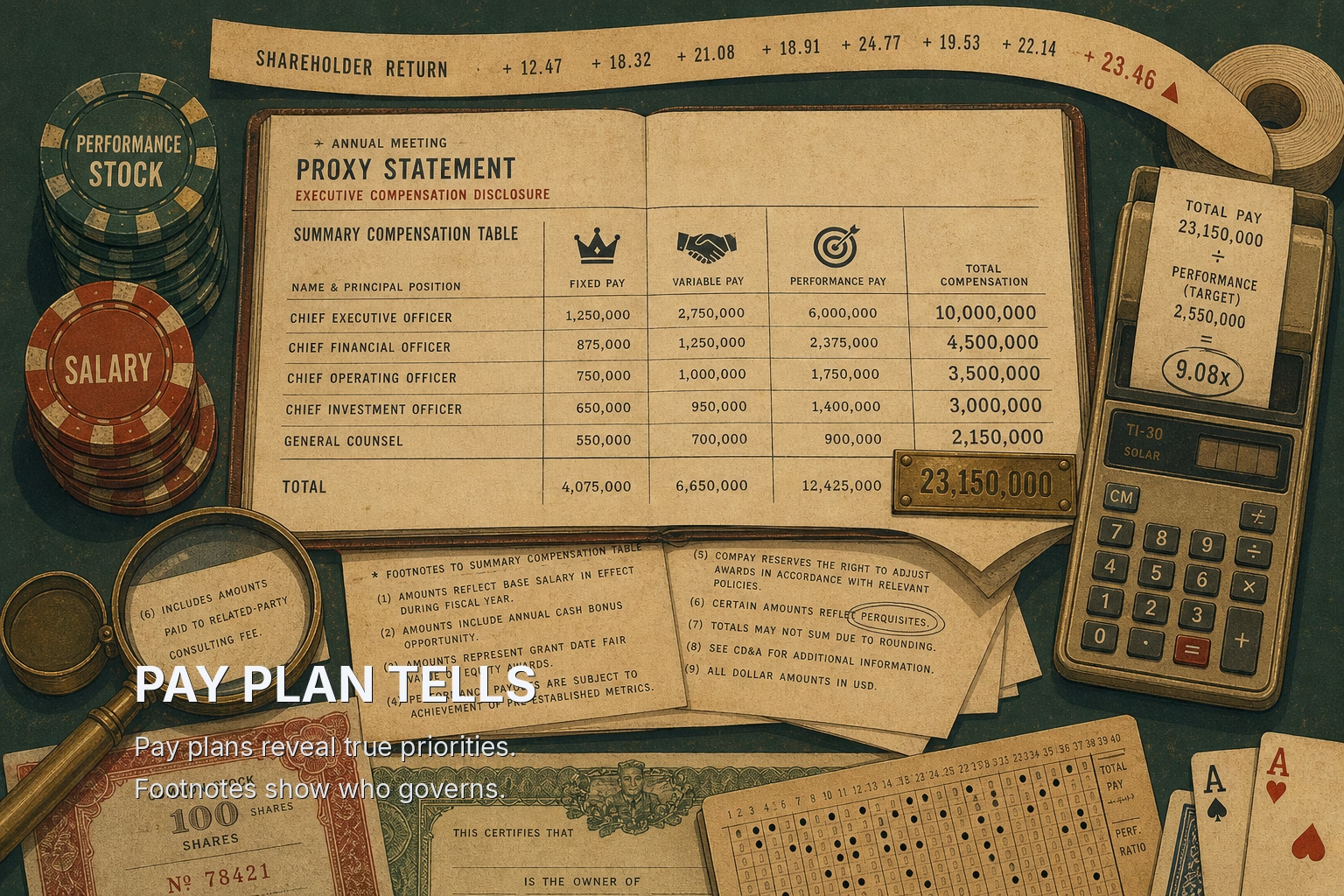
The most honest statement of strategy a public company publishes is the compensation section of its proxy statement, not its investor-day deck. Tesla's 2018 proxy materials spelled out a growth-at-scale mandate in plain numbers, years before a Delaware court spelled out the governance problem underneath it.
The Tesla award that told you the strategy in 2018
In early 2018 Tesla asked shareholders to approve a performance award for Elon Musk built from twelve tranches. Each tranche vested only when two conditions were met. The first was a market capitalization milestone, starting at $100 billion and stepping up in $50 billion increments to $650 billion. The second was an operational milestone drawn from a list of revenue and adjusted EBITDA targets. Shareholders approved it.
Read the scorecard and notice what is absent. There was no return on invested capital, no free cash flow target, no margin floor. The board had written down, in a binding contract, that it would pay its chief executive for size and for the stock price. Whatever the earnings calls said about efficiency, the incentive pointed at scale.
The second half of the story arrived in January 2024. In Tornetta v. Musk, Chancellor Kathaleen McCormick of the Delaware Court of Chancery ordered the award rescinded. She found that the directors who negotiated it, several with long personal and financial ties to Musk, had not bargained at arm's length, and that the proxy given to shareholders did not adequately disclose those conflicts or how the deal was struck. Shareholders voted to ratify the award again in June 2024, Tesla reincorporated in Texas, and the litigation moved on to appeal. The governance lesson does not depend on how the appeals end. The metrics revealed the strategy, and the board's relationships revealed who was setting the terms.
What this means for you: the compensation scorecard is a forecast of management behaviour, and it is far more reliable than guidance language because someone gets paid on it.
Why the metric choice is the real strategy
The Compensation Discussion and Analysis (CD&A) is the narrative section of the proxy where the board explains what it paid executives and why. Inside it sits the list of performance metrics, the measurable targets that determine how much of the bonus and equity award actually pays out.
Here is the mechanism. Executives allocate capital toward whatever the metric rewards. A plan paying on revenue growth and adjusted EBITDA rewards acquisitions, price cuts that buy volume, and capacity additions, because all of them raise the top line. Whether the new capital earns its keep never enters the calculation.
A worked example makes the gap visible. Suppose a company invests $10 billion to add $2 billion of revenue, and the new business earns an 8% after-tax return on that capital. Its cost of capital is 10%.
Economic profit = invested capital × (return on capital − cost of capital)
$10B × (8% − 10%) = −$200 million per year.
The revenue metric pays at maximum. The shareholder loses $200 million a year in value relative to simply returning the cash. The proxy told you this would happen the moment it chose revenue over returns.
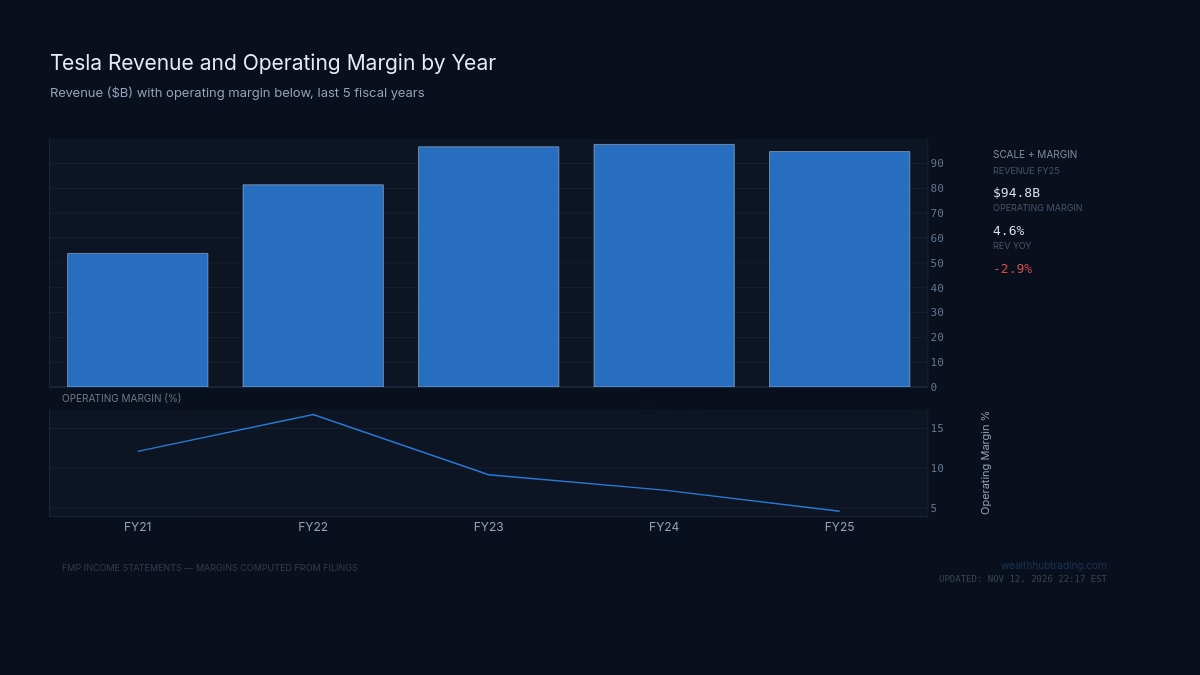
Tesla's own filings illustrate the tension. Annual operating margin fell from roughly 17% in 2022 to under 10% in 2023 after aggressive price cuts, while revenue kept climbing. A growth scorecard registers that year as progress. A returns scorecard would have flagged it.
What this means for you: find the metrics table in the CD&A, then ask whether any metric would penalise management for investing below the cost of capital. If none would, assume the company will grow first and justify the returns later.
The peer group as a quiet thumb on the scale
Boards set pay by benchmarking against a compensation peer group, a list of companies the board considers comparable for talent and size. Most committees target pay near the median of that group. The selection of peers therefore sets the pay level before any performance is measured.
The red flag is a peer group that skews larger than the company itself. Take an illustrative case. A company with $5 billion of revenue picks twelve peers whose median revenue is $10 billion. Executive pay scales with company size, so the peer median is inflated, and "paying at the median" quietly delivers pay suited to a firm twice as large. When every board in an industry does this, pay ratchets up across the sector year after year, since each company's median becomes the next company's benchmark.
A related tell is peer-group churn. If the CD&A shows companies dropped and added from one year to the next, check whether the departures were smaller or underperforming firms. A peer group that keeps getting bigger and better-performing raises the bar for comparison only on pay, never on results.
The pay-versus-performance table, required by the SEC since rules adopted in 2022, lets you test this directly. It reports "compensation actually paid" alongside the company's total shareholder return and a peer index return, plus one company-selected measure. That company-selected measure is the single metric the board considers most important, a short confession of priorities.
What this means for you: compare the company's revenue and market value with the peer medians disclosed in the CD&A; a gap of more than double deserves an explanation in the text, and the absence of one is itself informative.
Pledged shares and the margin-call channel
Insider ownership is usually treated as alignment. The footnotes to the beneficial ownership table can turn that reading upside down. Under SEC rules, companies must footnote shares that directors and officers have pledged, meaning used as collateral for a personal loan.
Pledging separates the executive's economic exposure from the shareholder's. The insider has borrowed against the stock, so a falling price triggers a margin call, a lender's demand for more collateral or repayment. If the insider cannot meet it, the lender sells the shares into a falling market.
Chesapeake Energy in 2008 is the cleanest case. Co-founder Aubrey McClendon had borrowed heavily against his stock, and in October 2008 margin calls forced the sale of nearly all of his stake as the share price collapsed. Within weeks the board awarded him a large bonus and agreed to buy his personal collection of antique maps for $12.1 million. One proxy cycle exposed both risks at once: a pledged stake that became forced selling, and a related-party purchase that moved company cash to the chief executive.
Tesla's filings have also disclosed that Musk pledged a portion of his shares as collateral, and the company has listed that pledge among its risk factors. Pledging is not proof of bad faith. It is a mechanical source of selling pressure at the worst possible moment, and it gives a large holder a personal reason to care about the next quarter's price more than the next decade's cash flow.
What this means for you: read every footnote to the ownership table, note the pledged share count, and treat a large pledge by a controlling holder as a latent supply of stock that arrives during drawdowns.
Related-party seats and who the board answers to
Item 404 of Regulation S-K requires disclosure of related-party transactions, any deal above $120,000 between the company and a director, officer, major holder, or their family members. Leases on buildings the founder owns, purchases from a director's other company, consulting fees paid to a relative: all of it lands in a section often titled "Certain Relationships and Related Transactions."
The section matters less for the dollar amounts than for what it says about the board. A director who sells services to the company, or who sits on the boards of the chief executive's private ventures, is formally independent under exchange rules in many cases but practically conflicted. The Tesla ruling turned on exactly this distinction: directors who met the listing standards for independence were still found too close to Musk to bargain against him.
Cross-reference three places. The director biographies list other board seats and prior business ties. The related-party section lists current transactions. The compensation committee roster names who set the pay. When the same names appear in all three, the people negotiating the chief executive's pay have reasons to keep him happy.
What this means for you: map the compensation committee members against the related-party section and the biographies; overlap there is a stronger warning than any single transaction.
The economic machinery behind captured boards
Why does any of this happen when directors have a fiduciary duty to shareholders? The answer is a set of incentives that run the wrong way.
Directors are typically nominated with management's input and paid by the company they oversee. Re-nomination depends partly on staying collegial with the chief executive. Compensation consultants, hired to benchmark pay, often have other business with the same company and gain little from recommending lower pay. Each actor is behaving rationally inside the structure, and the structure tilts toward management.
Shareholders are meant to supply the counterweight through the annual say-on-pay vote, an advisory vote on executive compensation. Because the vote is non-binding and most institutions vote with management, a pay plan typically passes. That is why the prior year's result is useful: support below roughly 70% often signals that large holders are unhappy and the board will face pressure to respond. The vote count is filed shortly after the meeting, and the next CD&A usually describes what the board changed in response.
The mechanism breaks, in the sense that red flags stop mattering, when a credible outside force imposes discipline. An activist with a board seat, a concentrated institutional holder, or litigation like Tornetta can override the tilt. The mechanism also intensifies when founders hold super-voting shares, because the shareholder vote that would normally check the board no longer can.
What this means for you: weigh the red flags by who could enforce change. A conflicted board facing an engaged activist is a different risk from a conflicted board protected by dual-class shares.
When a red flag is not a red flag
The checklist can mislead. A growth metric is the correct metric for an early-stage company whose returns on new capital are clearly above its cost of capital; penalising expansion there would destroy value. A peer group of larger companies may be legitimate when the firm genuinely hires from them. A related-party lease can be cheaper than the market rate, and some founders pledge small fractions of very large stakes with ample collateral cushions.
The misreading runs the other way too. A clean proxy with returns-based metrics, a size-matched peer group, and no pledges can still house a weak strategy. Governance documents describe incentives, not competence.
The reliable signal is inconsistency between the documents. When the earnings call promises disciplined capital allocation and the CD&A pays on revenue, believe the CD&A. When the board describes itself as independent and the related-party section lists consulting fees to two committee members, believe the footnote.
The read that pays
A proxy statement is a contract written in advance, and contracts sometimes say what the narrative will not. The metrics tell you whether management is paid to grow or to earn; the peer group tells you how much of the pay was set before performance was measured; pledges and related-party seats tell you whether the people governing share your exposure. Start with the metrics table, end with the footnotes, and trust the document that someone gets paid on.