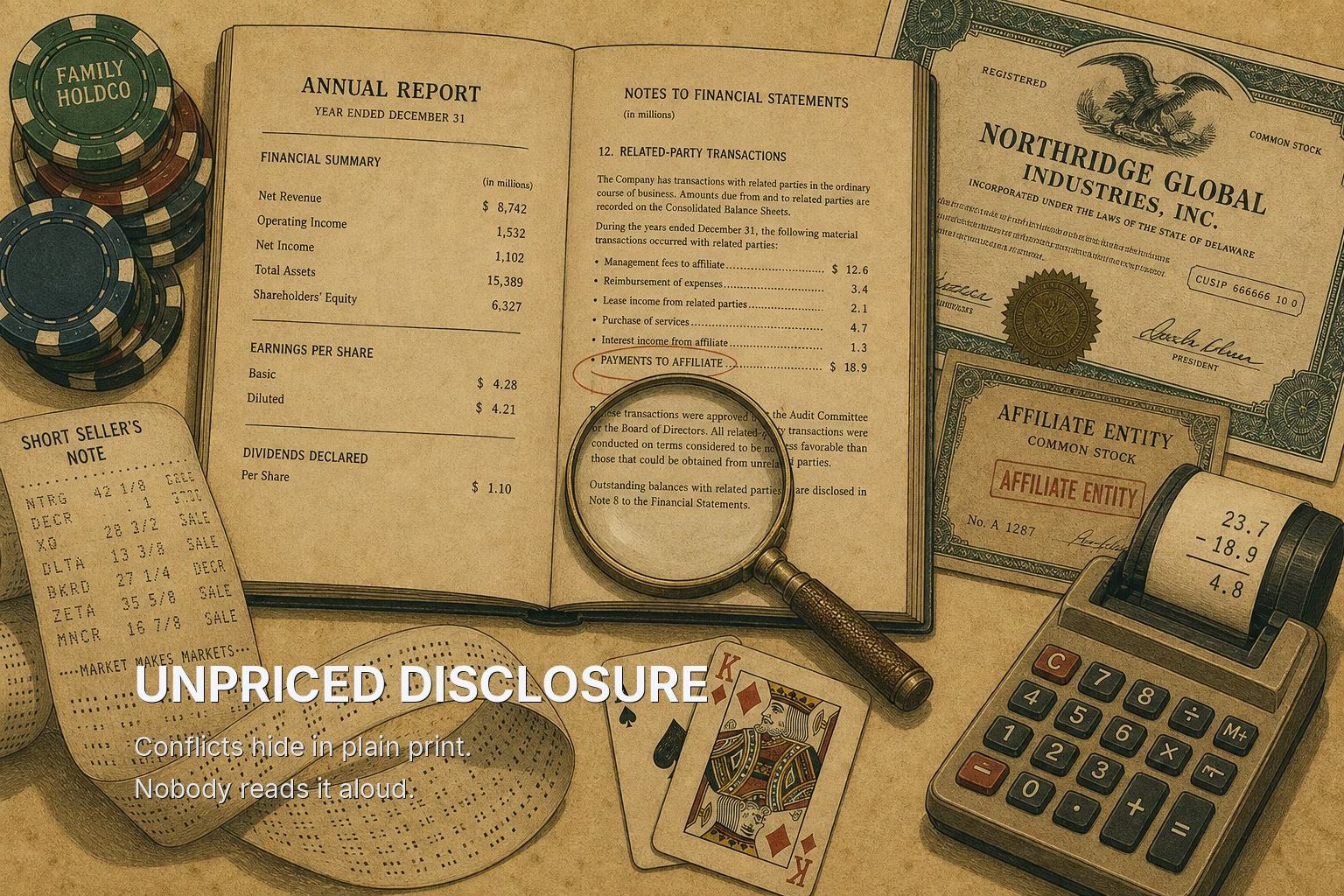
The disclosures that preceded the largest accounting frauds were mostly filed on time, in plain view, and ignored. Related-party footnotes are not where companies hide conflicts. They are where companies are legally required to confess them, in language dull enough that almost nobody models the confession.
The partnership Enron told everyone about
Enron's annual report for fiscal 2000 contained a related-party note explaining that "a senior officer of Enron" was the managing member of partnerships that transacted with the company. That officer was Andrew Fastow, the chief financial officer. The partnerships, known as LJM, bought assets from Enron and entered hedging arrangements that kept losses off Enron's income statement.
None of this was secret. The structure was described, the officer's role was acknowledged, and the board had approved a waiver of Enron's own conflict-of-interest code to allow it. The market priced Enron on its reported earnings growth and its guidance about a trading-and-broadband future. The footnote sat underneath, telling anyone who read it that the CFO was negotiating against his own employer.
Enron restated its financials in November 2001 and filed for bankruptcy on December 2, 2001. The board's own investigation, the Powers Report, later found that Fastow had received more than $30 million from the LJM partnerships. The confession had been in the filings for more than a year.
What this means for you: the question is never whether a company disclosed its conflicts. The question is whether you read what it disclosed and asked who set the price.
Why a conflict has to file its own paperwork
A related party is any person or entity that can control or significantly influence the company, or be influenced by it: executives, directors, major shareholders, their family members, and companies any of them control. Under US accounting rules (ASC 850), a company must disclose the nature of each material related-party relationship, the dollar amounts transacted, and the balances owed at period end. Separately, SEC Regulation S-K Item 404 requires the proxy statement to disclose transactions above $120,000 in which a related person has a material interest.
Notice what these rules require and what they do not. They require disclosure. They do not require the terms to be fair. A company may describe a deal as conducted on arm's-length terms, meaning the price a willing buyer and seller with no relationship would agree on, but only if it can substantiate that claim. Many simply describe the transaction and move on.
The rules also leave the reader to do the analysis. Nothing in the footnote tells you whether $40 million of sales to an affiliate is large relative to the business, whether it is growing faster than the business, or whether the affiliate is paying its bills.
What this means for you: treat the related-party note as raw evidence, not as a conclusion. The company has told you the facts; it has not told you what they mean.
The economics of a deal priced by one person
Why does this one footnote matter so much more than the others? Because it marks every place in the business where the normal check on pricing has been removed.
In an ordinary transaction, two parties with opposed interests negotiate. The buyer wants a low price, the seller a high one, and the result approximates fair value. In a related-party transaction, the same person, or the same family, influences both sides. The negotiating tension that normally disciplines price disappears, and whatever price is recorded becomes a choice rather than a market outcome.
That choice can move value in three directions. Through asset transfers, the company buys property, a subsidiary, or intellectual property from an insider at an inflated price, or sells to one at a depressed price. Through financing, the company lends to insiders or affiliates, or guarantees their debt. Adelphia's Rigas family used co-borrowing arrangements that left the company exposed to billions of dollars of family-linked debt, and WorldCom extended loans and guarantees to Bernard Ebbers reported at roughly $400 million. Those episodes are why Sarbanes-Oxley Section 402 banned most personal loans to executives of public companies in 2002. Through revenue and cost routing, sales flow to controlled customers, or purchases flow from controlled suppliers, letting insiders manufacture revenue or skim margin.
The gatekeepers who should catch this each face a constraint. Auditors test samples and rely heavily on management's representations about who is related. Audit committees approve transactions they are shown, not ones they are not. Sell-side analysts build models from guidance and segment data, and the related-party note rarely feeds a model line. The market ignores the footnote for a structural reason: it is recurring, boilerplate in tone, and absent from every number the company asks you to focus on.
The mechanism breaks, and stops being a red flag, when there is a genuine economic reason for the relationship and independent evidence that pricing is fair. A founder-owned supplier that has served the company for twenty years at prices matching third-party quotes is a related party, but not necessarily a problem.
What this means for you: every related-party line is a spot where you, not the market, must supply the price discipline the transaction lacks.
Measuring the footnote against the business
Raw dollar amounts tell you little. Scale them against the company, and against each other.
The most useful single test compares how quickly related parties pay versus how quickly everyone else pays. Collection speed is measured in days sales outstanding (DSO), the average number of days it takes to collect a receivable:
DSO = (Receivables / Revenue) × 365
Take a hypothetical company with $500 million of annual revenue and $82 million of total receivables. Its company-wide DSO is ($82M / $500M) × 365 = 60 days. Now suppose its footnote shows $40 million of sales to an entity controlled by the CEO's brother, with $25 million owed by that entity at year end. The related-party DSO is ($25M / $40M) × 365 = 228 days.
The affiliate is taking nearly four times longer to pay than ordinary customers. That gap is the signal. Either the affiliate is being granted terms no outside customer would receive, or a meaningful share of that $40 million in revenue is not converting into cash. Both readings matter more than the headline revenue figure.
Three further ratios sharpen the picture. Related-party revenue or purchases as a share of total, tracked across years, shows whether the dependence is growing. Related-party balances as a share of equity shows how much of the company's net worth is a claim on insiders. And the year-over-year change in the description itself, new counterparties, renamed entities, or terms that suddenly go unstated, often tells you more than the numbers.
What this means for you: never read the related-party note in isolation. Divide every figure in it by a figure from the income statement or balance sheet, then compare it to last year.
Super Micro and the two-month lag
The same pattern played out recently, and the price record shows exactly when the market chose to care.
Super Micro Computer had disclosed for years that it bought components and services from Ablecom and Compuware, companies tied to CEO Charles Liang's family. The relationships were in the filings. The company had also settled with the SEC in 2020 over improper revenue recognition, paying a $17.5 million penalty. Through the 2023 and early-2024 AI server boom, the market priced Super Micro on revenue growth and guidance.
On August 27, 2024, a short seller published a report centered partly on those related-party dealings. The next day, Super Micro said it would delay its annual 10-K filing. The stock fell sharply. The larger move came later: on October 30, 2024, Ernst & Young resigned as auditor, saying it was unwilling to be associated with financial statements prepared by management. Shares dropped about a third the following session.
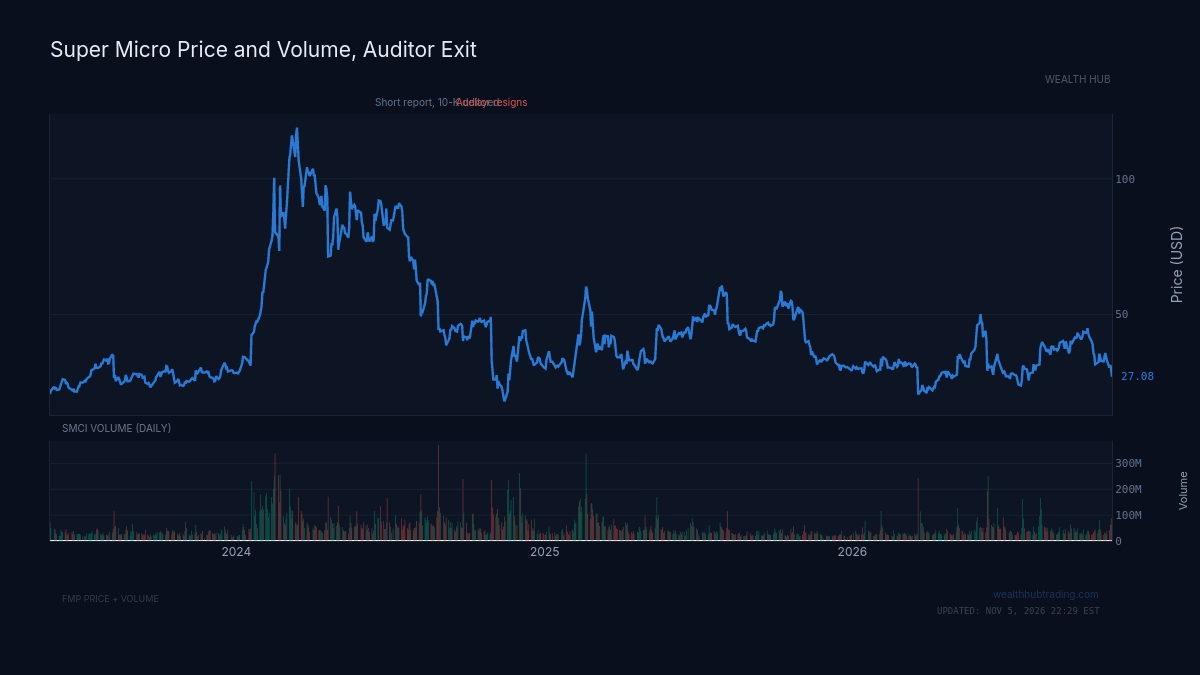
The sequence is the lesson. Disclosure came first and was ignored. The allegation came second and was partly priced. The auditor's exit came third, and that was the moment the market treated the footnote as real. In equity-fundamental terms, the gap between the guided narrative and the filed disclosure stayed open until an independent gatekeeper closed it.
What this means for you: an auditor resignation, disclosed on an 8-K under Item 4.01, is the point where a related-party concern stops being theoretical. If you had already done the footnote work, you were not surprised by it.
When the footnote misleads
The related-party note is a powerful filter, and it fails in two opposite directions.
The first failure is the false positive. Super Micro itself shows it: a special committee reported in December 2024 that it found no evidence of misconduct by management or the board, and the company later filed its delayed reports with a new auditor. Large related-party exposure plus governance weakness justified the selloff as a risk repricing; it did not prove fraud. Controlled companies, family-run industrial groups, and many Asian conglomerates carry extensive related-party activity as a normal feature of how they are organized. Reading every such line as a crime will keep you out of plenty of sound businesses.
The second failure is the false negative, and it is more dangerous. The footnote only contains relationships management chooses to label as related. Luckin Coffee fabricated roughly RMB 2.2 billion of 2019 sales; subsequent reporting linked parts of the scheme to entities connected to its chairman that were not presented to shareholders as related parties. When a fraud depends on the relationship staying hidden, the footnote is clean by design.
That is why the footnote should be cross-checked against things management does not control: the names of directors on corporate registries, the addresses of major customers and suppliers, and whether a newly significant counterparty appeared out of nowhere.
What this means for you: a clean related-party note is not a clean bill of health, and a busy one is not a conviction. It is a question you are obligated to answer.
What to do with the footnote
Related-party disclosure is the one place a company must describe, in its own words, where insiders sit on both sides of a deal. Start every new position by reading that note and the proxy's "Certain Relationships and Related Transactions" section before you read the guidance. Scale each disclosed figure against revenue, receivables, and equity, and compare it to the prior year. Flag any related-party receivable collected far more slowly than ordinary receivables, any growing share of revenue or costs routed through affiliates, and any description that becomes vaguer over time.
The mechanism in one sentence: when the same person sets both sides of a price, the filings will tell you the transaction exists, and your job is to supply the arm's-length test the market skips until someone forces it.