
On November 1, 2018, Apple told the market it would stop reporting how many iPhones it sold. The headline numbers that night were a record September quarter. The disclosure that mattered was the decision to stop counting. Two months later, on January 2, 2019, Tim Cook published a letter cutting holiday-quarter revenue guidance to roughly $84 billion, against a prior range of $89 to $93 billion, with weakness in China and slowing iPhone upgrades cited as the causes.
The guidance cut is the event most people remember. The more useful lesson is the order of events. Management withdrew the iPhone unit metric first, and the bad news arrived later. The explanation offered on the call was reasonable: unit counts in any single 90-day window understate the value of a growing installed base and rising average selling prices. Every word of it could be defended. It was also the moment a company with a slowing flagship product stopped giving outsiders the cleanest way to measure that slowdown.
This is the core of reading a transcript well. Consensus anchors to the reported figure and the guided narrative. The information sits in the gap between those and what management has quietly stopped volunteering.
Why silence leaks more than speech
The reason evasions carry information is legal, not psychological. Executives on an earnings call face an asymmetric liability structure: the penalty for saying something false is far larger than the penalty for saying less. Under Rule 10b-5, a material misstatement exposes the company and its officers to securities fraud claims. The Private Securities Litigation Reform Act of 1995 created a safe harbor for forward-looking statements, meaning projections accompanied by meaningful cautionary language are shielded from many lawsuits even when they prove wrong. Voluntary operating metrics, the ones not required by accounting rules, can generally be discontinued without legal consequence.
Put those three facts together and the incentive is obvious. A CFO who knows a number is about to deteriorate has two options. She can report it and absorb the hit, or she can stop reporting it and offer a principled reason. She cannot, without serious risk, keep reporting it and misstate it. Securities counsel will steer management toward the second path every time, because omission is cheap and fabrication is expensive.
So the honest information comes out sideways. Management does not lie; it narrows. The metric that was a highlight for six quarters disappears from the prepared remarks. A specific question gets a general answer. A guidance sentence picks up a new conditional clause. Each change is individually innocent, and together they form a disclosure that nobody had to sign.
What this means for you: treat every voluntary metric as a privilege management can revoke, and treat the revocation itself as a data point that deserves the same weight as the reported number.
The three deflections that matter
Not all evasions are equal. Three patterns carry most of the signal, and each has a different mechanism behind it.
The first is the orphaned metric: a figure management cited prominently in prior quarters that no longer appears in the prepared remarks or the earnings release. The test is simple. Pull the last four transcripts and list every number management volunteered in the opening remarks. Any figure that appeared three quarters running and then vanished needs an explanation, and the explanation needs to be checked against the 10-Q. Often the underlying data still surfaces in the filing, buried in a segment note or a revenue disaggregation table, because accounting rules require it even when the call no longer highlights it.
The second is the question answered with a different question, or more commonly, a question answered at a different altitude. An analyst asks about gross margin in a specific product line, and the CFO responds with company-wide margin targets for the full year. The answer is true and responsive in form. It is unresponsive in substance. The shift in altitude, from specific to aggregate, is the tell, because executives drop to the aggregate level precisely when the specific number is unflattering.
The third is the new qualifier. Last quarter, management "expects revenue growth in the high single digits." This quarter, management "expects revenue growth in the high single digits, assuming stable demand conditions in our enterprise segment." The added clause is a safe-harbor reflex. Lawyers add cautionary language where they see real risk, so a qualifier that was absent last quarter is effectively management telling you which assumption they are least confident about.
What this means for you: read prepared remarks against the previous quarter's prepared remarks line by line, not against analyst expectations. The comparison that matters is the company against its own prior language.
A worked example of measuring drift
Evasion becomes useful when you quantify it rather than react to it. Here is a hypothetical company, built to show the method; the figures are illustrative and do not describe a real issuer.
Last quarter, the guidance section of the prepared remarks ran 120 words and contained 2 hedging qualifiers ("assuming," "subject to"). This quarter it ran 140 words and contained 7.
Qualifier density = qualifiers / words × 100
Last quarter: 2 / 120 × 100 = 1.7 per 100 words. This quarter: 7 / 140 × 100 = 5.0 per 100 words.
Hedging density roughly tripled while the headline guidance range stayed unchanged. The market will likely read the unchanged range as stability. The language says the range now rests on more conditions than before.
Now apply the same logic to the Q&A. Of 12 analyst questions last quarter, management answered 9 with a specific number or a direct yes or no.
Direct-answer ratio = direct answers / questions asked
Last quarter: 9 / 12 = 75%. This quarter: 5 / 12 = 42%.
A 33-point drop in directness, with the same analysts asking similar questions, is not noise. The final step is to map which questions lost their direct answers. If the five dodged questions cluster around one segment, you have located the problem without management ever naming it.
Academic work supports the premise that language shifts carry information. Larcker and Zakolyukina's 2012 study of conference calls found that executives at firms that later restated earnings spoke in measurably different patterns from their peers. The exact markers matter less than the principle: deception and discomfort leave traces in word choice, and those traces can be counted.
What this means for you: build a small spreadsheet per holding with qualifier density and direct-answer ratio by quarter. The level tells you little; the change across two or three quarters tells you a great deal.
Checking the transcript against the filing
The transcript is where management chooses its words. The 10-Q and 10-K are where it is required to. This is the lens most readers skip, and it is where the real edge lives.
When a metric disappears from the call, open the filing and look for three things. First, check whether the underlying data still appears in segment disclosures or the revenue disaggregation note required under ASC 606, the revenue recognition standard. Second, read the risk factors section against the prior filing; new or expanded risk language often mirrors the new qualifier you found on the call. Third, read the management discussion and analysis for changes in how the company describes the drivers of a line item, since a shift from "volume growth" to "pricing and mix" tells you volume has stopped growing.
Apple is instructive again. After the unit counts stopped, the 10-K still broke out iPhone net sales as a product category. Revenue by product remained a required disclosure even when units no longer were. A reader who tracked iPhone revenue against the old unit trajectory could keep a rough read on the business. The call went quiet; the filing did not.
What this means for you: when the call stops citing a number, the filing is the first place to look, and the gap between the two is the disclosure the market is not yet pricing.
When an evasion is not an evasion
Every one of these signals can mislead, and a disciplined reader needs to know the failure modes as well as the method.
The cleanest counterexample is Netflix. The company announced in April 2024 that it would stop reporting quarterly subscriber counts beginning in 2025, the most closely watched metric in streaming. On the evasion framework, that looks like a red flag. In practice, Netflix was in a strong position: its ad-supported tier and password-sharing crackdown had changed the economics so that revenue per member and engagement mattered more than raw headcount. Management redirected attention to revenue and operating margin, metrics that were moving in its favor. Dropping the metric reflected a changed business model rather than a hidden deterioration.
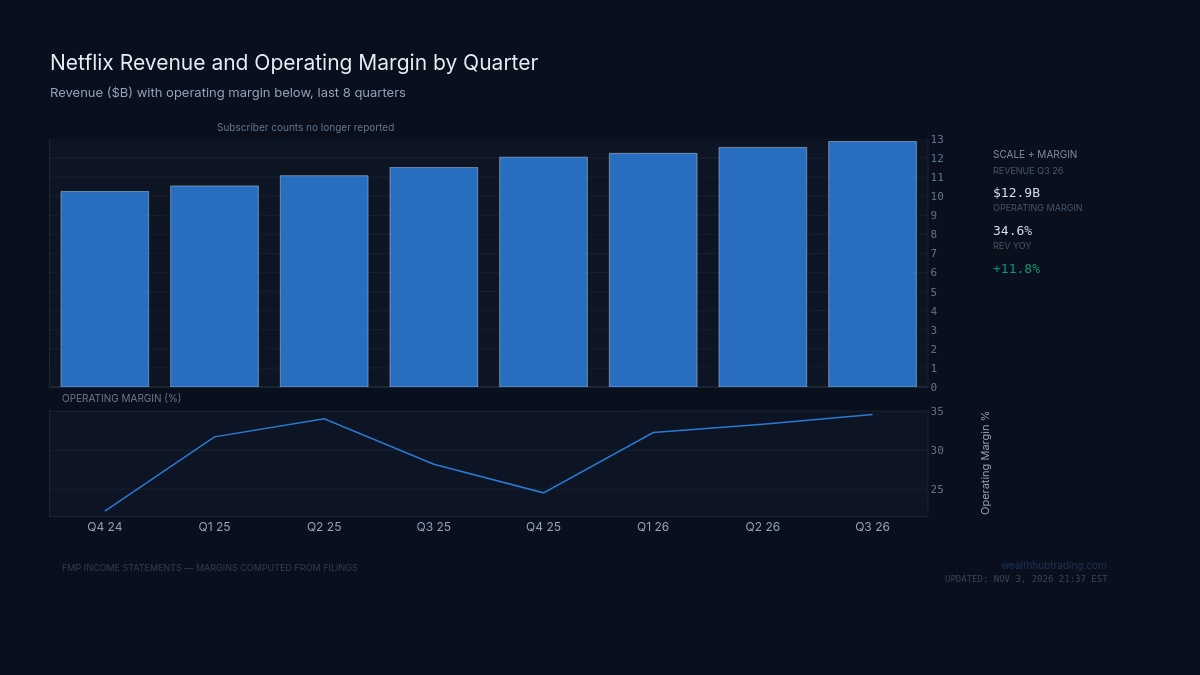
The distinguishing test is what replaces the dropped metric. When a company retires a number and elevates a harder, more audited one, like revenue or operating margin from the income statement, the change is usually about relevance. When a company retires a number and replaces it with a softer, management-defined one, like an adjusted engagement score or a non-GAAP margin, the change deserves suspicion.
Other failure modes are more mundane. A new CFO may simply have a different style, so a drop in directness after a management change measures personality, not trouble. Some companies run every word through counsel every quarter, producing uniformly hedged language that never changes and therefore never signals. And in a broad macro shock, nearly every issuer adds qualifiers at once, which makes the drift a market-wide feature rather than a company-specific one. Compare each company's qualifier density to its peers in the same quarter before drawing conclusions.
What this means for you: an evasion is a hypothesis, never a verdict. Confirm it against the filing, check what replaced the missing metric, and benchmark the language change against peers before acting on it.
Reading for what stops
The mechanism comes down to a single sentence: because executives face heavy liability for false statements and almost none for silence, the truth on an earnings call leaks through omission, narrowing, and new qualifiers rather than through the numbers themselves. That matters because the market prices the headline and the guided range on the night of the call, while the deflections often precede the revision by a quarter or two. Read the prior transcript before the current one, count what changed, and open the filing whenever a familiar number goes missing.