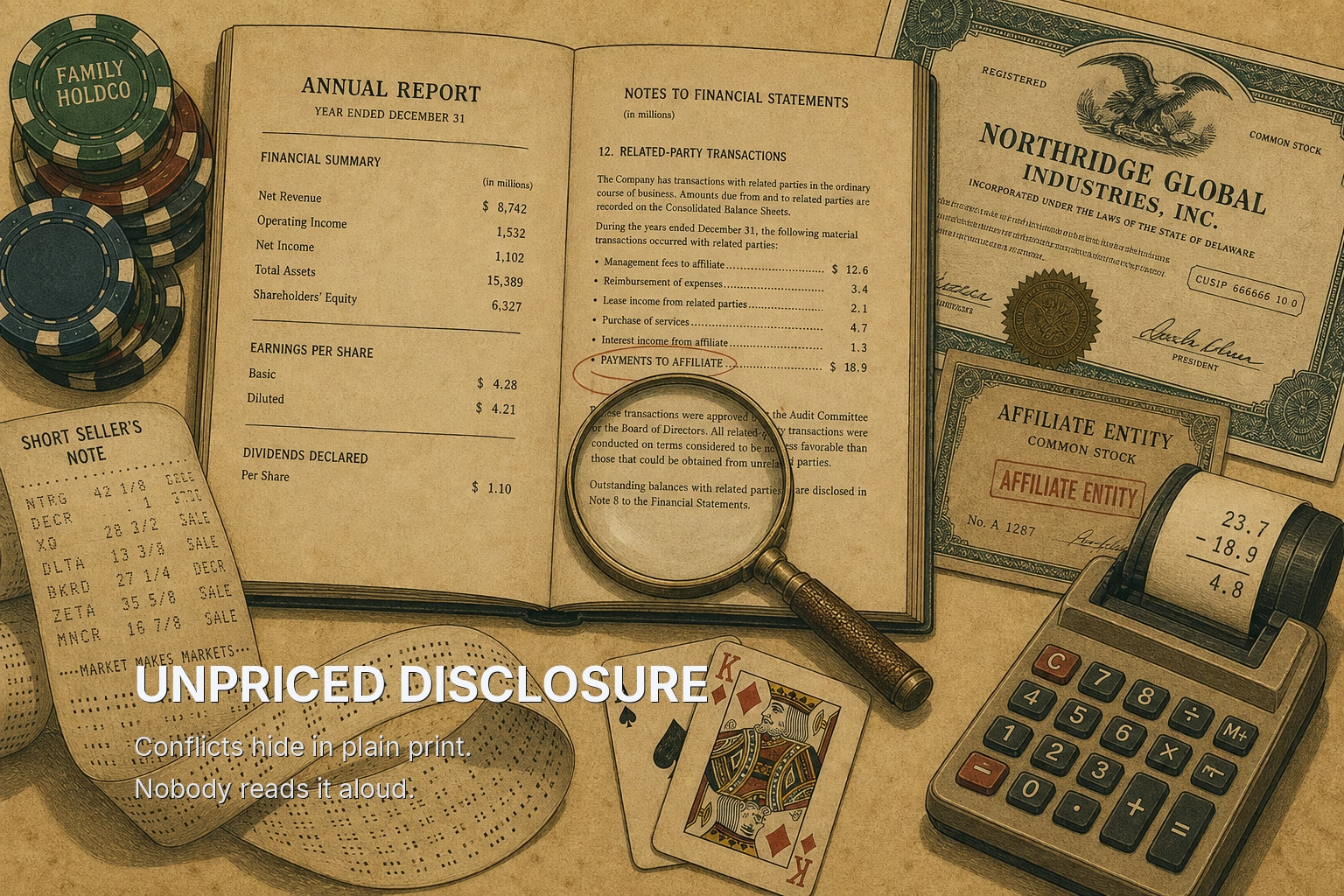
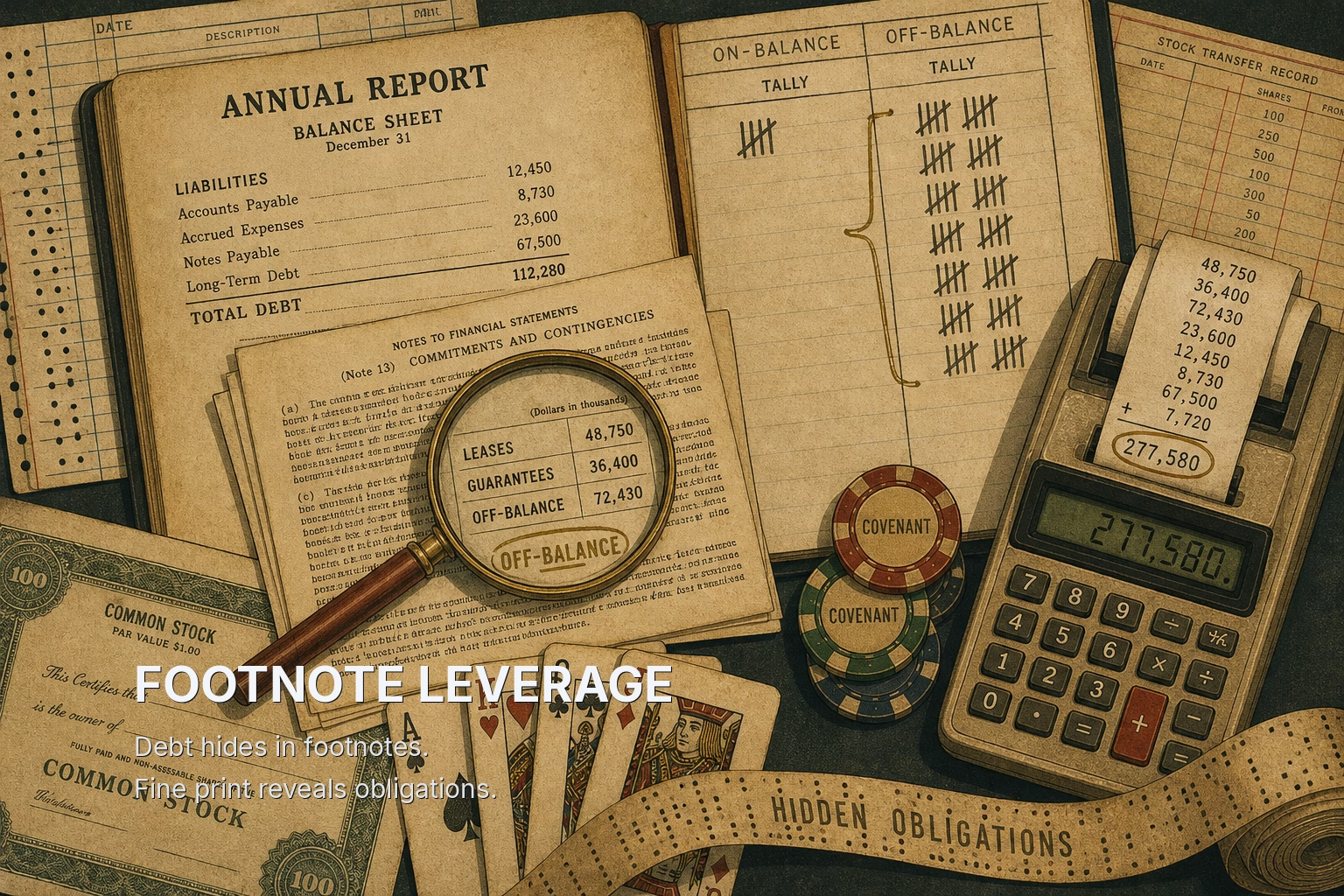
The most valuable sentence in a Federal Register notice is rarely the policy itself. It is the effective date and the definition of what falls in scope, and those are exactly the two details that company guidance tends to soften. The market prices the headline. The filing gap opens in the definitions.
The October 2023 chip rules and the filing that followed
On October 17, 2023, the Commerce Department's Bureau of Industry and Security (BIS, the agency that administers U.S. export controls) released updated rules on advanced computing chips bound for China. The headline was simple: Washington tightens AI chip curbs. Most coverage stopped there.
The rule text said more. It replaced the 2022 test, which keyed on chip-to-chip interconnect speed, with thresholds based on total processing performance and performance density (computing power per unit of chip area). That change mattered because the 2022 rule had a gap. Chips designed to fall just under the old interconnect line could still ship. The new definitions closed it. Products built specifically to comply with the 2022 rule were now inside the perimeter. The rule also carried a delayed effective date for most provisions, roughly a month out, which suggested an orderly wind-down of sales already in progress.
NVIDIA said publicly that it did not expect a meaningful near-term impact on its financial results, citing strong demand elsewhere. A week later, on October 24, the company filed an 8-K. That is the form a public company uses to disclose material events between quarterly reports. The filing said the government had informed it that the licensing requirements were effective immediately for a list of its data center products. The wind-down period the market had assumed was gone.
The full size of the exposure came out at the November earnings report. Management said sales to China and the other affected destinations had made up roughly 20 to 25 percent of data center revenue, and it expected those sales to fall significantly in the following quarter.

Look at the order of events. The scope definition was public on October 17. The accelerated timing was public on October 24. The revenue share at risk was confirmed in late November. A reader who had the rule text next to the company's prior geographic revenue disclosures could have built the exposure estimate weeks before management put a number on it. The stock fell on the headline, then recovered as demand outside China overwhelmed the loss. The lesson is not that the trade was obvious. It is that the information arrived in a fixed sequence, and the primary source came first.
For your own process, the practical point is this. When a rule names products by technical threshold, check those thresholds against the company's product list yourself, before management tells you whether it matters.
Why the information gap exists at all
The Federal Register is the government's daily journal of record. Every final rule, proposed rule, and agency notice that carries legal effect has to appear there. The Office of the Federal Register also posts documents for public inspection the business day before formal publication. So a notice is often readable a day before its official date, and sometimes before most outlets have written it up.
Why does this produce a tradeable lag? It comes down to who reads it. Trade lawyers, customs brokers, and corporate compliance officers read the Register daily because their jobs require it. Their incentive is legal accuracy, not price discovery. Equity analysts mostly get policy secondhand, through agency press releases, news summaries, and management commentary on earnings calls. Each of those layers compresses the text. Press releases lead with intent ("protecting national security"). News stories lead with the headline number. Management commentary leads with reassurance, because a company has every reason to frame a regulatory hit as manageable until it is forced to quantify it.
The regulatory text itself is not compressed. It defines terms, lists covered products by code, sets licensing policy, and states dates. That is why reading a notice the way you would read a 10-K footnote, the section that discloses what the summary leaves out, is the right habit.
What this means for you: the edge is not speed of access, since the document is free and public. The edge is reading the definitions instead of the summary.
What to pull out of a notice
A Federal Register document has a standard layout: agency, action type, summary, dates, supplementary information, and then the regulatory text and any annexes. Four elements do most of the analytical work.
Action type. A final rule carries legal force. An interim final rule takes effect immediately but invites comment afterward, so its terms can still shift. A proposed rule opens a comment period and has no force yet. A notice can be anything from a hearing date to an Entity List addition. Markets often react to a proposed rule as if it were final, which creates mispricing in both directions.
The dates block. Publication date, effective date, and any separate compliance date are often different. A tariff that takes effect in thirty days gives importers thirty days to act. An export restriction effective on publication gives exporters none.
Scope definitions. For tariffs, scope sits in annexes listing HTS codes (Harmonized Tariff Schedule product classifications). For export controls, scope sits in ECCNs (Export Control Classification Numbers) and technical thresholds. This is where a company's actual products either fall inside or outside the rule.
Licensing or exclusion policy. The phrase "presumption of denial" means licenses will rarely be granted. "Case-by-case review" means some business may continue. One phrase can separate a manageable delay from a revenue line going to zero.
Many significant rules also include a regulatory impact analysis, the agency's own estimate of costs and affected entities. It is an agency estimate, not audited data, but it gives you a sense of scale that management commentary rarely offers.
Turning a notice into an earnings estimate
The mechanism becomes concrete once you put numbers on it. For a tariff, the core calculation is:
Earnings at risk = in-scope cost of goods × tariff rate × (1 − pass-through share)
Pass-through share is the portion of the cost increase the company can push onto customers through higher prices.
Take a hypothetical importer with $4 billion in revenue, $500 million in operating income, and $800 million of annual purchases that match HTS codes listed in a tariff annex. The notice imposes a 25 percent duty. Assume the company can pass half the cost through.
Earnings at risk = $800M × 0.25 × (1 − 0.50) = $100M
That is 20 percent of operating income. If management has described the tariff as "manageable" and the stock moved 2 percent on the headline, the gap between the filing and the guidance is the signal. The inputs come from two public documents: the annex in the Register and the sourcing or geographic disclosure in the company's 10-K. Neither requires private information.
The same structure works for export controls. Replace cost of goods with in-scope revenue and replace the tariff rate with the share of that revenue a presumption of denial eliminates. In the NVIDIA case, the November disclosure that 20 to 25 percent of data center revenue came from affected destinations was the in-scope figure. Analysts with good geographic revenue estimates could have bracketed it in October.
The practical rule: never accept "not material" from management until you have run the scope against the disclosures yourself.
The second-order effect hiding in the effective date
Effective dates do not only set when a cost begins. They change behavior before that date.
A tariff scheduled thirty days out gives importers a reason to pull forward orders, buying inventory early at the lower rate. The first-order effect is a strong quarter for suppliers and freight carriers. The second-order effect, which shows up a quarter or two later, is a demand air pocket as customers work through the extra stock. The 2018 and 2019 China tariff rounds produced this pattern repeatedly, with importers building inventory ahead of each scheduled rate step-up.
The reverse also happens. Export restrictions with a delayed effective date can produce a final burst of shipments before the cutoff, which then flatters one quarter's revenue. That is part of why NVIDIA's accelerated timing in October 2023 mattered: it removed a quarter of shipments the market had reason to expect.
When you read the dates block, ask what a rational buyer or seller does between publication and the effective date, then look for that behavior in the next two quarters of reported results.
When the method fails
Reading the Register is not a guaranteed source of mispricing, and several conditions break it.
Leaks and pre-announcements come first. Major trade actions are often signaled by officials, reported by journalists, or announced by press release days or weeks before the formal notice. In those cases the Register document confirms rather than reveals, and the scope details may already be in the price.
Rules change after publication. Interim final rules get amended after comment. Courts can enjoin rules, and tariff actions taken under emergency powers have drawn legal challenges that put their durability in question. Exclusion processes can carve specific products out months later. An earnings-at-risk estimate built on a rule that later narrows will overstate the damage.
Company disclosure may also be too coarse to map. If a company reports revenue only by broad region and does not break out product lines, you cannot match HTS codes or ECCNs to its sales with any precision. The method needs a disclosure on the other side of the equation.
Finally, the market may simply not care. In October 2023, demand for AI accelerators outside China was strong enough that the restriction barely mattered to the share price within weeks. A correct reading of scope does not guarantee a correct reading of what the market will weigh.
The practical response is to treat a Register reading as a hypothesis about earnings, not a trade by itself. Size conviction by how clean the mapping is between the rule's scope and the company's disclosures.
The habit worth building
Policy becomes legally binding in the Federal Register before it becomes a number in a company's guidance, and the delay between the two is where mispricing lives. Read the dates block and the scope definitions first, match them against the issuer's own segment and geographic disclosures, and run the earnings-at-risk calculation before management runs it for you. The headline tells you that a rule exists. The annex tells you who pays.