The most informative line on a Form 4 is rarely the one that makes the news. Headlines report the dollar figure. The signal sits in a one-letter transaction code, a checkbox, and a footnote, and those three fields often tell you the opposite of what the headline implies.
Two Dimon filings, two different messages
In February 2016, with bank stocks sliding on recession fears and energy-loan worries, Jamie Dimon bought 500,000 shares of JPMorgan Chase in the open market at roughly $53 a share, a purchase of about $26.6 million. The filing carried transaction code P, meaning an open-market purchase paid for with the insider's own money. The stock jumped the next session, and the broader bank group rallied with it. The market read the filing correctly. The chief executive, who already had most of his net worth tied to the company, chose to add more at a price he plainly considered cheap.
Eight years later, in February 2024, Dimon sold JPMorgan stock for the first time in his tenure as CEO: a block worth roughly $150 million. The headlines wrote themselves. "Dimon dumps shares" is a more clickable sentence than "Dimon executes the plan he announced in October." Yet that second sentence was the accurate one. The company had disclosed months earlier that he and his family intended to sell about one million shares for diversification and tax planning, and the sale ran under a Rule 10b5-1 trading plan, a pre-arranged schedule adopted when the insider is not in possession of material non-public information.
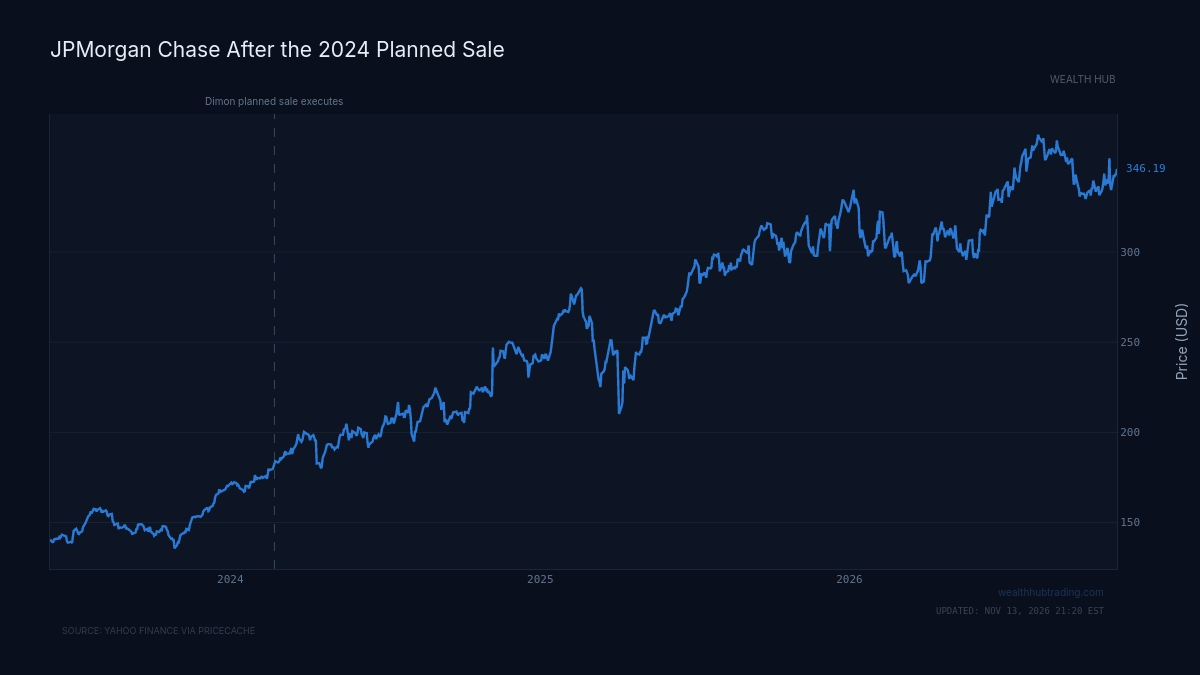
JPMorgan kept climbing after the sale. Nobody who understood the filing should have been surprised. The 2016 purchase was a discretionary decision made under stress. The 2024 sale was a calendar entry made long in advance. Same person, same company, opposite information content, and the headline dollar amount pointed readers toward the wrong one.
What this means for you: before reacting to any insider headline, open the filing and find the transaction code. That single character resolves most of the confusion.
What a Form 4 actually records
A Form 4 is the statement officers, directors, and holders of more than 10% of a company's stock must file with the SEC when their ownership changes. The deadline is two business days after the transaction, which makes these filings one of the fastest public windows into what insiders are doing with their own positions.
Each transaction row carries a code. The ones that matter most:
- P: open-market or private purchase. The insider spent cash.
- S: open-market or private sale.
- A: grant or award from the company, such as restricted stock.
- M: exercise or conversion of a derivative, typically stock options.
- F: shares withheld to pay the exercise price or taxes on vesting.
- G: a gift, often to family trusts or charity.
Read that list again with one question in mind: which codes involve the insider making a voluntary bet with personal money? Only P, and to a lesser degree S. Codes A, M, F, and G mostly reflect compensation mechanics and estate planning. An "F" row showing 40,000 shares "disposed" is the company holding back stock to cover a tax bill. It shows up in aggregate insider-selling tallies anyway, inflating them.
Since April 2023, Form 4 also includes a checkbox indicating whether a transaction was made under a 10b5-1 plan, along with the plan's adoption date. Before that change, you often had to dig through footnotes to find it. Now it sits near the top of the form.
What this means for you: sort every filing into "voluntary with own cash" and "everything else" before reading the dollar figure. The second bucket can be large and still carry almost no information.
Why buying and selling are not symmetric
Why does a purchase say so much more than a sale? Because insiders have one reason to buy and many reasons to sell.
An executive buying stock in the open market is already overexposed to the company. Salary, bonus, unvested equity, reputation, and career all ride on the same outcome. Adding more concentration with after-tax cash makes sense only if the insider believes the stock is undervalued. There is no tax reason, no diversification reason, no mortgage reason to buy.
Selling is different. Executives sell to pay taxes on vesting stock, to diversify a portfolio that would make any financial adviser wince, to fund a house, a divorce settlement, a tuition bill, or a philanthropic pledge. Most of those motives say nothing about the company's prospects. This is the economic mechanism behind the asymmetry: compensation structures load insiders with equity they did not choose to buy, so routine selling is the default state and routine buying barely exists.
Academic work supports this. Cohen, Malloy, and Pomorski's 2012 study "Decoding Inside Information" split insiders into routine traders, who trade in the same calendar month year after year, and opportunistic traders, who break pattern. The routine trades carried essentially no predictive value. The opportunistic ones did. The lesson generalizes beyond buying versus selling: a trade that deviates from the insider's own history is the one worth weighing.
Selling is not always noise. A discretionary sale outside any plan, by an insider who has never sold before, in size, ahead of a quiet period, deserves attention. The asymmetry is a default weighting, not a rule that sales can be ignored.
What this means for you: treat a single sale as presumptively uninformative and a single open-market purchase as presumptively informative, then let the details overturn the presumption.
Size against wealth, not size against the headline
A $500,000 purchase sounds large. Whether it is large depends on the buyer. For a newly appointed CFO whose total holdings are worth $2 million, that purchase raises personal exposure by 25%. For a founder holding $4 billion of stock, it is a rounding error, possibly a public-relations gesture.
The useful ratio is transaction value divided by the insider's existing stake (or, when you can estimate it, by their total liquid net worth). Form 4 makes the first version easy because the final column reports shares beneficially owned after the transaction. A worked example:
A director buys 20,000 shares at $45, spending $900,000. The "amount owned following transaction" column shows 60,000 shares. Prior holding = 60,000 − 20,000 = 40,000 shares. Stake increase = 20,000 / 40,000 = 50%
A 50% increase in personal exposure, paid in cash, is a strong statement. Compare a CEO who sells 100,000 shares out of 3 million owned: a 3.3% reduction, almost certainly diversification. The second headline will carry the larger dollar number. The first filing carries the information.
Dimon's 2016 purchase fits this frame. In dollars it was large; relative to his existing holdings it was a meaningful but not reckless addition. What gave it force was context: a voluntary cash purchase during a sector drawdown by an executive who did not normally buy.
What this means for you: compute the percentage change in the insider's own position for every transaction you care about. Ignore the dollar figure until you have it.
Clusters beat lone filings
One insider buying can be idiosyncratic. A director may have received a windfall elsewhere or want to signal confidence after a board appointment. When three or four officers and directors buy in the open market within a few weeks, the explanation narrows. Different people with different finances, tax situations, and personal needs rarely converge on the same discretionary trade unless they share a view about the company.
Cluster buying is often where the strongest signal lives, especially when it includes the CFO, who sees the numbers before anyone else, and when it follows a sharp price decline. The mirror image, cluster selling outside 10b5-1 plans, is rarer and deserves equal scrutiny.
There is a timing wrinkle. Insiders generally trade only during open trading windows, which typically follow earnings releases. That means purchases naturally bunch together after results. A cluster in the two weeks following an earnings report is partly calendar, so weight it by how many insiders participated and how unusual buying is for this company, not merely by the fact of bunching.
What this means for you: scan for multiple distinct insiders filing code P on the same stock within a short window, and give the most weight to clusters in companies where insiders almost never buy.
Where the reading goes wrong
The method has failure modes worth knowing before you rely on it.
First, plans can be gamed. Before the 2023 rule changes, insiders could adopt a 10b5-1 plan and begin selling almost immediately, or cancel plans selectively. The SEC introduced cooling-off periods partly in response. A plan adopted shortly before a sale, or modified recently, is less clean than one adopted many months earlier. The adoption date on the form is there for a reason; check it.
Second, insiders can be wrong. Bank executives bought shares on the way down in 2007 and 2008 and lost heavily. Conviction is not foresight, especially when the risk is macro or systemic rather than company-specific. Insider buying tends to be most useful where insiders have a genuine informational edge, such as operating trends, order books, or a misread one-off charge, and least useful when the threat comes from outside the company.
Third, small-cap purchases can be tiny and theatrical. A $25,000 buy by a director at a company where the board is under shareholder pressure may be optics. Size against wealth filters most of this out.
Finally, absence is not information. A company with no insider buying is not necessarily in trouble; many large-cap executives are prohibited or discouraged from buying, and their equity arrives through grants anyway.
What this means for you: confirm the plan adoption date, ask whether the risk the stock faces is one insiders can actually see better than you, and discount small buys that coincide with governance pressure.
Reading the next filing
The mechanism in one sentence: compensation loads insiders with stock they did not choose, so voluntary purchases with personal cash, sized meaningfully against their existing stake and repeated across several insiders, carry information that routine and scheduled sales almost never do.
Applied in practice, the next time a "CEO sells $40 million" headline crosses your screen, open the filing before you open a position. Find the code, check the 10b5-1 box and adoption date, compute the percentage change in the holder's stake, and look for other insiders filing in the same window. Most of the time you will find a calendar entry. Occasionally, as with JPMorgan in February 2016, you will find a decision, and that is the filing worth acting on.