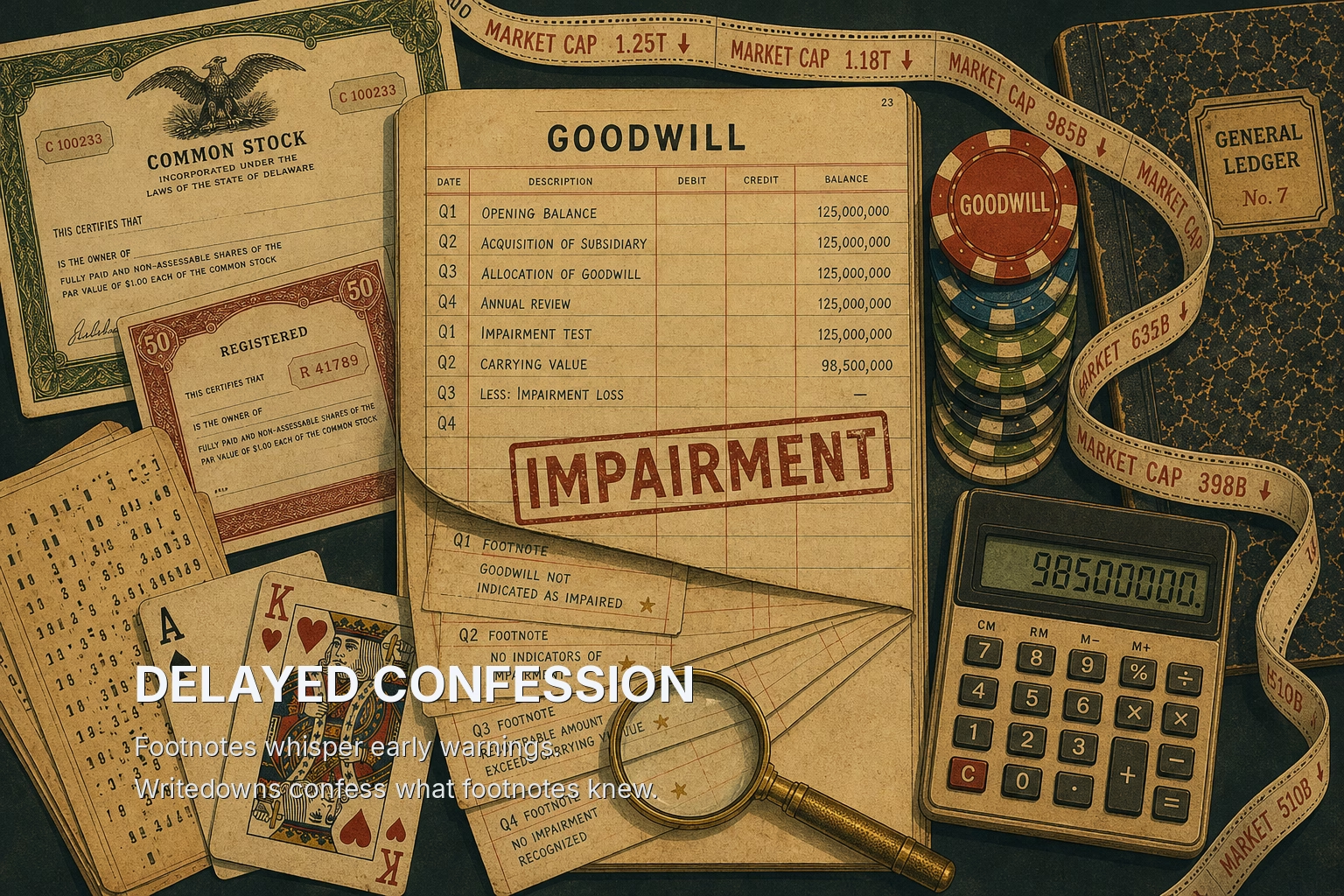
By the day a company announces a goodwill impairment, the market has usually seen the news already. The useful information came earlier, in the valuation assumptions management quietly stretched to keep the charge off the income statement. A reader who tracks those assumptions can see an impairment approaching long before it lands.
The Kraft Heinz writedown that arrived years late
In February 2019, Kraft Heinz reported a $15.4 billion writedown of goodwill and brand intangibles, mostly tied to the Kraft and Oscar Mayer businesses. On the same day it cut its dividend by 36% and disclosed an SEC subpoena over its procurement accounting. The shares fell about 27% in one session. Days later, Warren Buffett, whose Berkshire Hathaway had backed the 2015 merger alongside 3G Capital, said publicly that they had overpaid for Kraft.
Look at what that charge actually was. No cash left the company in February 2019. The cash, or the stock used in its place, left in 2015 when the deal closed. The writedown was an accounting admission, years after the fact, that the price paid had assumed cash flows the brands were not going to produce.
The admission was also not a surprise to anyone reading the filings closely. Revenue at the legacy brands had been soft for years. The company's annual reports had described reporting units whose estimated fair value sat only modestly above the value carried on the books. The cushion had been shrinking in public view. The February headline only put a number on it.
The practical point is that the 27% drop measured how much of the market had been reading the press releases instead of the footnotes.
What goodwill actually records
Goodwill is the part of an acquisition price that cannot be assigned to any specific asset. When a buyer pays $10 billion for a company whose identifiable net assets are worth $6 billion at fair value, the extra $4 billion is booked as goodwill. Identifiable net assets means factories, receivables, patents and brand names, minus debt and other liabilities. Goodwill stands for everything else the buyer believed it was getting: synergies, market position, future growth.
Under US GAAP, goodwill has not been amortized since 2001. Amortized here means written down gradually on a schedule. Goodwill instead stays on the balance sheet at full value until a test shows it has lost value. That test, set out in the accounting standard ASC 350, runs at least once a year. It works at the level of the reporting unit, which is an operating segment or one level below it.
The test compares the reporting unit's fair value with its carrying value, meaning the book value of its net assets including goodwill. Since a 2017 simplification, if carrying value exceeds fair value, the company writes off the difference, capped at the goodwill balance. Companies may also start with a qualitative screen, informally called "step zero," and skip the numerical test when they judge an impairment unlikely.
Notice the asymmetry. Carrying value is a fixed historical number. Fair value, for a business unit that does not trade on its own, almost always comes from a discounted cash flow model that management builds. Discounted cash flow (DCF) values a business by projecting its future cash flows and converting them to today's money at a chosen discount rate. Management picks the growth rate, the margins, the terminal growth rate and the discount rate.
For you, this means a goodwill balance is not a measurement of anything current. It is the deal price, preserved, defended each year by a forecast the defender writes.
Why the charge comes late
The delay is not an accident, and it is not usually fraud. It comes from incentives meeting a test with soft inputs.
Start with the people involved. The executives running the test are often the same executives who approved the deal, or their direct successors. An impairment is a public verdict on their capital allocation, and pay plans that use return on invested capital or earnings per share make that verdict expensive personally. Boards that approved the deal share the same exposure. None of them need to lie to delay a charge. They only need to believe their own turnaround plan for one more year.
Auditors check the inputs, but the forecast is management's by design. An auditor can question a 4% revenue growth assumption for a unit that has shrunk three years running. It is much harder to reject that assumption outright when management presents a restructuring program, new product launches and a plausible industry recovery. The audit standard is reasonableness, and a range of reasonable forecasts is wide.
The discount rate is where the most room sits. A reporting unit's discount rate is meant to reflect the return investors would demand for that business. It is estimated, not observed. A company can hold it steady while borrowing costs and equity risk premiums move, and defend that choice with a long-run averaging method.
Then there is the mechanical shield. Because the test runs at the reporting-unit level, a failed acquisition folded into a healthy, growing legacy business can avoid impairment entirely. The legacy unit's rising fair value covers the acquired goodwill. Reorganizing reporting units, merging a weak one into a strong one, can produce the same effect. Accounting rules permit reorganizations, and they do not have to be driven by impairment risk, but the effect on the test is the same either way.
The economic force underneath is simple. Writing off goodwill destroys no cash, yet admitting it costs the people who decide when to admit it. The charge arrives when the forecast can no longer be defended, which is a later date than when the deal stopped working.
For you, the timing of an impairment tells you more about management's room to maneuver than about the business. The business usually deteriorated earlier.
Watching the assumptions bend, in numbers
A simplified example shows how little has to change for a comfortable cushion to disappear.
Take the $10 billion acquisition from above, carried at $10 billion, with $4 billion of goodwill. Use a single-stage DCF, the Gordon growth formula:
Fair value = Next year's cash flow / (Discount rate − Long-run growth rate)
In year one, management projects $700 million of cash flow, 3% growth and an 8% discount rate.
Fair value = $700M / (0.08 − 0.03) = $14.0 billion. Headroom, meaning the excess of fair value over carrying value, is $4.0 billion, or 40%. The filing describes the unit as comfortably passing.
In year two, the business disappoints, and management trims long-run growth to 2%, keeping everything else the same.
Fair value = $700M / (0.08 − 0.02) = $11.7 billion. Headroom falls to roughly 17%. Still passing, and the press release does not mention it.
In year three, interest rates have risen and the auditor pushes the discount rate to 9%.
Fair value = $700M / (0.09 − 0.02) = $10.0 billion. Headroom is zero. The unit passes by the thinnest possible margin.
In year four, cash flow comes in at $650 million instead of $700 million.
Fair value = $650M / (0.09 − 0.02) = $9.29 billion. Carrying value exceeds fair value by about $710 million, and the company records an impairment of that amount.
Three things stand out. A one-point cut in growth erased more than half the cushion. A one-point rise in the discount rate erased the rest. The final charge came from a cash flow miss of only about 7%. Each of those changes is small enough to explain away in a single earnings call. Together they take a unit from 40% headroom to a writedown in three years.
The example also shows where the delay comes from. Had management held the discount rate at 8% in year three, the unit would have kept about $1.7 billion of headroom, and the charge would have been pushed back by at least a year.
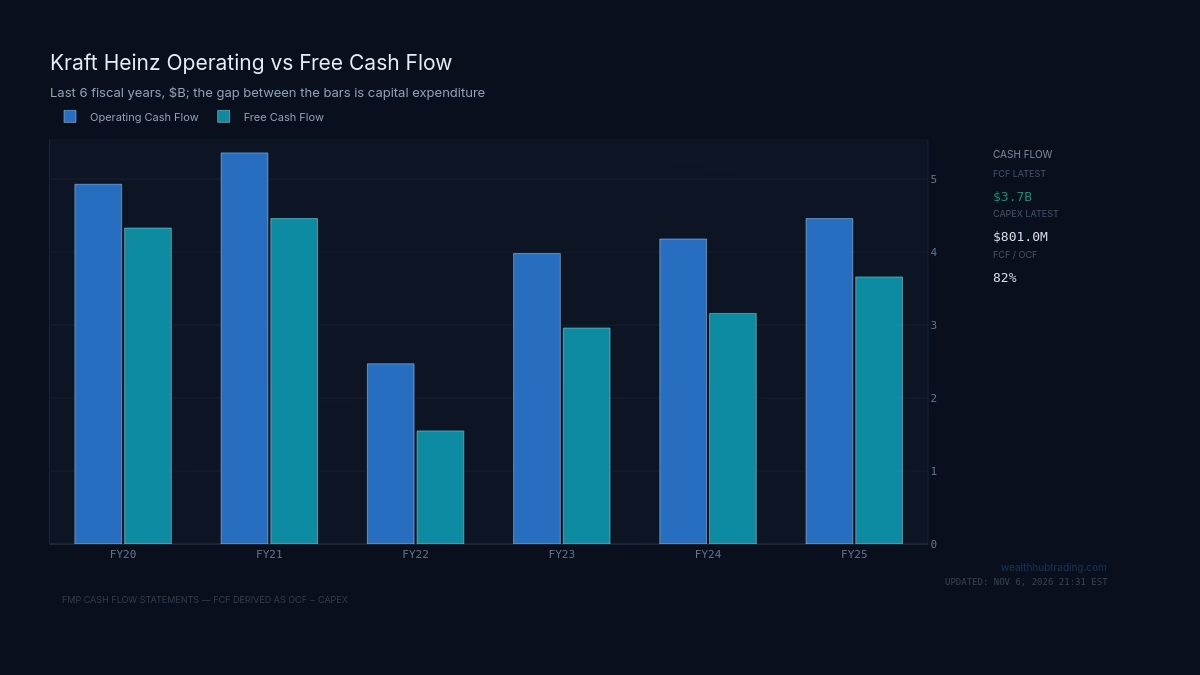
The cash flow chart above shows why the Kraft Heinz charge changed nothing about the company's cash generation in the year it was booked. The impairment hit reported earnings. Operating cash flow, which excludes non-cash charges, followed the underlying business rather than the writedown. The cash cost was paid at the 2015 closing.
The footnotes that move first
The assumptions in that example do not stay hidden. Several disclosures reliably shift before a writedown.
Headroom language. Many companies state, in the critical accounting estimates section of the annual report, which reporting units have fair value exceeding carrying value by less than some threshold, often 10% or 20%. A unit appearing on that list, or its percentage falling from year to year, is the clearest early tell.
Critical audit matters. Since fiscal years ending in mid-2019, auditors of large accelerated filers have had to describe critical audit matters (CAMs), the areas of the audit that involved especially challenging judgment. A CAM that names the goodwill test for a specific reporting unit, and lists the growth and discount rate assumptions as the challenging inputs, tells you the auditor spent real time arguing about the forecast.
Interim tests. Companies must test between annual dates when a "triggering event" occurs, such as a sustained share price decline or a lost major customer. A disclosure that an interim test was run and passed often comes one or two quarters before a failed test.
Market value below book value. When the company's entire market capitalization falls below its book equity, the market is saying the assets, goodwill included, are worth less than the balance sheet claims. Management may still pass the test using internal forecasts, but the gap between the two valuations is itself the confession forming.
Segment reorganizations. A change in how reporting units are drawn, close in time to declining headroom in one of them, deserves a direct read of the reasons given.
For you, the method is comparison over time. Read the same footnote across three or four years of annual reports. A single year tells you little. The trend in the cushion tells you where the charge is heading.
When the confession reading misleads
The "delayed confession" frame fits deal-specific impairments best. It breaks down in three situations.
First, market-wide shocks can trigger impairments with no deal error behind them. In late 2008 and early 2009, falling equity prices and soaring discount rates forced writedowns across banking, media and industrials at once. Those charges reflected a repricing of risk across the whole market, not a confession about any single acquisition. AOL Time Warner's roughly $99 billion of charges in 2002 combined both forces, a deal priced at the dot-com peak and the adoption of new accounting rules, which makes it a poor clean example of either.
Second, a small impairment is not always the start of a larger one. Companies sometimes write off goodwill on a minor unit they intend to sell, as part of portfolio cleanup. The useful question is whether the charge hit a unit that matters to the investment case.
Third, and most important, the absence of an impairment proves nothing. The reporting-unit shield described above means a failed acquisition can sit inside a healthy division indefinitely. A goodwill balance that never moves can mean the deal worked, or that something else is carrying it.
Under IFRS, used outside the US, the test runs at the level of cash-generating units and the details differ. The incentive problem is the same, and goodwill impairments cannot be reversed under either framework.
Reading the next one before it lands
Treat every large goodwill balance as an open claim management has to keep defending. Find the reporting units that hold it. Track their disclosed headroom, the discount and growth rates used in the test, and whether the auditor flags them as critical audit matters. Compare the discount rate to the direction of the company's own borrowing costs.