
A restructuring charge that appears every other year is an operating cost, and the filing usually admits it in a footnote the earnings call never mentions. The headline treats each charge as an isolated cleanup. The reserve rollforward table records something else: a recurring expense, and sometimes a pool of accrued cost that flows back into later profits without anyone announcing it.
Sunbeam and the reserve that came back as profit
The clearest case is still Sunbeam under Al Dunlap. He took over the appliance maker in 1996 and moved quickly to book a large restructuring charge, roughly $337 million before tax, covering plant closures, product line exits and workforce cuts. The 1996 loss looked enormous. That was part of the plan, because the bigger the hole in year one, the easier the recovery looks in year two.
In 1997 Sunbeam reported a dramatic turnaround. The Securities and Exchange Commission's later enforcement action alleged that a meaningful share of that improvement came from reserves set up in the restructuring and then released into income, along with other practices such as pulling sales forward. The company restated its results. The episode is the template because each step looked defensible on its own, and only the full sequence exposed the pattern.
In September 1998, SEC Chairman Arthur Levitt gave a speech called "The Numbers Game" at New York University and named the two moves directly. A big bath is an oversized charge, taken in a year that is already bad or under a new management team, that pushes future costs into the present. A cookie jar reserve is the excess part of that accrual, held on the balance sheet and released later when earnings need help.
The point to take from Sunbeam is that you cannot judge a restructuring charge by the quarter in which it appears. You judge it by what happens to the reserve over the next eight quarters.
How an accounting reserve turns a cost into a timing choice
Why does this work at all? Accrual accounting requires a company to estimate a cost before it pays it, and estimates are where discretion lives.
When a company announces a restructuring, it records an expense and creates a liability called a restructuring reserve. This is an accrued obligation for severance, lease exits, contract termination fees and similar costs the company expects to pay over the following months. The expense hits the income statement immediately. The cash goes out later, when people are paid or leases are settled.
That gap between expense and cash creates two kinds of freedom. The first is size. If management estimates high, the current year absorbs costs that would otherwise land in future periods. The second is reversal. If the actual payments come in below the estimate, the leftover reserve is reversed, and the reversal is a credit to expense, which raises reported profit in the later period.
The rules tightened after the Sunbeam era. Accounting standard SFAS 146, issued in 2002 and now codified as ASC 420, generally requires exit costs to be recognized when the liability is actually incurred rather than when management commits to a plan. That closed the widest door. It did not close all of them. Severance paid under an ongoing benefit arrangement, the kind of standard formula many large companies maintain, falls under ASC 712 and can be accrued once the payout is probable and estimable. Asset write-downs bundled into restructuring programs still depend on management's judgment about recoverable value.
For you, this means the size of a restructuring charge tells you about management's estimate, and the reversal line tells you how good or how convenient that estimate was.
Why management keeps choosing the costume
The incentive has nothing to do with fooling the auditor. It works on the analyst.
Most sell-side models and most executive bonus plans run on adjusted earnings, a non-GAAP figure that excludes items management labels as non-recurring. Restructuring charges are the most common exclusion. If a company spends $150 million a year on severance and facility consolidation, and every dollar is classified as restructuring, the adjusted earnings line never carries that cost. The valuation multiple then gets applied to a profit figure that is structurally too high.
Three actors make this stable. Management benefits because compensation targets are often set on adjusted figures. Analysts accept the exclusion because their consensus models are built around the company's own guidance framework, and deviating means explaining a different number to clients every quarter. Incoming CEOs have the strongest motive of all, because a large charge in their first year resets the baseline and gets attributed to the predecessor.
The economic reality is simpler than the presentation. A business that must cut workers and close sites every two years to stay competitive has a recurring cost of staying competitive. Calling it restructuring changes the label on the expense, not the fact of the expense.
What this means for you: when a company's adjusted margin has been expanding for years while GAAP margin is flat, the difference is a cost you are being asked to ignore, and you should decide deliberately whether to.
Reading the rollforward instead of the press release
The disclosure that matters sits in the restructuring footnote of the 10-K and 10-Q. Most companies with material programs present a rollforward, a table that starts with the opening reserve balance, adds new charges, subtracts cash payments and non-cash utilization, shows any adjustments or reversals, and ends with the closing balance.
Here is how the numbers work on a hypothetical industrial company with $4 billion in annual revenue. Assume these restructuring charges over six years: $120 million, zero, $180 million, $40 million, $210 million, zero. The company described each program as one-time.
Total charges come to $550 million across six years, an average of about $92 million a year. Against $4 billion of revenue, that is a recurring cost of roughly 2.3% of sales. If the company reports an adjusted operating margin of 14%, the margin that includes the run-rate restructuring cost is closer to 11.7%. On a business valued at 15 times operating profit, that gap is worth about $1.4 billion of enterprise value: $4 billion × 2.3% × 15.
Now add the reversal test. Suppose the rollforward for year four shows $35 million of reversals credited back to income. Year four's reported restructuring charge of $40 million was then almost entirely offset by releasing earlier reserves, and the net effect on operating profit was close to zero. Meanwhile the year-three charge of $180 million was excluded from adjusted earnings. The company excluded the charge on the way in and kept the benefit of the reversal on the way out, if the reversal ran through a line that adjusted earnings included. That asymmetry is the modern cookie jar, and the footnote is the only place it appears.
There is a cash check as well. Restructuring cash payments flow through operating cash flow under US accounting rules, whatever the adjusted EPS figure excludes. A company whose operating cash flow never seems to recover to the clean level implied by its adjusted earnings is showing you the recurring cost in the one statement that cannot be relabeled. IBM, which has reported workforce rebalancing charges across multiple years, is a useful company to practice this comparison on.
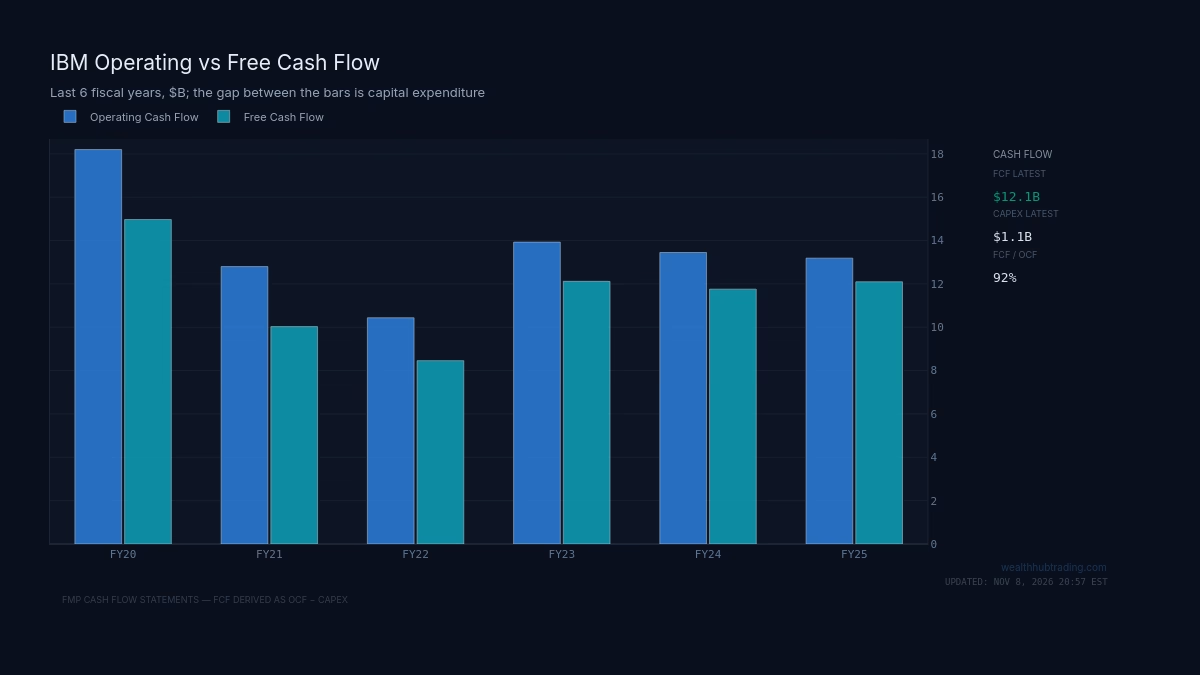
The practical rule: add up five or more years of restructuring charges, divide by years, and treat the average as an operating expense. Then read the reversal line every quarter and ask which earnings figure it landed in.
When the one-time label is honest
The test above will mislead you in specific situations, and applying it mechanically is its own error.
A genuine exit is a one-time event. When a company sells or closes an entire division and leaves that business, the associated costs do not recur, because the activity generating them no longer exists. Averaging a single large divestiture charge across six years overstates the run-rate cost of the remaining business. The distinguishing feature is whether the charge removes a business or merely reshapes the same one.
Reversals are not always manipulation. Severance estimates depend on how many employees accept voluntary packages, how many find internal transfers, and how lease negotiations resolve. A modest reversal after a large program is consistent with honest estimation error. The signal sharpens when reversals are large relative to the original charge, cluster in quarters where the company narrowly met guidance, or repeat across several programs in the same direction.
Size relative to the business matters too. A restructuring charge of 0.3% of revenue every few years is housekeeping. Normalizing it into margins changes little and is not worth arguing over. The method earns its keep when cumulative charges reach the low single digits of revenue and recur on a cycle.
Finally, a new management team inheriting a genuinely bloated cost base may take one large, accurate charge that is followed by real improvement. Sunbeam shows what the fraudulent version looks like; the honest version looks identical in year one. Only the following years separate them, which is why the reserve rollforward has to be read over time rather than at the announcement.
The implication: before normalizing a charge, classify it. Exits get excluded, recurring reshaping gets averaged in, and reversals get tracked against the quarter they rescued.
The habit that replaces the headline
A restructuring charge is a management estimate of future cash costs, pulled forward into the present, and its truthfulness only becomes visible when the reserve is spent or released. The market prices the headline adjusted figure because that is what guidance supplies. The filing prices the cost, quarter by quarter, in the rollforward table and the cash flow statement.
So when you next see a company describe a charge as non-recurring, check the prior five annual reports for the same line. If it is there in most of them, you are looking at a cost of doing business, and your margin estimate and your valuation should carry it.