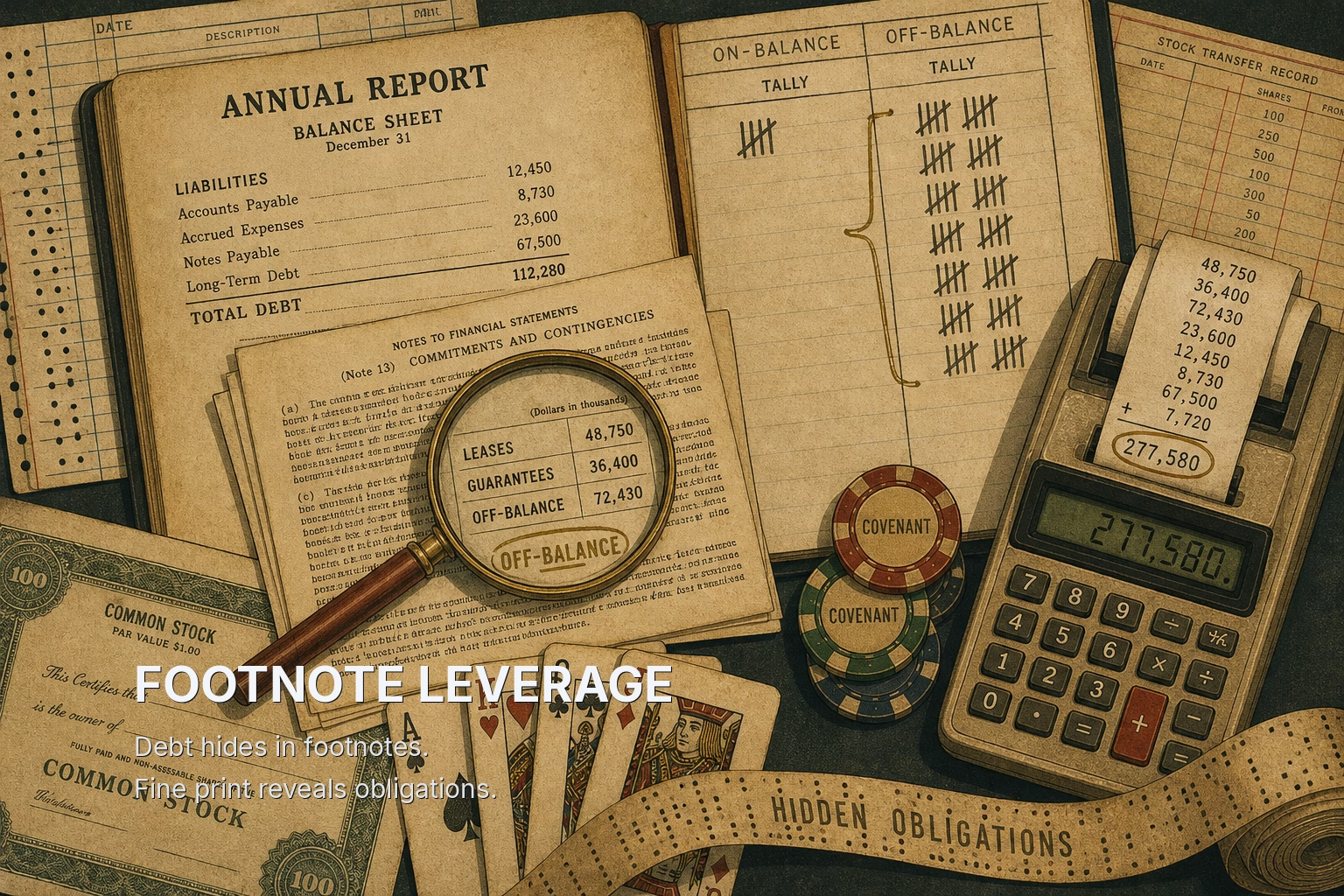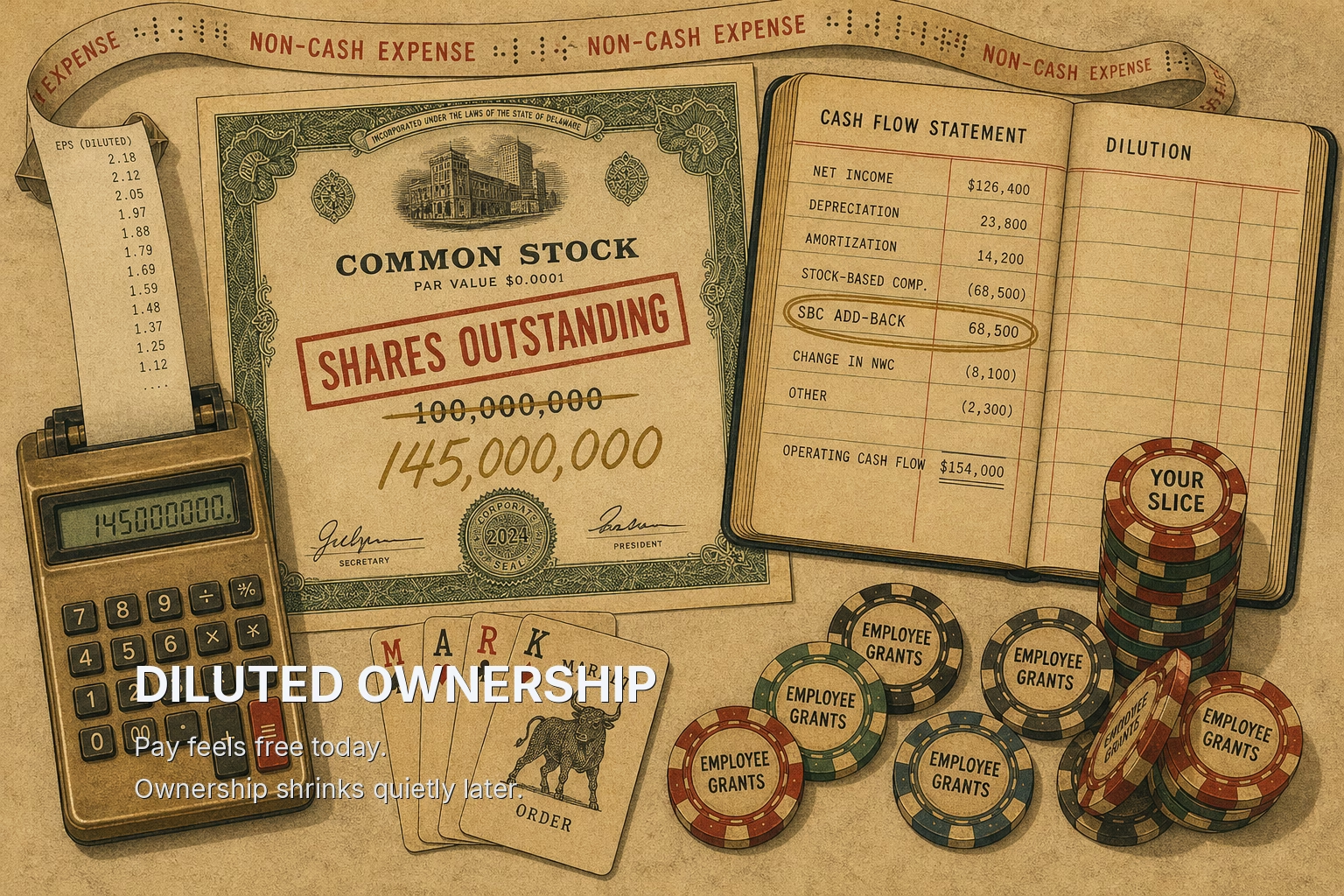
The most consequential number in a software company's annual report usually sits in a footnote and in the share count, not on the income statement line management wants you to read. Adjusted earnings remove stock-based compensation (SBC) because no cash changes hands when it is granted. The filings then quietly record what happens next: more shares outstanding, or cash spent on buybacks to hide the new shares. Either way, the expense was paid. The market prices the headline. The cost lives in the disclosures.
The fight Congress had in 1994
The cleanest illustration of how this expense hides is the accounting war of the early 1990s. Under the rules then in force, a company that granted employees stock options at the current market price recorded no expense at all. The logic was mechanical: an option struck at today's price has no intrinsic value (the gap between the share price and the exercise price) on the day it is granted, so the accounting charge was zero.
The Financial Accounting Standards Board, the body that writes US accounting rules, proposed in 1993 to require companies to expense options at their fair value. Technology companies and their investors lobbied hard against it, and the Senate passed a resolution urging the board to back down. It did. The standard that emerged in 1995 let companies keep options off the income statement and disclose their estimated cost in a footnote instead.
The footnote became the most ignored page in the filing. Warren Buffett put the problem plainly in his shareholder letters: if options are not compensation, what are they, and if compensation is not an expense, what is it? Through the late 1990s, reported profits at option-heavy companies were flattered by a cost that every employee understood as part of their pay. Only after the accounting scandals of the early 2000s did the board finish the job, with a revised standard issued in late 2004 that forced options and stock awards onto the income statement at grant-date fair value.
The episode matters because the industry's response to losing that fight was to move the argument one layer up. SBC now appears in GAAP earnings. Management then removes it again in "adjusted" or "non-GAAP" figures, and much of the analyst community has adopted the adjusted figure as its anchor. The 1994 footnote is back, wearing a press-release format. For you, the lesson is that any number a company volunteers in place of GAAP deserves the same suspicion the old footnote earned.
Why stock pay is a real cost
Stock-based compensation is payment to employees in shares or share rights rather than cash. The common forms are restricted stock units (RSUs, promises of shares that vest over time) and options. The company records the grant-date fair value as an expense spread over the vesting period.
The argument for adding it back runs like this: no cash left the building, so the charge is not "real." The flaw is in who pays. When a company issues a new share to an employee, the company itself spends nothing, but every existing shareholder now owns a smaller fraction of the same business. The employee is paid with your equity. A cash salary would have reduced the company's bank balance; a share grant reduces your ownership. The economic effect on you is the same.
Why do companies prefer this currency? Three incentives line up. First, it preserves reported cash and lets free cash flow look larger. Second, the expense is easy to strip out of adjusted metrics, which then drive analyst models and often executive bonuses. Third, employees at fast-growing firms accept it because they expect the shares to appreciate. None of these reasons changes the fact that the shareholder base is funding a payroll.
The practical move is to treat SBC exactly as you would a cash wage of the same size, then ask what the business earns after paying its people.
How the cash flow statement flatters
The cash flow statement under the indirect method starts with net income and adds back non-cash charges. SBC is one of those add-backs. So operating cash flow, and therefore free cash flow (operating cash flow minus capital spending), is reported as if the employee pay never happened.
That add-back is technically correct as a measure of cash movement in the period. It is analytically misleading as a measure of what owners keep, because the cost has been deferred into the share count. Many companies then close the loop by buying back stock to offset the new issuance. The buyback appears in the financing section, below free cash flow, where most valuation screens never look. The result is a circle: the expense is excluded from earnings, excluded from free cash flow, and then paid in cash through a line almost nobody subtracts.
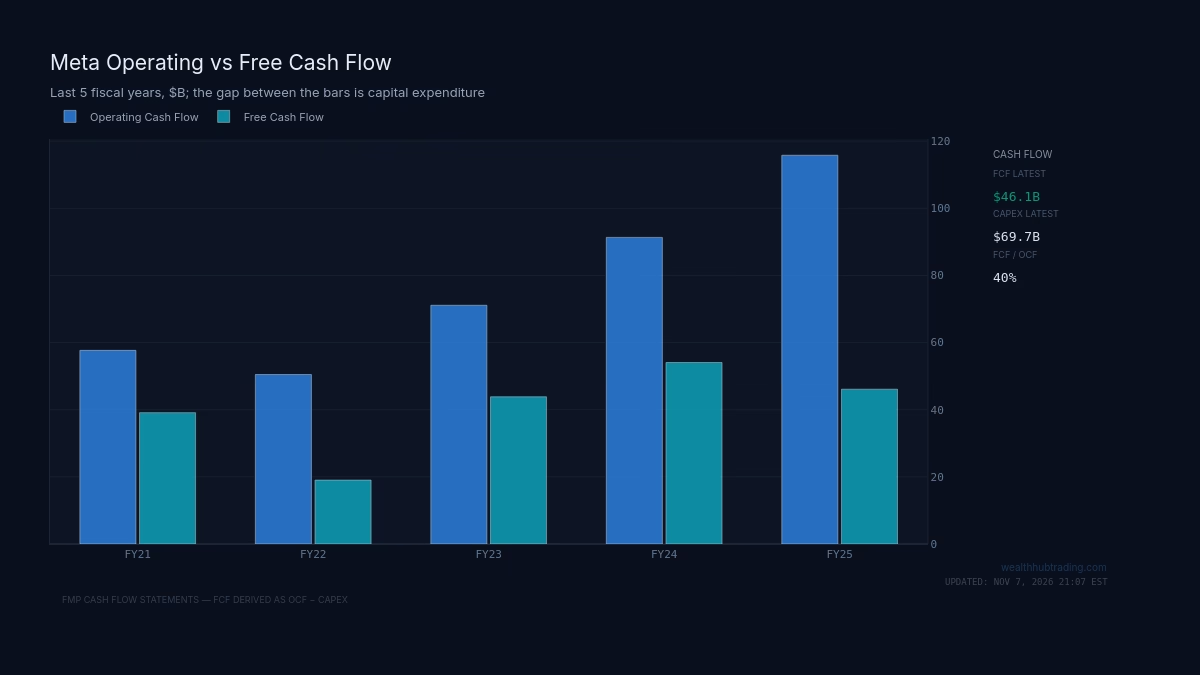
The chart uses Meta Platforms as an illustration of the structure, not as a verdict on the company. The gap between its operating and free cash flow bars is capital spending. The stock-pay add-back sits inside the operating bar and is not visible as a gap at all. To see it, open the cash flow statement and find the stock-based compensation line, then find the repurchase line in financing activities. Those two lines, read together, tell you how much of the reported free cash flow was actually spent keeping the share count still.
A worked example in numbers
Take a hypothetical company with $10 billion of revenue, $1.0 billion of GAAP operating income, and $1.5 billion of SBC. Its adjusted operating income is:
Adjusted operating income = GAAP operating income + SBC = $1.0B + $1.5B = $2.5B
On the adjusted figure, the margin is 25%. On GAAP, it is 10%. The press release leads with 25%.
Now the share count. The company has 1,000 million shares at $60. Its annual grants add 25 million new shares, about 2.5% gross dilution. To hold the count flat, it repurchases 25 million shares:
Buyback cost = 25M shares × $60 = $1.5B
Reported free cash flow is $3.0 billion. Subtract the repurchases required just to stand still, and the cash available to owners is:
Owner free cash flow = $3.0B − $1.5B = $1.5B
Half of the headline free cash flow was payroll. On a market value of $60 billion, the reported free cash flow yield is 5.0%; the honest yield is 2.5%. That difference alone can separate a cheap stock from an expensive one.
Suppose instead the company does not buy back stock and simply lets dilution run at 2.5% a year. After ten years:
Ownership retained = 1 / (1.025)^10 = 1 / 1.280 = 0.781
A shareholder who held a fixed number of shares now owns about 22% less of the company. Per-share earnings must grow 28% faster than total earnings just to keep pace. This is the compounding claim the signal describes: each year's grants stack on the last, and the claim on your equity grows like interest on a debt you never signed.
The practical check is the diluted weighted-average share count across five years of filings. If it is rising, dilution is unpaid. If it is flat while SBC is large, buybacks are paying it in cash.
Where the honest read breaks down
Subtracting SBC is the right default, but applied carelessly it can mislead in four ways.
Double counting. If you deduct SBC from earnings and also divide by a share count that already includes future grants, you charge the same cost twice. Pick one method: either expense SBC and use the current diluted count, or ignore the expense and model the share count growing. Do not do both.
Grant-date pricing. The expense is fixed at the share price on the grant date. If the stock then falls 50%, the employee receives far less than the expense recorded, and the company often issues refresh grants to retain staff. The share count can rise faster after a selloff than the income statement suggests, because more shares are needed to deliver the same dollar value of pay. Read the footnote on shares granted, not only the dollar expense.
Net settlement. Many companies withhold shares at vesting and pay the employee's tax bill in cash. That cash sits in financing activities and is a genuine outflow tied to stock pay. A company can look modestly diluted while spending heavily on these tax payments.
Early-stage substitution. A young company with little cash may use stock pay because it cannot afford the wage bill. Here SBC is a financing decision as much as a compensation one, and the question is whether the growth funded by that dilution earns more than the ownership it costs. The expense is still real; the judgment is about its return.
The practical implication is that the honest read is one consistent method applied across companies, not a reflexive subtraction.
Reading the filings, not the guidance
When a company guides to adjusted margins, it is guiding to a number that excludes part of its wage bill. The filings disclose the rest: the SBC line on the cash flow statement, the equity compensation footnote with unvested awards and expected future expense, the repurchase line, and the diluted share count. The unvested-awards figure is especially useful, because it shows the cost already committed for future years that adjusted guidance will never mention.
Compare SBC to revenue across peers. A company spending 15% of revenue on stock pay and one spending 3% can report similar adjusted margins while delivering very different returns per share. Then compare SBC to free cash flow. When stock pay approaches or exceeds free cash flow, the business is, in owner terms, much less cash-generative than its marketing suggests.
The mechanism comes down to one sentence: stock-based compensation is a wage paid in ownership, and the cost arrives either as dilution or as buybacks that consume the cash the add-back pretended was free. Read SBC as a cash cost, track the diluted share count, and you will price the claim on your equity that the adjusted figure was built to hide.