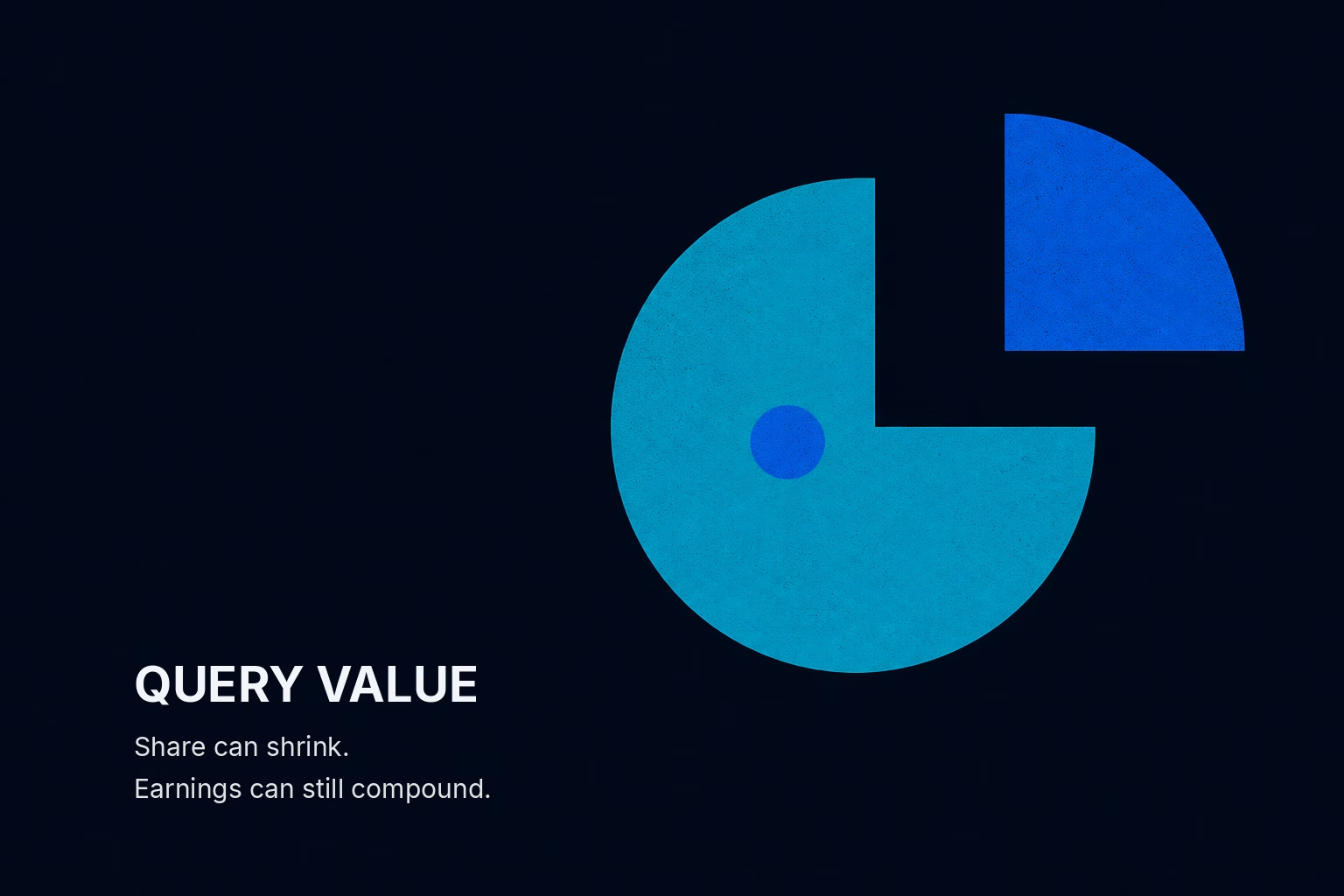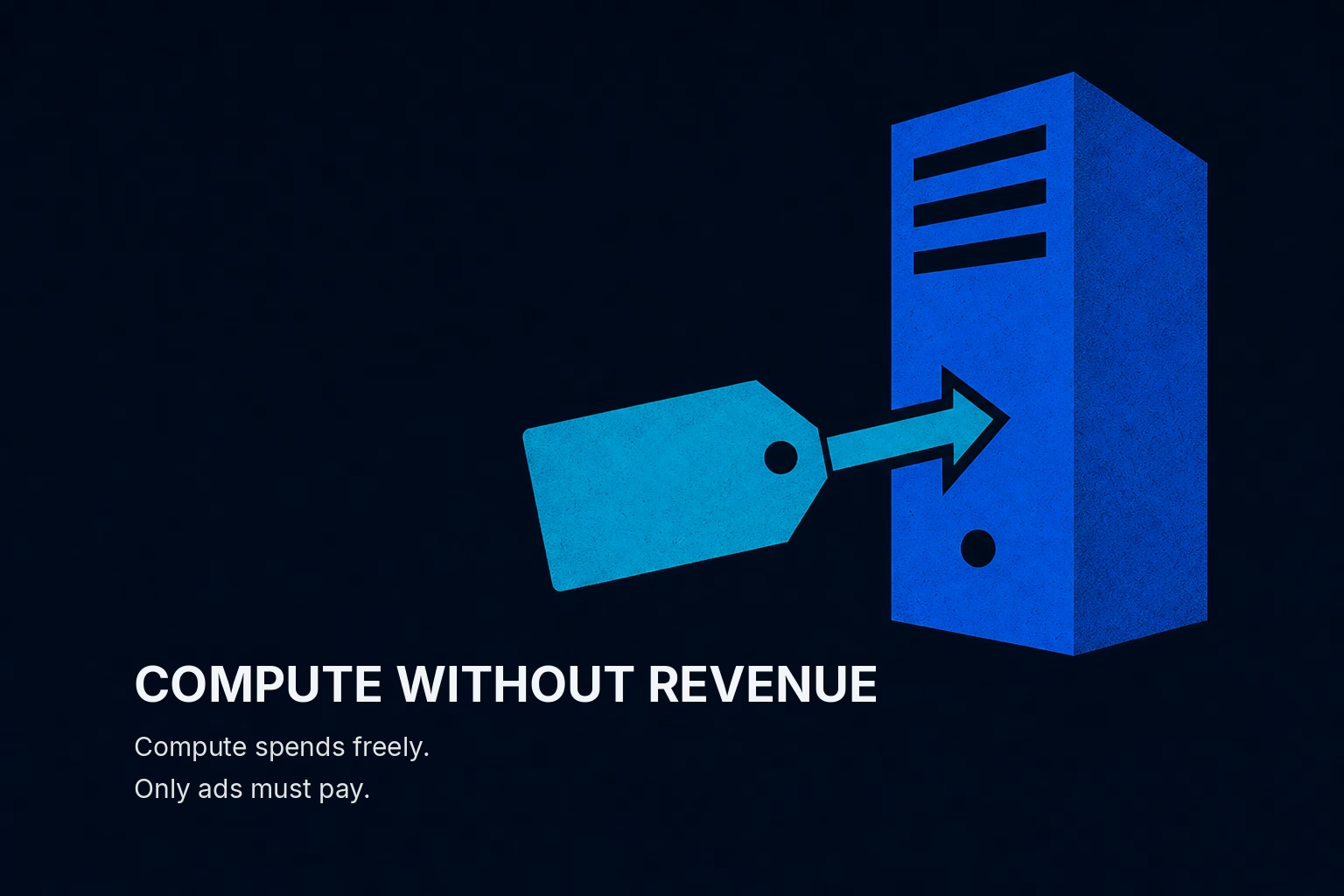
The most useful input to a Meta advertising model right now comes from a company that sells no advertising at all. Anthropic's S-1 shows that the share of its compute serving paying customers fell from 44% in the first half of 2025 to roughly 25% in the latest period the filing covers. The rest went mostly to research and training. If frontier compute is mostly a training expense, then the familiar modeling instinct, that every incremental dollar of Meta capex must be matched by revenue it "pays for," is backwards. The ad forecast should not be built to justify the capex. It should be built on its own drivers, and whatever capex those drivers cannot absorb belongs in margins and depreciation.
That is the logic behind rebuilding a Meta model from scratch instead of patching an old one, and it starts with advertising, the piece of the business where the temptation to link spend and revenue is strongest.
Capex Is Not a Revenue Line
The earlier framework had a defensible premise. Over time, inference would become the dominant use of compute. Near-term capex would still go mostly to training, but by 2028-30 most incremental spend would serve users. Under that view, a model that assumed heavy capex without crediting the revenue that capex served would simply be wrong, because inference capacity exists to handle demand that is already monetizing.
The premise contains a hidden assumption: that the training phase is a temporary hump and the steady state is inference-heavy. The Anthropic disclosure points the other way, at least for now. The paying-customer share of compute is not climbing toward dominance. It nearly halved. Training is absorbing a growing share of the fleet even at a company whose entire business is selling inference.
For a Meta model, this changes the direction of causation the analyst should assume. A model built on "capex implies revenue" lets the capex guide set the ad forecast. A model built on "capex is mostly training" forces the ad forecast to be justified independently, and treats the gap as a cost the business must carry. The second approach is more conservative on margins and more honest about advertising.
What a Frontier Lab's Compute Mix Reveals
The Anthropic figure matters because it is one of the few hard, disclosed numbers on how frontier compute is actually allocated. Most public discussion of AI capex is framed around demand: data center buildouts, chip orders, power contracts. Almost none of it says what fraction of the resulting capacity earns revenue on the day it is switched on.
Three implications follow for Meta.
First, training does not earn revenue directly. A model trained this year contributes to revenue only through what it later enables, and that contribution passes through products, engagement and pricing with a lag that a capex schedule cannot see.
Second, the training share can rise even as inference demand grows. A lab selling inference still saw its customer-serving share fall, which means capacity additions are outrunning the monetized load. The more competitive the frontier, the more compute goes to staying in the race.
Third, and most important for Meta, a large portion of incremental capex may never produce commensurate revenue, at least not in a form traceable back to the spend. That does not make the spend irrational. It makes it a strategic cost, closer to R&D than to a factory that ships units.
The link from Anthropic's mix to Meta's mix is inferred, not disclosed. Meta does not publish a comparable split, and the businesses differ in ways covered below. The direction of the lesson is sound even where the magnitude is unknown.
Advertising as Impressions Times Price
Strip advertising back to its mechanics and it is two numbers multiplied together: how many ads Meta serves, and what advertisers pay for each one. Meta reports growth in both, ad impressions and average price per ad, which gives a model a decomposition that is anchored in disclosed data rather than in the capex plan.
Each driver has a distinct engine.
Impressions depend on users and time spent. More daily users across the Family of Apps, more sessions per user, more minutes in feed and short video, and the ad load Meta chooses to run inside that time. AI affects this channel through recommendation quality: better content ranking keeps people scrolling longer, and longer sessions create more inventory.
Price per ad depends on how much value advertisers extract from each impression. That is a function of targeting, measurement and conversion. When ranking and retrieval systems put an ad in front of someone more likely to act on it, the advertiser's return rises and auction prices follow. AI affects this channel through ad relevance, not through raw serving capacity.
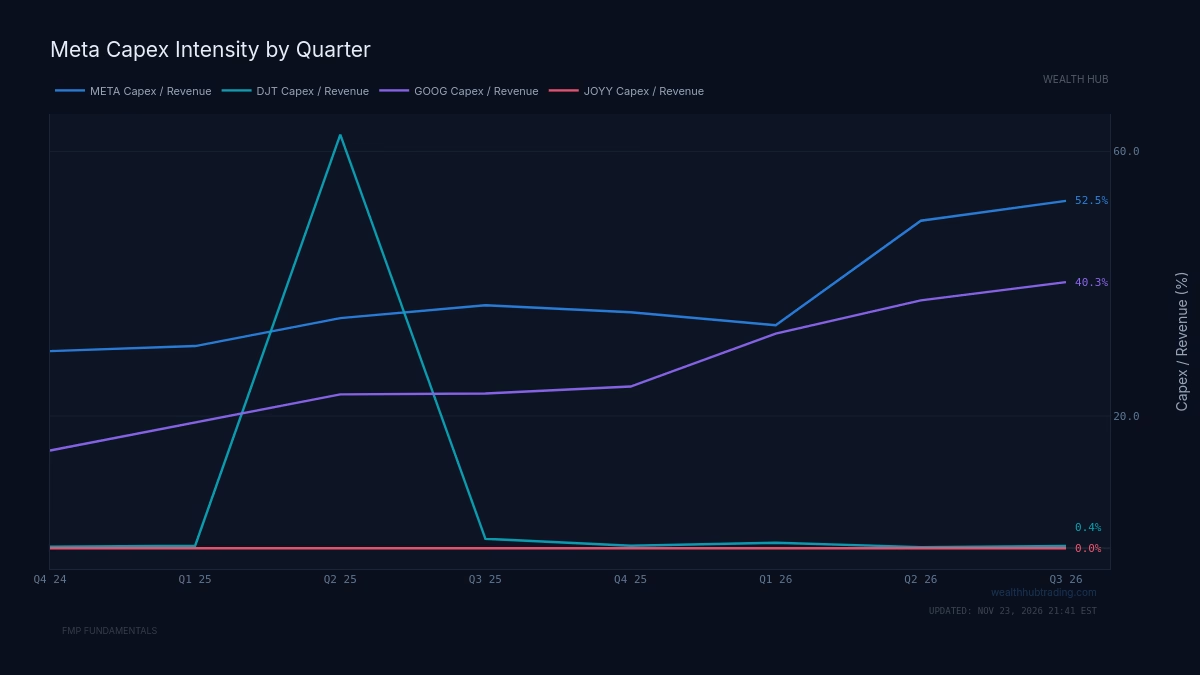
Neither driver scales with capex one for one. A recommendation model that is 5% better can lift engagement across billions of sessions without a proportional increase in compute spend, and a capex surge aimed at frontier training may move neither driver for years. Modeling advertising off users, engagement, ad load and pricing keeps the forecast tied to quantities Meta reports, and quarantines the capex question in the cost side of the model where it belongs.
This also explains why the revenue taxonomy matters. Meta reports two segments, Family of Apps and Reality Labs, but revenue resolves more cleanly into three pieces: advertising and "other revenue," both inside Family of Apps, plus Reality Labs. Costs are best placed next to the revenue they support wherever that is possible. Advertising is the piece where that pairing is cleanest for serving and ranking compute, and murkiest for frontier training, which is why separating the two is the core design decision.
Where Meta Differs From a Model Lab
The strongest objection is that Meta is not Anthropic, and the objection has real force.
A frontier lab's inference load is set by paying API and subscription customers. Meta's inference load is set by billions of people opening its apps every day, with every feed refresh, every Reel and every ad auction running ranking models in real time. That serving workload is enormous and already monetized through advertising. A company with that much always-on inference could plausibly run a far higher inference share than any lab, which would make the Anthropic ratio an overstatement of Meta's training burden.
The objection also points at the type of training. Much of Meta's model work is on ad ranking, retrieval and content recommendation, systems that feed directly into impressions and price per ad. Training on those systems is not a frontier-race expense with a distant payoff. It shows up in the auction within quarters.
Both points are correct, and both reinforce the case for separation rather than against it. If Meta's compute splits into a monetized recommendation-and-ads layer and a frontier general-model layer, a model should credit the first with ad revenue through the impression and pricing drivers, and treat the second as an investment cost until a product proves otherwise. The mistake would be to blend them and let the frontier spend borrow revenue credibility from the ads stack.
What remains genuinely unknown is the size of each layer. Meta does not disclose it, and any split an outside model assumes is an estimate. The rebuild later in this series takes up the costlier pieces directly: Muse, capex, margins and depreciation, with the full model to follow in Part 3.
The Decomposition That Settles It
The read here is that Meta's ad revenue should be modeled as if the capex guide did not exist, because for a large share of that spend it effectively does not touch advertising. The capex then becomes a test of margin resilience rather than an input to revenue.
The disclosed decomposition is where the test resolves. If price per ad keeps compounding while capex accelerates, the AI spend is earning indirectly through conversion and relevance, and the monetized layer is larger than the Anthropic analogy implies. If capex climbs while price-per-ad growth stalls and revenue leans on impression volume alone, the incremental spend is functioning as a cost with no visible ad return, and depreciation will do the talking in the margin line. That split between pricing and volume, reported every quarter, is the observable that decides which version of Meta the model should carry.