Meta looks like the more speculative of the two companies, and that impression is mostly an accounting artifact. Meta's AI bet sits on the balance sheet, where everyone can see the capex. Anthropic's bet runs through the income statement, where it reads as operating cost. The more important difference is what each company owns if its bet fails. At Meta, the ads business keeps earning whether or not the AI program pays off. At Anthropic, the "safe" API revenue is itself a function of staying at the frontier. At roughly the same price, one of these businesses leaves an investor room to be wrong and the other does not.
The reported valuations make the comparison unusually clean. Anthropic is expected to list near $1.5 trillion, with some investors reportedly pushing toward $1 trillion after last week's AI selloff. Meta's enterprise value is also about $1.5 trillion. Each company has a core that makes money today and a bet on what comes next. The useful test is how much of each price depends on the bet.
Where the Speculation Hides
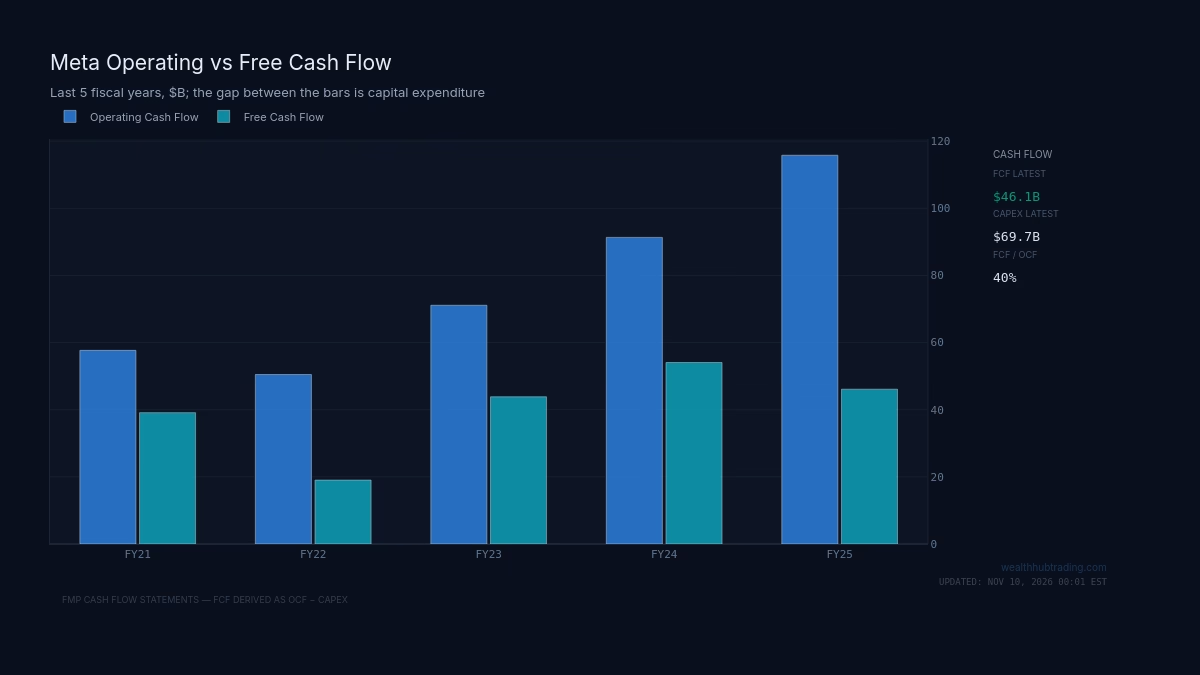
Meta's numbers are large and public. Capex is planned at $135 to $145 billion this year, about 3.5 times the 2024 level. Meta does not break out how much goes to Meta Superintelligence Labs and related AI work. Estimates from MBI Deep Dives, built two different ways, both put about 60% of this year's capex on the bet, and about two-thirds of the roughly $212 billion consensus capex for next year. Much of that money funds products such as Muse and the Meta Enterprise Platform, which have not settled their economics or have not fully launched. Zuckerberg has said Muse must become more than 10 times cheaper to run before it can be profitable at scale.
Anthropic is making a similar bet, and it shows up in a less obvious line. Anthropic says demand exceeds the compute it has, and it took delivery of $5 billion of short-term compute from SpaceX at prices well above its multi-year contracts. Even so, the share of its compute serving paying customers fell from 44% in the first half of 2025 to about 25% in the third quarter of 2026. The rest goes to research, training and the free tier.
A supply-constrained company that keeps shrinking the share of compute it sells is wagering that compute earns more in training than in serving. That wager has two parts. The first is that research makes serving cheaper, and so far it has. Quarterly revenue grew about 29 times over that period while serving compute grew about 5 times, so each serving dollar now earns roughly six times what it did. The second part is that the models keep improving, because the first-party products Anthropic will eventually depend on need that.
Neither company is spending conservatively. Meta's bet is simply easier to see.
The Compounding Loop and Its Price Tag
The reason every frontier lab is pushing this hard is a feedback loop. Take two labs with equal compute, one of which has the better model. Customers pay more for the better model, so the leader needs a smaller share of its fleet to hit its revenue target and can put the rest into training. The next model widens the gap. The lab that falls behind gets squeezed in the opposite direction, unless training does not depend on inference revenue at all. Meta's ad business provides exactly that independence.
There is outside evidence that the loop is speeding up. METR spent eleven weeks inside Anthropic and found its models gaining about 15 points a year on a capability index before October 2025 and about 29 points since, a 1.9 times acceleration. METR attributes roughly 80% of that to AI itself rather than faster growth in training compute. Anthropic's amended S-1 warns that it may soon meet its own definition of "dramatically accelerated progress attributable to AI."
The acceleration has been expensive. R&D expense rose from about $1.9 billion in the first half of 2025 to about $9.7 billion a year later. As Michael Wiebe and Séb Krier pointed out, benchmark progress per R&D dollar fell about 60% over that stretch even as progress per year doubled. Revenue per R&D dollar is the better test of whether research pays for itself. It rose from $0.74 in 4Q'25 to $1.91 in 2Q'26, then slipped to $1.78 in 3Q'26 as R&D grew faster than revenue. More of the costly short-term capacity is still arriving, so the ratio has room to keep falling.
On capital efficiency, Anthropic deserves real credit. John Hempton estimates it has spent just under $20 billion on compute in its history, about $12 billion of that on training, and still has what he calls "clearly at the moment the best model." Counting only what hits the income statement, Anthropic has spent about $26 billion on compute since the start of 2025. On MBI's estimates, Meta's AI compute has cost about $16.5 billion. Because Meta owns its fleet and avoids a cloud provider's margin, that would equal about $26.5 billion at rental prices. The spend is roughly the same, and Meta got to Muse Wonder in about 15 months, though that model still looks about a generation behind the frontier. Owning the fleet buys Meta cheaper compute, and Meta carries the capital risk in exchange.
A Floor Priced at Ten Times
The decision variable is what the market pays for each company's floor, the business that earns regardless of how the race turns out.
For Meta, the floor is advertising, and advertisers pay for outcomes. Better ranking models produce better advertiser returns, which support higher ad prices. No advertiser can bring in a cheaper open-weight model to run Meta's auction. The ads business does not need Meta to win the AI race, but it benefits when Meta does well in it. On the 3Q'26 call, Meta said its Muse models cut per-unit content processing costs by more than 80% in offline tests.
Here is the arithmetic. Consensus 2027 EBIT is about $105 billion. Add back the roughly $15 billion Reality Labs is guided to lose and about $35 billion of estimated MSL and AI costs, and the core ads business earns something like $155 billion. Against a $1.5 trillion enterprise value, that is about 10 times EV to EBIT for the core alone. The MSL cost figure is an estimate, because Meta does not disclose it. Two separate methods land at $35 to $36 billion, which is close enough to make the multiple a useful approximation rather than a precise one.
Meta itself admits that line is blurring. Capacity moves between training, the core and new products, and MSL models already feed content understanding, ranking research and ad creative tools. Some of what is counted as the bet will show up as better ads. That makes the 10 times figure more conservative, not less.
Why the Meter Is the Weak Point
Intuition says Anthropic's API is its Meta-style floor: existing customers, recurring usage, fast growth. The mechanism points the other way. About 80% of revenue in the first half of 2026 was billed by usage, and only about 20% came from subscriptions. A meter invites customers to optimize against it, and Anthropic's largest customers are doing so.
DoorDash co-founder Andy Fang has said the company's AI spend rose 20 times from January to June before flattening. DoorDash then built its own benchmark and worked with Applied Compute to train its own models. A good return does not remove the incentive to cut the bill. If a cheaper model does nearly as well, the return improves further. On Microsoft's FY27 Q1 call, Satya Nadella said customers are asking, "Can I own the weights? Can I manage my costs?"
Metering alone is not the problem; AWS meters too, and leaving AWS is painful. The API faces several pressures that reinforce one another:
- Spend that a sophisticated buyer can break down into cost per task.
- Drop-in rivals often a one-line change away. About 44% of Anthropic's revenue through September came through cloud marketplaces such as Bedrock and Foundry, where switching models is easy.
- A substitute that keeps getting cheaper. Epoch estimates the cost of a fixed level of performance has fallen about 47% a quarter since 2023.
- A bill large enough for a CFO to notice.
- Buyers increasingly able to build the substitute themselves.
Each pressure feeds the next. A large bill gets scrutinized, evals show when a cheaper model is good enough, and the switch takes a line of code.
Usage APIs have shown this pattern before. Uber was 14% of Twilio's revenue in 2016. As its bill grew, Uber moved work in-house and to other vendors, and its spend at Twilio fell from about $39 million in 2016 to about $32 million in 2017. The largest, most sophisticated customers are often the first to insource, because their bill is the one big enough to justify a team to replace it.
The S-1 already shows some of this. Models released in the six months to September 30 made up more than 80% of third-quarter revenue, and the filing cites $600 million of price reductions and contractual discounts in 3Q'26. Revenue that depends that heavily on recent releases is hard to value as a durable floor. Hempton's chemicals analogy fits. Selling tokens resembles the pellet plant: enormous fixed cost, low marginal cost, persistent competition. Meta's ads resemble the enzyme maker, which takes a small slice of a very large pie and prices on results. Muse is pitched the same way, with no model picker, so Meta can swap in cheaper models and keep the savings.
What Breaks the Read
The strongest case for Anthropic is that it is not Twilio. Its customer base is broadening quickly, which is how Twilio eventually got past its Uber problem. If the frontier keeps accelerating at the pace METR measured, new tasks that only the frontier can handle may arrive faster than customers can distill the old ones onto cheaper models. In that world, the meter stays full because the work keeps getting harder.
The case against Meta is real too. Reality Labs has absorbed more than $100 billion with no sign of positive economics. Every new speculative program reasonably raises the question of whether it is another Reality Labs. Muse still lacks a business model, and a model a generation behind the frontier is exactly the position the compounding loop punishes. The 10 times core multiple also depends on undisclosed cost splits.
None of that changes the shape of the payoffs. If MSL disappoints, a Meta shareholder still owns an ads business at about 10 times 2027 EBIT, and the loss is the capex: painful, but bounded. If Anthropic's bet disappoints, the API's value falls with it, because the API depends on staying meaningfully ahead. Anthropic's floor is built from the bet.
Three Ratios That Decide It
Anthropic's route to a real floor requires non-metered revenue to overtake metered revenue, a large shift from today's 80/20 split. If usage revenue merely doubles over five years, everything else must grow about 8 times to pass it. That has to happen while much of Anthropic's distribution runs through clouds that compete with it.
After listing, three disclosures will show whether the loop is working:
- Serving share against revenue per serving dollar. If the serving share keeps falling while revenue per serving dollar keeps rising, Anthropic is earning more from each unit of compute it sells and putting the rest into the next model.
- Revenue per R&D dollar. The slip from $1.91 to $1.78 needs to reverse. A rising ratio is the clearest sign that research pays for itself.
- Subscription share of revenue. A rising share means Anthropic is building a floor that does not depend on staying ahead.
For Meta, the only open question is whether Muse finds a business model and gets cheap enough to run.