Kazakhstan pumps roughly 2 million barrels a day, but the number that matters is not what the fields produce. It is what can leave. Nearly all of it exits through one Russian port, Novorossiysk, via a pipeline whose loading terminal was partially disabled by a Ukrainian sea drone in November. The consensus reads Kazakh output as a supply-growth story bolted onto Chevron, Exxon, Shell and Eni balance sheets. The actual exposure is a chokepoint the war has now demonstrated it can close, and that no Western operator controls.
The Barrel That Cannot Reach Water
Kazakhstan's oil boom is real. Chevron's 1993 entry into Tengiz, followed by Karachaganak and the enormously complex Kashagan development, roughly doubled national production through the 1990s and set the trajectory that reached the 2 million bpd level in 2025. That is the part the supermajors put in investor decks.
The part they footnote is geography. Kazakhstan is landlocked. Its principal export artery, the Caspian Pipeline Consortium line, runs across Russian territory to Novorossiysk on the Black Sea and carries close to 1.4 million bpd, the large majority of Kazakh crude that reaches world markets. The pipeline's build-out coincided almost exactly with Vladimir Putin's arrival in power around 1999 and 2000, which is the first uncomfortable fact: the takeaway capacity for Western-produced Kazakh oil was constructed through, and remains dependent on, the territory of the state those same barrels are meant to be independent from.
Independence from Moscow was always partial. A production-sharing agreement does not move a barrel to a tanker. A mooring buoy does.
Novorossiysk Is the Whole Position
Novorossiysk is not a Kazakh problem alone. It is a primary conduit for Russian crude and grain, which is precisely why it sits on Ukraine's target list. Kyiv's drone and unmanned-boat campaign against Russian export infrastructure has treated the port as a legitimate military objective for two years.
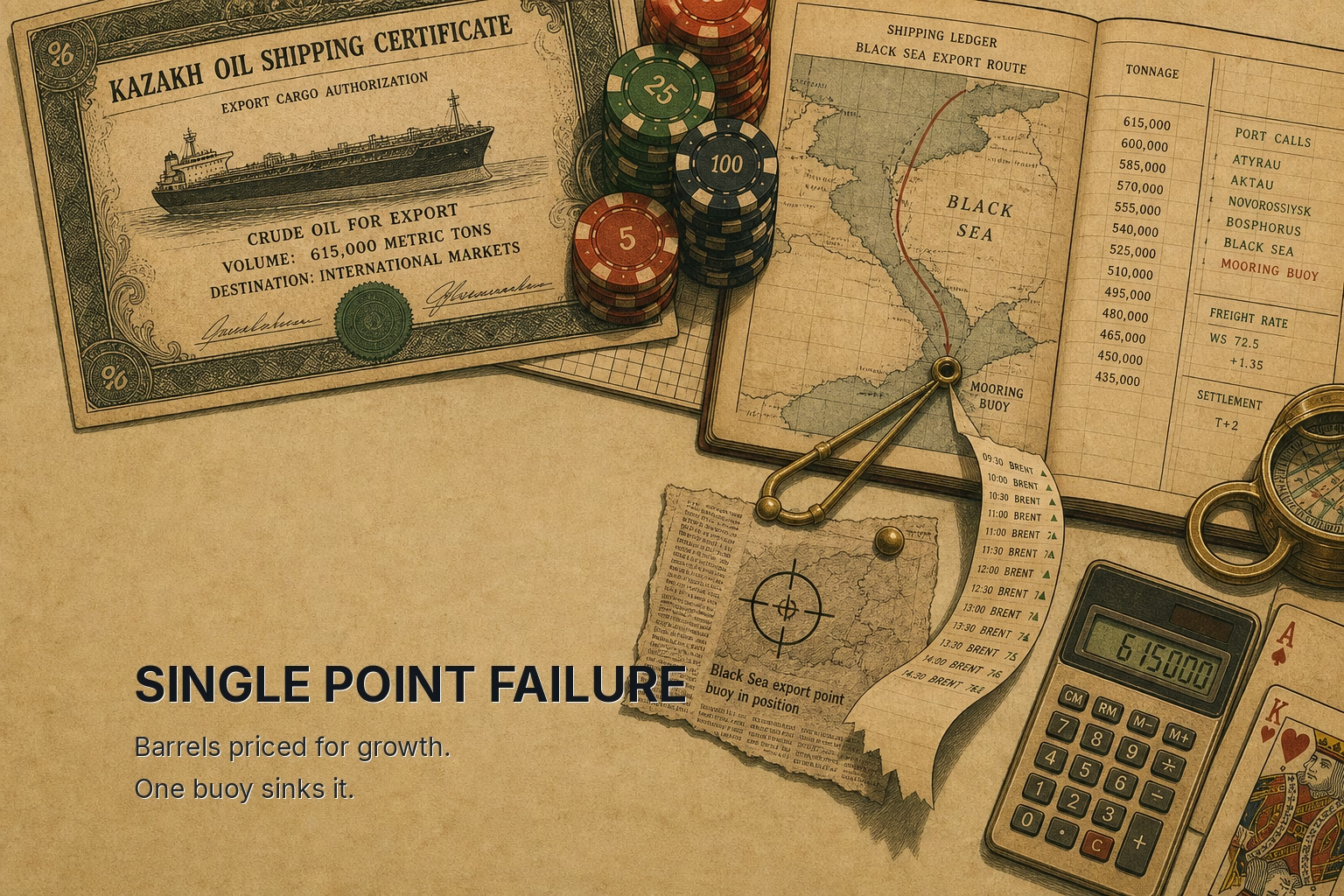
On November 29, that campaign reached the CPC terminal directly. The consortium halted loading after one of its three single-point moorings, mooring 2, was, in the operator's words, significantly damaged and rendered inoperable. Tankers were pulled from the water area. Shipments were suspended until the drone and unmanned-boat threat was cleared.
Read the mechanism carefully, because this is where the market misprices the risk. The vulnerable node is not the fields, not the 1,500-kilometer pipeline, not the storage. It is three offshore mooring points where crude transfers into tankers. Take out a mooring and the entire upstream chain backs up regardless of how much oil Tengiz can produce. Kazakh production capacity is not the constraint. Loading capacity at one Russian port is. When a single buoy carries a third of a nation's export throughput, that buoy is the asset, and it is the asset most exposed to a shooting war.
The strategic weight of this was made explicit by Washington's response. The State Department delivered a formal démarche to the Ukrainian ambassador over the CPC strike, an extraordinarily pointed diplomatic rebuke to a government almost wholly dependent on American support. Governments do not spend that kind of capital over a symbolic hit. They spend it when a genuine strategic interest, in this case the free flow of oil in which US supermajors hold multibillion-dollar stakes, has been threatened.
What Chevron and Exxon Actually Own Here
The equity exposure is easy to underrate because it is diluted across enormous, diversified companies. Chevron's Tengiz interest and Exxon's Kazakh holdings are individually material assets, but a Novorossiysk disruption does not show up cleanly in a single line item. It shows up as a discount and a delay: Kazakh barrels that cannot load are barrels that cannot be sold at the marker price, and CPC Blend is priced against the ability to physically deliver it.
There is no verified positioning data attached to this signal, and I am not going to manufacture a scenario table to fill the gap. What can be stated without a model is directional. A sustained loading outage at the CPC terminal compresses realizations on a specific slice of Chevron and Exxon volumes, widens the differential on CPC Blend against Brent, and tightens the physical Med and Black Sea crude market at the margin. Whether that translates into a tradable move in the majors depends on outage duration, and the November event showed the outage was measured in days, not months. The scarier read is not the single strike. It is the demonstration that the mooring can be hit at all, and repeatedly.
The Case Against Reading Too Much Into One Buoy
The honest counterargument is redundancy and repair speed. The CPC terminal has three moorings, so losing one does not zero out throughput; it throttles it. Repairs on the November damage were a matter of resuming operations once the threat was cleared, not a structural rebuild. Kazakhstan also has alternative routes, trans-Caspian shipping toward Baku and onward, plus limited volumes eastward to China, that can absorb a share of displaced barrels, albeit at higher cost and lower capacity. And there is a diplomatic circuit breaker: Washington's démarche signaled that the US will lean on Kyiv to keep the CPC line off the target list, which is a real constraint on how often this recurs.
That counterargument is why this is not a standing short on the supermajors. Diversified oil companies with global books do not reprice on a single-port event that resolves in a week. The thesis is narrower and more durable: the market treats Kazakh takeaway as reliable infrastructure when it is in fact a wartime target sitting inside the territory of a belligerent, and that mispricing widens every time the buoy is hit.
The macro backdrop does no work here, and I will not pretend it does. This is a physical-logistics story about moorings and drones, not a rates or inflation story; the July CPI print of 332.8 is not the variable that moves CPC Blend differentials.
Where the Thesis Confirms or Breaks
The read is straightforward to falsify. If the CPC terminal absorbs future Ukrainian strikes without material loading interruptions, throughput holds near 1.4 million bpd, and CPC Blend differentials stay stable through the next drone campaign, then the redundancy argument wins and the chokepoint is more resilient than this thesis claims. That is the condition that breaks the view.
The confirmation runs the other way. Watch for a second successful mooring strike, an outage measured in weeks rather than days, a visible widening in the CPC Blend discount to Brent, and, most tellingly, further démarches or public US pressure on Kyiv. Washington does not repeat an unusual diplomatic rebuke over a target it considers safe. If the State Department leans on Ukraine again, that is the tell that the people with the most to lose have concluded the buoy is more fragile than the equity market is pricing.
The Dylan line the signal opens with, accepting chaos without knowing whether it accepts you, is the accurate frame for what the supermajors did in the 1990s. They accepted the chaos of the post-Soviet republics and captured a generational resource. The question the war reopens is whether the chaos, three decades later, accepts them back, and the answer routes through a single mooring buoy in a Russian port that Ukraine has already learned to hit.