The distance between PAR Technology's $84 target and its FY2025 income statement is not a rounding error. The bull case asks investors to underwrite a s...
The distance between PAR Technology's $84 target and its FY2025 income statement is not a rounding error. The bull case asks investors to underwrite a swing from a 15.1% operating loss margin to the kind of profitability that supports a 27x EBITDA multiple, and the filings on record show the company is still on the wrong side of that line. The thesis is not wrong. It is early, and the evidence gap is the whole story.
PAR's most recent annual report puts revenue at $455.5 million against an operating loss of $68.8 million. Free cash flow ran to negative $30.5 million on operating cash flow of negative $27.2 million. This is a company that, as of its latest full-year disclosure, still consumes cash to run its business. The "Voss Sauce" the pitch describes, accelerating revenue with concurrent rising margins, is a real and powerful re-rating mechanism when it arrives. The question the filings force is whether it has arrived, and the honest answer is that it has not shown up on the P&L yet.
The Multiple the Bull Case Needs vs. the Margin the Filings Show
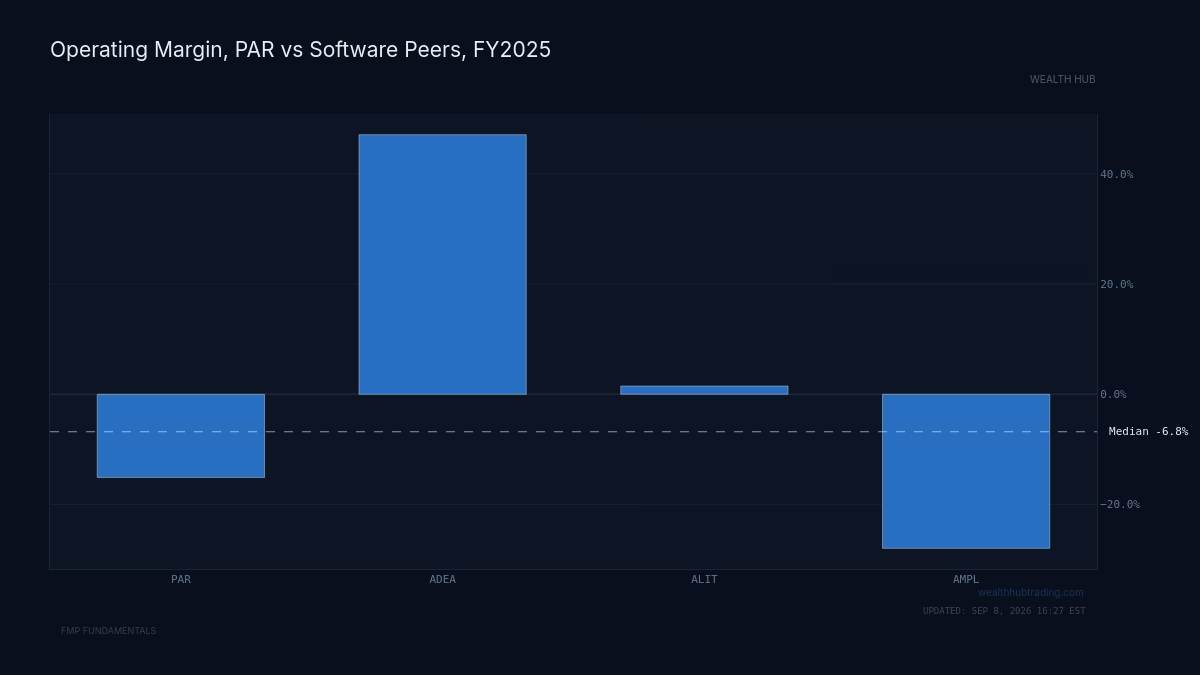
A 27x forward EBITDA multiple and 5.5x EV/Sales are described as a conservative discount to scaled vertical-software winners. That framing is only defensible once the company generates the EBITDA to put in the denominator. Today it does not. The gap between a negative 15.1% operating margin and the mid-teens-or-better positive margins that peers like Agilysys, AppFolio, Manhattan Associates, Guidewire, and Tyler Technologies command is not a valuation nuance. It is the entire investment case, and it is unresolved on current disclosures.
Look at what scaled peers actually earn. Adeia posted a 47.2% operating margin on $443.4 million of revenue in its most recent fiscal year, converting that into $149.3 million of free cash flow. That is roughly the same top line PAR carries, at a profitability level PAR has never reached. The point is not that PAR should be valued like Adeia; the two businesses differ. The point is that the peer set the pitch invokes to justify a premium multiple is populated by companies already delivering the profitability PAR is still forecasting.
Where the Capital Discipline Story Gets Interesting
There is a genuinely underappreciated detail buried in the cash-flow statement, and it cuts in the bull's favor. PAR's capital intensity is remarkably low: capex ran to just $3.3 million, or 0.7% of revenue, in the latest year. Contrast that with Alight at 4.9% of revenue and $110 million of capex. PAR is not a business that needs to pour cash into physical infrastructure to grow. Its cash burn is operating burn, not investment burn.
That distinction matters for the inflection thesis. A company burning cash on capex has a structural drag that persists as it scales. A company burning cash on operating costs, where much of the spend is the upfront cost of acquisitions and go-to-market investment ahead of contracted revenue, can flip to positive free cash flow quickly once that revenue lands and the upfront costs stop recurring. The negative $30.5 million of free cash flow is a softer number than it looks precisely because only $3.3 million of it is capital expenditure. The rest is, in principle, harvestable.
This is the strongest part of the fundamental case. The cost base is loaded with investments made ahead of revenue, the MENU integration and the more recent Stuzo and Task acquisitions among them, and the ARR from large contracted wins has not yet fully arrived to cover them. If the Burger King rollout and the RFP pipeline convert on the timeline the pitch describes, the operating leverage is real because the capital base is light.
The Rollout Timeline Is the Load-Bearing Assumption
The catalyst structure hangs on execution dates. The pitch anchors the inflection to a Burger King rollout beginning in earnest around Q2 2024 and running through mid-2026, with the Government divestiture simplifying the story into a software pure-play and Stuzo and Task adding scaled, profitable revenue. Each of these is plausible. None of them is yet visible in the annual figures on file, which show the loss and the cash burn but not the margin turn.
That is the pattern the thesis itself concedes has repeated for years. R&D debt had to be cleaned up. MENU added upfront cost. Payments and Table Service were slow off the ground. The Arby's ARR stepdown obscured growth. In every prior instance the large-win pipeline was described as full and the cost stabilization as imminent, and in every instance the P&L declined to confirm it on schedule. The company has been "waiting for Godot," in the pitch's own phrase, for several years running. A thesis that has been early four times in a row does not become wrong, but it does raise the bar for what counts as confirmation. Guidance language is not confirmation. A positive operating margin is.
The Balance Sheet Sets the Clock
PAR carries $402.4 million of total debt against $1.4 billion of total assets. That leverage is manageable for a growing software platform, but it changes the tolerance for delay. A cash-generative business can wait indefinitely for a multiple to re-rate. A business burning $30.5 million of free cash flow a year with $402 million of debt on the books cannot. The runway is finite, and every quarter that the inflection slips is a quarter of burn against a fixed debt load.
This is what turns an interesting long-term story into a dated one. The bull case and the balance sheet are on the same clock. If revenue acceleration and margin expansion show up in the next couple of quarters as the pitch expects, the burn reverses before the debt becomes a constraint and the re-rating mechanism engages. If the inflection slips again, as it has repeatedly, the burn compounds against the debt and the margin of safety erodes even as the thesis narrative stays intact.
What Would Confirm the Read, and What Would Break It
The thesis is confirmed the quarter PAR prints a positive operating margin with accelerating ARR, because that is the exact combination, rising revenue growth plus a swing from loss to profit, that historically drives the multiple expansion the pitch is underwriting. That is the observable condition. Not a larger backlog, not another named logo in a press release, not reaffirmed guidance. An operating income line that crosses zero while revenue growth accelerates.
The thesis breaks if the FY2025 pattern extends: another year of double-digit negative operating margin, another round of upfront acquisition costs that "obscure underlying progress," and free cash flow that stays negative while the debt load stays fixed. The light capex base means the potential leverage is real, and the pure-play simplification from the Government divestiture is a genuine positive. But the filings currently show a company that spends more to operate than it earns, and the entire $80-plus case is a bet that the next two quarters finally end a delay that has outlasted every prior forecast of its end. Until the operating margin turns positive, the loss is the fact, and the target is the forecast.