When a challenger acquires the incumbent it has been trying to unseat, the market usually reads it as a coronation. In HNI's case, the more useful read ...
When a challenger acquires the incumbent it has been trying to unseat, the market usually reads it as a coronation. In HNI's case, the more useful read is the reverse: a company that generates roughly $210 million in annual free cash flow just agreed to absorb a business several times its size in unit volume, and the interesting question is not whether Wall Street cheered but what the deal does to the financial structure that made HNI worth owning in the first place.
That is the disclosure the applause is not pricing. The Steelcase acquisition is being narrated as a growth event. It is more accurately a balance-sheet event, and the guidance language and the filings are not telling the same story.
The Cash-Flow Company That Just Went Shopping
Start with what HNI actually is before the deal. Per HNI's FY2025 10-K, the workplace-furnishings and residential-building-products business ran $2.8 billion in revenue at an 8.5% operating margin, producing $240.6 million of operating income. The cash-flow statement is the cleaner tell: $276.2 million of operating cash flow, $65.8 million of capex, and $210.4 million of free cash flow. Capex ran a lean 2.3% of revenue and 23.8% of operating cash flow.
That is a capital-light compounder. It converts operating cash into free cash at a high rate because it does not need heavy reinvestment to keep the lights on. The FY2025 balance sheet carried $4.9 billion of total assets against $1.6 billion of total debt, a manageable load for a business throwing off this kind of cash.
The reason this matters is mechanical. A company whose entire investment thesis rests on high free-cash-flow conversion has a specific vulnerability: any acquisition that raises the capital intensity of the combined entity, or that levers the balance sheet to fund the purchase, attacks the exact quality that justified the multiple. Steelcase is a scale office-furniture manufacturer with its own plants, its own working-capital cycle, and its own margin profile. Bolting it onto a 2.3%-capex-of-revenue business does not obviously preserve the 2.3%.
Why the Encore Question Is the Only Question
The framing in the market is "what will HNI do for an encore." That is usually the retail version of a real analytical concern. HNI's brand roll-up strategy has worked because each addition was digestible relative to the cash engine underneath it. Steelcase breaks that pattern by size.
The integration math is where guidance language and filing disclosure diverge, and it is worth being precise about what we can and cannot see here. What the filings establish is HNI's standalone profile: high FCF conversion, low leverage, thin capex. What the deal narrative asserts is synergy and market leadership. Those are not the same category of claim. One is reported; the other is guided.
The gap to watch is capital intensity. 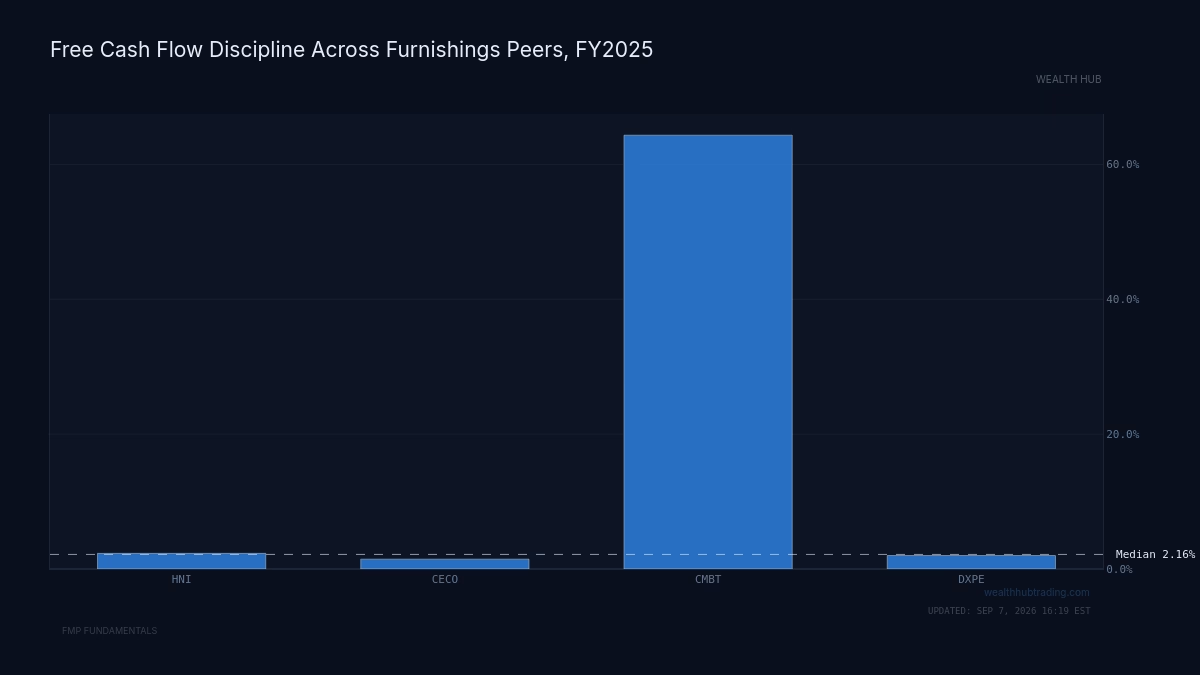
The G-III Lesson: Read What the Press Release Omits
There is a template for how this goes wrong, and it played out in real time in an adjacent name worth studying for the mechanism, not the ticker. G-III Apparel, after rising more than 50% from an original skeptical report, gave most of it back and now sits up a modest 16%. Last week the stock tumbled despite a raised earnings guide, because the company missed on sales, which fell 10%, and because the headline touting higher earnings guidance quietly left revenue guidance flat.
That is the entire lesson in one sentence. The earnings guide went up; the revenue guide did not move. The reasons offered were the familiar cast, weather and macro softness in Europe and the Middle East, the latter looking self-inflicted given new stores in Dubai, Oman, and Doha. Underneath, licensing revenue is sliding as the Calvin Klein and Tommy Hilfiger relationships wind down, and management flagged dilution over the next twelve months from the Marc Jacobs acquisition that closed September 1 and was supposed to help margins.
The transferable point for HNI is not that G-III is HNI. It is that the market rewards the guided narrative and punishes the disclosed reality, and the two arrive in the same press release. When a company raises the metric it controls (earnings guidance) while leaving flat the metric that reflects demand (revenue guidance), the omission is the signal. Apply that lens to HNI's coming quarters: watch whether the Steelcase integration is narrated through accretion and synergy language while free-cash-flow conversion and capex intensity quietly drift toward the acquired company's heavier profile.
The Case That This Is Fine
The strongest counterargument deserves a fair hearing. HNI has integrated brands before and preserved its cash character; management has a track record of buying and absorbing without wrecking the model. A deal that adds genuine scale to a market-leading position can lower unit costs, improve procurement leverage, and expand the addressable base in ways that a purely financial read misses. If the combined entity holds operating margin near HNI's standalone 8.5% and the integration is funded conservatively rather than by loading the balance sheet, the encore worry dissolves into an ordinary accretion story.
There is also a demand-cycle case. Office furnishings is levered to return-to-office capital spending and commercial real-estate refresh cycles. If that spending firms, a larger combined footprint captures more of it, and scale becomes an asset rather than a drag.
The read here does not dismiss any of that. It says the burden of proof sits with the guidance, and the filings have not yet had a chance to confirm or deny it.
What Would Confirm the Skeptical Read
The thesis breaks, favorably, if HNI's post-close disclosures show free-cash-flow conversion holding near the standalone rate and capex intensity staying in the low single digits of revenue. If the combined company keeps converting operating cash to free cash at anything close to the 76% implied by FY2025's $276.2 million and $210.4 million, the market's applause was earned.
The thesis confirms, unfavorably, if the pattern rhymes with G-III: a headline that leads with accretion or synergy while the underlying revenue and cash-conversion guidance stays flat or slips, and capex-of-revenue creeps toward the acquired manufacturing base's heavier structure. The specific tell is language, then numbers. Watch the first two combined-entity releases for a raised earnings guide sitting next to an unmoved revenue guide, and watch the first full cash-flow statement for whether the 2.3% capex line survives contact with Steelcase's plants.
Until those disclosures arrive, the cleaner reading is that HNI paid to become the market leader and, in doing so, put the highest-quality attribute of its own business, its free-cash-flow discipline, on the table as the variable to prove out. The coronation is priced. The integration is not.