In late 2008, a European bank that wanted dollars had a problem no textbook prepared it for. It held euros, it held perfectly good euro-denominated assets, and it could not get dollars at anything close to the rate the math said it should pay. The premium it was forced to pay, over and above the interest-rate differential between the two currencies, spiked to levels that had never been seen. That premium has a name: the cross-currency basis. And its behavior that autumn revealed something the standard model of international finance quietly assumes away.
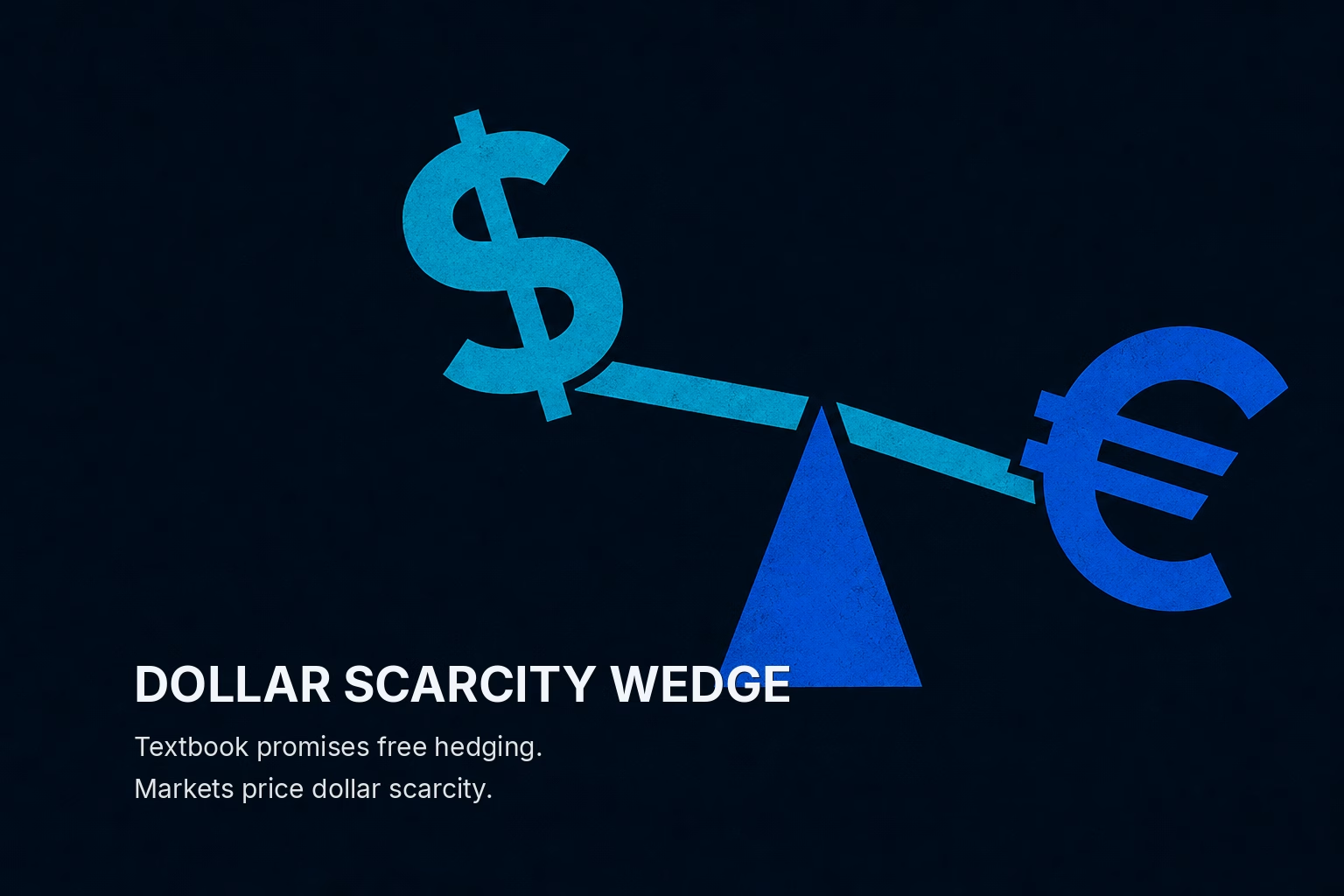
The standard model is covered interest parity, or CIP. It says that if you borrow in euros, convert to dollars at today's spot rate, and simultaneously lock in the rate to convert back later, you should end up in exactly the same place as if you had borrowed dollars directly. Any difference would be a riskless profit, and riskless profits get arbitraged to zero. So the theory predicts the cross-currency basis, the residual after accounting for interest-rate differences, should be zero.
It is not zero. It was not zero in 2008, it was not zero in the 2011 European crisis, it was not zero in March 2020, and it is not reliably zero on a quiet Tuesday. Understanding why is a lesson in the difference between what arbitrage says should happen and what balance sheets allow to happen.
Why the basis is not zero
The flaw in the textbook is a hidden assumption: that a bank can put on the arbitrage trade for free. It cannot.
To capture a nonzero basis, a bank must expand its balance sheet. It borrows in one currency, lends in another, and holds both positions until the forward contract settles. Every dollar of that trade consumes capital, because post-crisis regulation ties a bank's balance-sheet size to the equity it must hold against it. The leverage ratio, a rule that caps total assets as a multiple of equity regardless of how safe those assets are, means even a riskless arbitrage occupies scarce space on the balance sheet.
So the trade is not free. It has a cost, and that cost is the equity the bank must set aside plus the return its shareholders demand on that equity. Arbitrage only closes the basis to the point where the remaining profit equals this balance-sheet cost. Below that point, no bank will bother. The basis settles at a nonzero level that reflects how expensive balance-sheet space has become.
This reframes the whole picture. The cross-currency basis is not a market inefficiency waiting to be corrected. It is a price. Specifically, it is the price of renting a bank's balance sheet to manufacture dollars you do not already hold.
The mechanism, in one worked example
Here is the arbitrage the textbook assumes will be free, with numbers.
Suppose the dollar interest rate is 5% and the euro interest rate is 3%. Covered interest parity says the forward exchange rate should embed exactly that 2-percentage-point gap, so borrowing euros and swapping into dollars costs the same as borrowing dollars directly. The formula for the synthetic dollar rate is straightforward:
Synthetic USD rate = EUR borrowing rate + (forward premium annualized)
If the forward market prices the euro-to-dollar conversion so the annualized premium is exactly 2%, the synthetic dollar rate is 3% + 2% = 5%, matching the direct dollar rate. The basis is zero.
Now introduce stress. Everyone wants dollars at once, and banks are unwilling to grow their balance sheets to supply them. The forward premium widens to 2.5%. The synthetic dollar rate becomes 3% + 2.5% = 5.5%. That extra half-percentage point, the 0.5% wedge between the synthetic 5.5% and the direct 5%, is the cross-currency basis. A firm forced to raise dollars through the swap market pays 5.5% while a firm with direct dollar access pays 5%. The basis is the surcharge for not being American.
In 2008, that surcharge on three-month euro-dollar swaps blew past 100 basis points at its worst. Institutions that had funded dollar assets with short-term dollar borrowing, then lost access to that borrowing, were forced into the swap market at exactly the moment its price exploded.
Why it blows out precisely when dollars matter most
The basis widens most violently in a crisis, and the reason is a feedback loop between demand and supply that moves in the same direction.
On the demand side, a stress event sends every dollar-short institution scrambling for dollars simultaneously. Non-US banks and corporations that borrowed dollars to fund dollar assets suddenly need to roll that funding, and the swap market is where they go. Demand for synthetic dollars surges.
On the supply side, the institutions that could satisfy that demand, the dealer banks with the balance-sheet capacity to arbitrage, are pulling back at the same moment. In a crisis their balance-sheet space is most precious, their own funding is least certain, and their risk managers are cutting exposure, not adding it. Supply of arbitrage capital shrinks.
Demand up, supply down, and the price, the basis, gaps out. This is the cruel feature of the mechanism: the cost of borrowing dollars synthetically is lowest when you least need dollars and highest exactly when you are desperate for them. The basis is not a smooth line. It is quiet for long stretches and then spikes, because balance-sheet capacity does not degrade gradually; it withdraws in a rush.

The Federal Reserve understood this by 2008 and built the tool that addresses it directly: central bank swap lines. The Fed lends dollars to foreign central banks, which lend them onward to their own banks, injecting dollar supply into the system and bypassing the constrained private balance sheets. When the Fed reopened and expanded these lines in March 2020, the euro-dollar basis, which had gapped out as the pandemic hit, compressed within days. That speed is the tell: the problem was never a shortage of willing borrowers or lenders in principle. It was a shortage of balance sheet, and the central bank supplied the one balance sheet that faces no leverage constraint.
What this means for you
The practical use of the cross-currency basis is as a real-time gauge of dollar funding stress, available to anyone, not just the banks trading it.
When you read that the three-month euro-dollar or yen-dollar basis is widening, you are watching the price of emergency dollar access rise in real time. It is a cleaner signal than credit spreads or equity volatility because it measures one specific thing: how hard it is right now to get dollars if you do not have them. A widening basis has repeatedly preceded broader funding squeezes, because the institutions that hit the swap market first are the ones running out of options first.
If you hold assets in a firm, a fund, or a strategy that relies on rolling short-term dollar funding, the basis is your early warning. Treat a sustained widening the way you would treat a rising fever: not proof of disease, but a signal to check what is underneath. And when you see the Fed reopen its swap lines, understand what it is actually doing. It is not printing money in the loose sense. It is renting out the one balance sheet in the world that regulation does not constrain, to reset a price that private balance sheets can no longer hold at zero.
The cross-currency basis is the visible price of a hidden constraint, and it is most informative precisely when it is most alarming.