
The most consequential detail in the Dream Finders Homes story is not mortgage rates, the Tampa Bay Rays, or the $2.2 billion Beazer Homes purchase. It is a redemption clause. Under the terms of the 12% preferred stock that Dream Finders ($DFH) is issuing to fund the Beazer deal, holders can demand to be paid out in cash if Patrick Zalupski's stake falls below 50%, by votes or by ownership. Zalupski has pledged 35.5 million of his roughly 59 million shares as collateral for personal margin loans.
Put those two disclosures side by side and the apparent separation between the founder's personal debt and the company's debt turns out to depend on one condition: the share price must never force a sale. In practice, a margin call on Zalupski is a potential cash call on Dream Finders. The market is reading this as a story about a leveraged acquirer in a housing downturn. The filings describe something narrower and more dangerous: a feedback loop that runs from the stock price, through a personal lender, into the corporate capital structure.
The Clause That Joins Two Balance Sheets
The arithmetic deserves to be stated plainly, because it is starker than "a significant sale could create a cash demand."
If Zalupski's roughly 59 million shares currently give him majority ownership, total shares outstanding must be fewer than about 118 million. Suppose a lender liquidated the full margin collateral of 35.5 million shares. He would be left with about 23.5 million shares. Even in the most favorable case for him, where his 59 million shares represent the entire float, 23.5 million is about 40% of the company. On any realistic share count, it is less. Liquidating the margin collateral would therefore push him below the ownership threshold, whatever the exact capitalization. Another 4 million shares secure prepaid forward sale contracts, which deliver cash now against a future share sale. Their settlement would reduce his stake further.
One link here is unverified. If Dream Finders' voting structure gives Zalupski more voting power than economic ownership, the votes test and the ownership test could diverge. The provision as reported trips on either, so the ownership leg alone is enough to activate the put.
This is the mechanism that makes the story a corporate problem rather than gossip about a team owner. Founder margin loans unwinding into a stock have happened before. The source report points to Carl Icahn, whose Icahn Enterprises lost about half its market value within roughly three months of Hindenburg's report on his pledged units. The difference at Dream Finders is that a forced sale does more than depress the price. It can also hand a 12% preferred holder the right to demand cash from a company that, as discussed below, was already consuming cash before it took on Beazer.
Collateral Worth a Quarter of What It Was
The pledge has grown as the collateral has shrunk. Shares pledged for margin loans have doubled since just before the Rays purchase closed in September 2025. At that week's share price, the 35.5 million pledged shares were worth about $940 million, which implies a price near $26.50. At Wednesday's close of $7.42, they were worth about $263 million. That is a decline of roughly 72% in collateral value.
The filings do not show how much Zalupski actually borrowed, and that unknown is the hinge of the whole thesis. A modest loan against $263 million of stock is an inconvenience. A loan sized against the 2025 value would already have breached any conventional maintenance level. The doubling in pledged shares is consistent with two explanations: new borrowing to finance a share of the $1.7 billion Rays acquisition, or collateral top-ups demanded as the stock fell. The disclosures do not distinguish between them. Both point the same way. Fewer of his shares remain unencumbered. About two-thirds of the stake is already committed to margin loans or forward contracts, which leaves a limited buffer of unpledged stock to post if the lender asks.
The report also says Zalupski appears to have taken out new mortgages on older properties as recently as this year. If accurate, that weakens the most obvious alternative source of collateral. Homes and aircraft that are already encumbered offer less protection against a second margin call.
A Buyer Already Burning Cash
The redemption clause would matter less if Dream Finders could absorb a surprise cash demand. Its own FY2025 numbers suggest it cannot do so comfortably.
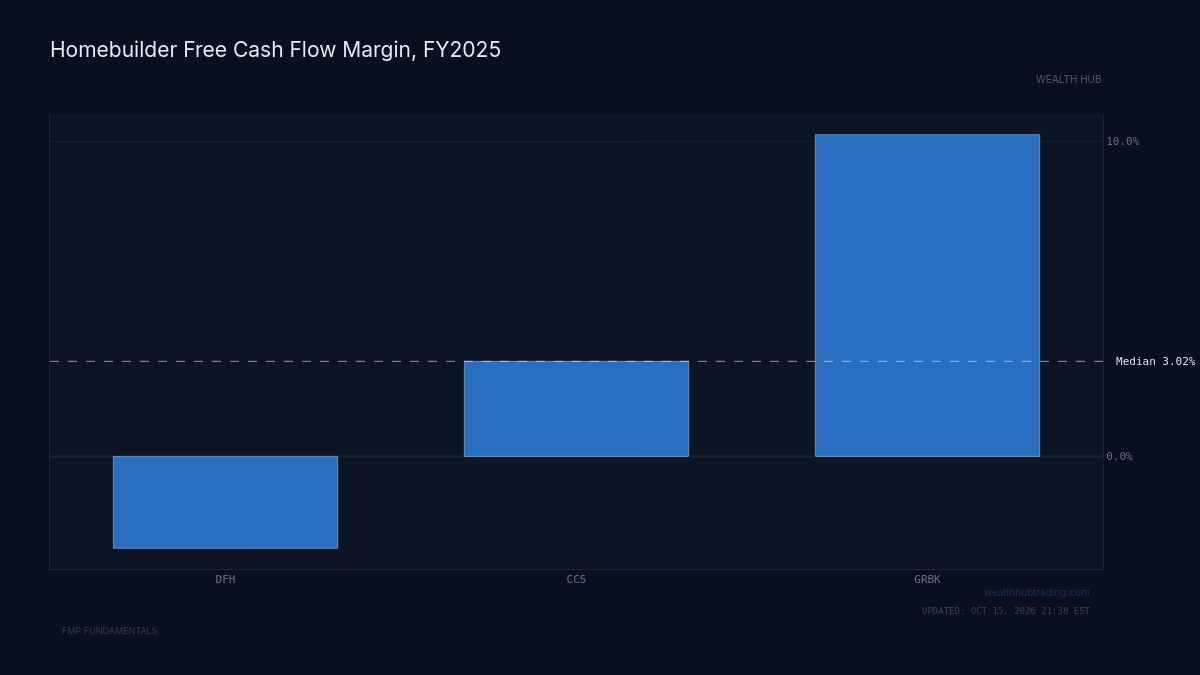
Per the FY2025 10-K, Dream Finders reported $4.3 billion of revenue and $269.6 million of operating income, a 6.2% operating margin. Operating cash flow was negative $100.6 million, and free cash flow was negative $126.4 million after $25.8 million of capex. Capex is not the drain, at 0.6% of revenue. The cash burn sits in working capital, meaning land, lots, and homes under construction. That is how homebuilders consume cash when they expand inventory ahead of sales.
The peer comparison is uncomfortable. Century Communities ($CCS) generated $4.1 billion of FY2025 revenue at a 9.2% operating margin and produced $124.3 million of positive free cash flow. Green Brick Partners ($GRBK) produced $208.4 million of free cash flow on $2.0 billion of revenue at a 20.1% operating margin. Dream Finders had the thinnest margin of the three and was the only one burning cash.
That is the starting point for the acquirer. According to the report, Beazer was also burning cash, and at the end of June the two builders owed about $3.2 billion combined. Dream Finders' FY2025 year-end balance sheet showed $591.1 million of total debt against $3.7 billion of assets. Debt definitions vary across homebuilders' warehouse lines and senior notes, so the two figures are not strictly comparable. Even so, the size of the gap shows how fast the combined borrowing base has expanded.
The financing sequence is also revealing. In August, Dream Finders said it might replace the $900 million bridge commitment from Bank of America and Goldman Sachs with permanent financing such as bonds before closing. No bond sale has been announced. Instead, last Friday the company had its banks add $220 million to its credit line. Choosing bank revolver capacity over a public bond deal right before closing does not prove the bond market declined. It does mean the permanent capital structure is not yet in place, and the maturity schedule leaves little room. About $300 million of the credit line expires in June 2027. In August 2028, $300 million of bonds come due along with the bulk of the credit lines.
The preferred stock carries a 12% coupon and ranks ahead of the common. That rate is expensive capital for a company whose operating margin was 6.2% last year. It is also the instrument carrying the change-of-control put.
Millrose and the Lender on Both Sides
The leverage extends beyond Dream Finders. Millrose Properties ($MRP), the land bank that holds homesites for builders to buy under option, priced $1 billion of bonds this month and plans to draw another $500 million on a term loan. It said the proceeds may go toward buying homesites from the combined Dream Finders and Beazer and toward paying down its own credit line.
Kennedy Lewis, whose affiliate manages Millrose, has committed to buy $450 million of the new Dream Finders preferred. That gives one investment firm an interest on both sides of the land relationship. As a preferred holder it benefits if Dream Finders stays liquid. As Millrose's manager it controls a counterparty that could ease that liquidity by buying more land, extending option deadlines, or accepting lower payments. Whether Kennedy Lewis would use that position is unverified. The incentive is structural and visible today.
The risk to Millrose follows from how land banking works. A builder short on cash can walk away from optioned lots, forfeit its deposit, and leave the land bank holding the inventory. If the founder's collateral problem turns into a preferred redemption demand, option walkaways are one of the few levers that free up cash quickly. Hunterbrook Capital discloses that it is short Millrose and Lennar ($LEN) and long a basket of comparable securities. Readers should weigh the report with that positioning in mind. The redemption terms and pledge counts come from company filings, not from the short seller's interpretation.
The Case for a Softer Landing
The strongest counterargument is that each link in the chain is a choice, not an automatic event. A margin lender is not required to liquidate. The report says the counterparty on the loan appears to be a well-known individual rather than a bank. A private lender may have more room to renegotiate than a bank margin desk, and Icahn's lenders ultimately restructured his loans so they no longer depended on the stock price. Zalupski could post other assets, sell part of his Rays interest, or negotiate an amendment before any sale occurs.
The deal's sponsors also continue to show confidence. Beazer shareholders approved the transaction this morning, two large banks committed bridge financing, and the lenders upsized the credit line last week. At $7.42, the common stock already reflects substantial stress. Some of this outcome may be priced in.
These points are valid, but they address timing rather than structure. Renegotiation reduces the likelihood that a forced sale happens. It does not remove the put. As long as the 50% clause is in place and most of the founder's stake is pledged, the preferred holders have an option whose value increases as the common falls. The common shareholders are effectively the ones who sold that option.
What the Closing Filings Must Show
The deal could close as soon as Tuesday, October 20, and the closing filings will answer most of the open questions. Four disclosures matter most. First, the full certificate of designation for the preferred, including whether the cash redemption can be settled in stock, the redemption price, and any cure period. Second, how much of the $900 million bridge was drawn compared with permanent financing. Third, any amended ownership filing that updates Zalupski's pledged share count. Fourth, any change to the Millrose option agreements on the combined lot pipeline.
The thesis breaks if the redemption put proves to be payable in shares, or if Zalupski's loan is restructured so it no longer depends on the stock price. Until either happens, a sharper Dream Finders decline is not just a valuation problem for shareholders. It brings closer the point at which a preferred holder can ask a cash-burning company for its money back.