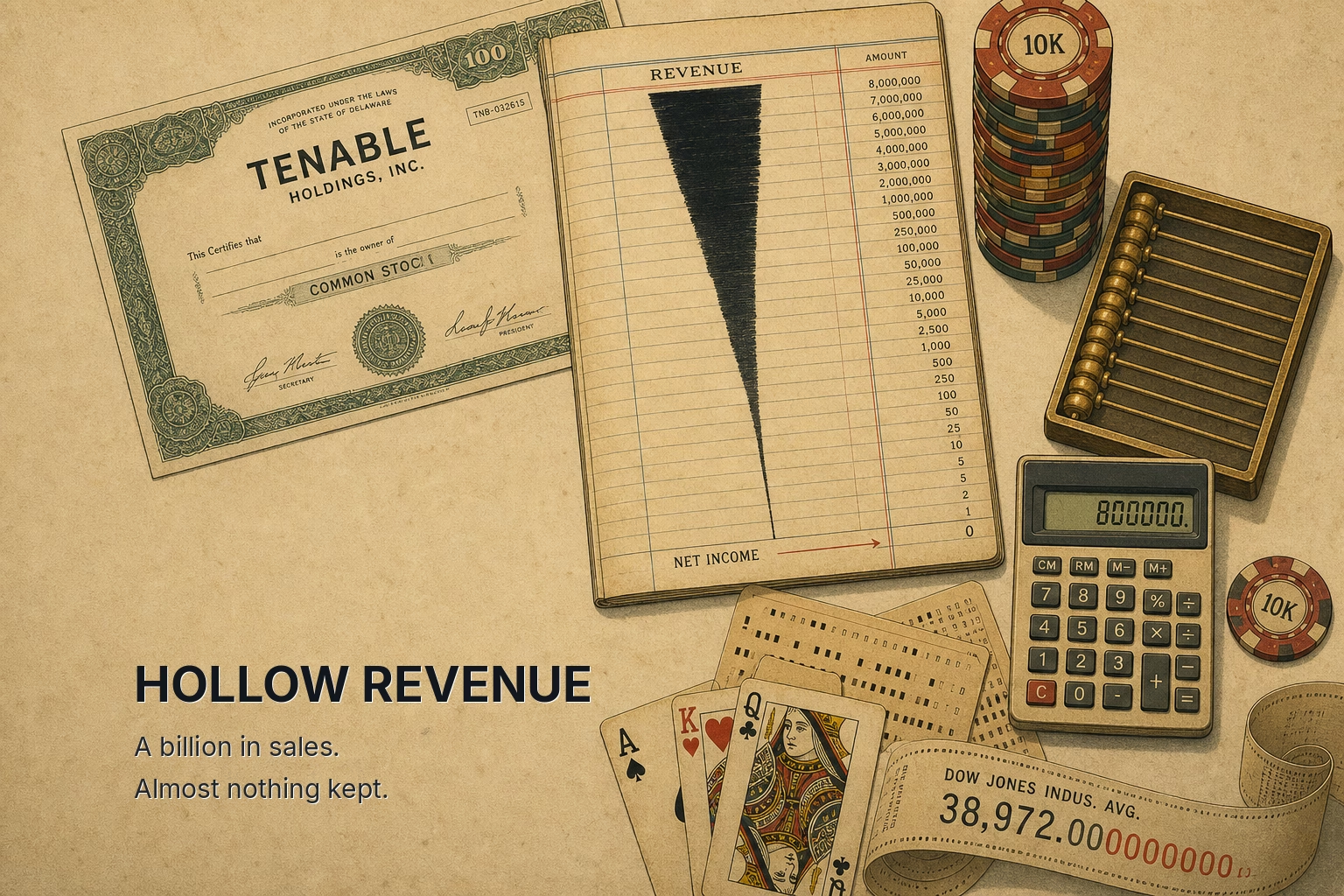
Tenable Holdings crossed a billion dollars in revenue in fiscal 2025 and reported an operating income of $1.2 million on the way there. That is not a rounding artifact. Against $999.4 million in revenue, per the FY2025 10-K, operating margin rounds to one-tenth of one percent. The market values this company at roughly $4 billion and the sell-side narrative still frames it as a durable subscription franchise. The disclosure that narrative skips is that the operating engine is already running at breakeven, before any of the competitive pressure The Bear Cave describes has fully arrived.
That is the gap worth pricing. The consensus read on a vulnerability-management incumbent is retention and recurring revenue. The filing says the business converts almost none of its top line into operating profit today, which means it has no operating cushion to absorb the price compression that commoditization brings.
The Number Under the Number
The bull case for Tenable does not live in the income statement. It lives in cash. FY2025 free cash flow was $254.6 million against that same $999.4 million of revenue, a free-cash-flow margin north of 25 percent. Operating cash flow was $266.8 million; capex was a trivial $12.1 million, or 1.2 percent of revenue. This is an asset-light software business that throws off real cash even while its accounting operating income sits at zero.
Reconciling those two facts is the whole analysis. The distance between $1.2 million of operating income and $254.6 million of free cash flow is almost entirely non-cash compensation and the timing of deferred revenue. Stock-based compensation is doing the heavy lifting: it depresses GAAP operating income while leaving cash generation intact. The company also bought back stock, with net common-stock issuance of negative $228.4 million in FY2025, meaning repurchases outran option issuance by that amount.
Read charitably, this is a cash machine masquerading as a breakeven business. Read skeptically, it is a business whose reported profitability depends on paying employees in a currency, its own shares, that a falling stock price makes more expensive to sustain. Both readings are true. Which one dominates depends entirely on what happens to the top line, and the top line is exactly what The Bear Cave argues is under structural attack.
Why Breakeven Is the Vulnerability
Commoditization does not usually announce itself as a revenue collapse. It arrives as price. When CrowdStrike, Palo Alto, and Microsoft fold vulnerability management into platforms customers already buy, and when AI-native entrants undercut on price, the incumbent's defense is to discount to hold seats. A business with a 20-point operating margin can discount and still clear profit. A business at 0.1 percent operating margin cannot discount at all without going negative on a GAAP basis.
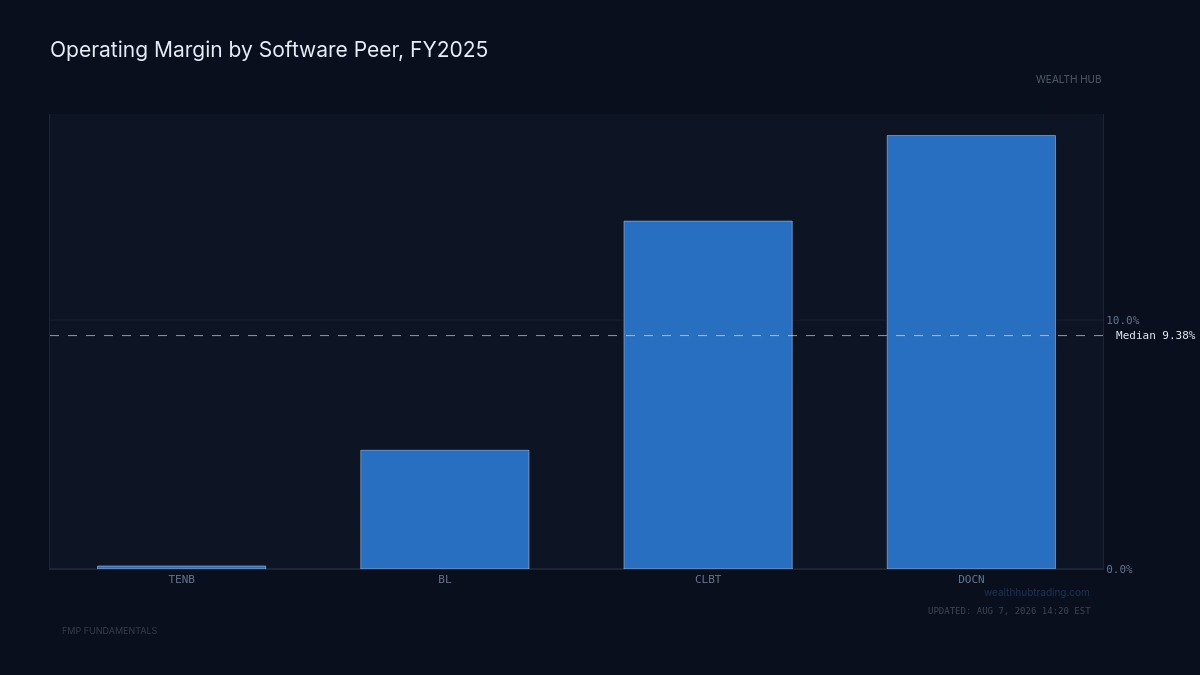
The peer set makes the point concretely. On the same FY2025 basis, BlackLine ran a 4.8 percent operating margin, Cellebrite 14.0 percent, and DigitalOcean 17.4 percent. Tenable's 0.1 percent is not merely low, it is an outlier among infrastructure-software names of comparable revenue scale. These are different businesses with different cost structures, so the comparison is directional rather than like-for-like. But the direction is unambiguous: Tenable has the least room of the group to trade margin for market share, at precisely the moment the competitive setup demands it.
That is the mechanism connecting The Bear Cave's qualitative case, the interviews calling vulnerability management "commoditized" and "permanently impaired," to a number a portfolio manager can act on. The thesis is not that Tenable's revenue falls off a cliff next quarter. It is that any sustained price pressure translates almost one-for-one into operating losses, because there is no margin buffer between the current cost base and zero.
What Would Break the Short
The strongest counterargument is the cash itself. A company generating $254.6 million of annual free cash flow, holding $187.8 million in cash and equivalents against $465.6 million of total debt, is not fragile in any near-term liquidity sense. It can fund buybacks, service its debt, and invest in the Anthropic partnership and agentic tools that management is betting on. Free cash flow of that size buys years of runway to reinvent the product. Rapid7's 90 percent drawdown from peak shows how the market punishes this category, but it also shows the punishment is a re-rating, not an insolvency.
So the bear thesis is not a solvency call. It is a terminal-value call, and terminal-value calls are slow to resolve. The evidence that would break the short is straightforward: renewal rates holding flat or rising through the next two to three quarters, revenue growth stabilizing rather than decelerating, and any sign that the agentic products are winning net-new seats rather than merely defending the base. If Tenable can show that its cash flow is durable because customers are not leaving, the low operating margin becomes a temporary artifact of SBC accounting rather than a structural weakness.
There is also a real chance the whole category re-rates before Tenable specifically deteriorates. Qualys, the closest public comparable at a $6.5 billion market cap, pushed back directly, arguing it has already migrated up-stack toward "risk-based prioritization, exploit validation, and remediation" and away from the commoditized scanning layer. If that mix shift is genuine and Tenable executes the same pivot, the commoditization thesis prices a decline in a business the incumbents are actively exiting. The short then earns nothing while the migration succeeds.
The Condition to Watch
The disclosure the market is underweighting is not complicated: Tenable already earns almost nothing on its operations, and its equity story rests on cash flow that is only as durable as its retention. The filing tells you the buffer is gone. The Bear Cave's reporting tells you the pressure is coming. The two facts only matter together.
The observable that resolves this is the sequence of the next few revenue and net-retention prints against the trajectory of free cash flow. If free cash flow starts converging down toward the near-zero operating income, rather than operating income eventually converging up toward free cash flow, the market is watching a cash machine reveal itself as a breakeven business in a shrinking category. That is the point at which the $4 billion valuation stops looking like a franchise multiple and starts looking like a liquidation of goodwill. Until net retention cracks, the cash flow keeps the story alive; once it cracks, there is no margin underneath it to catch the fall.