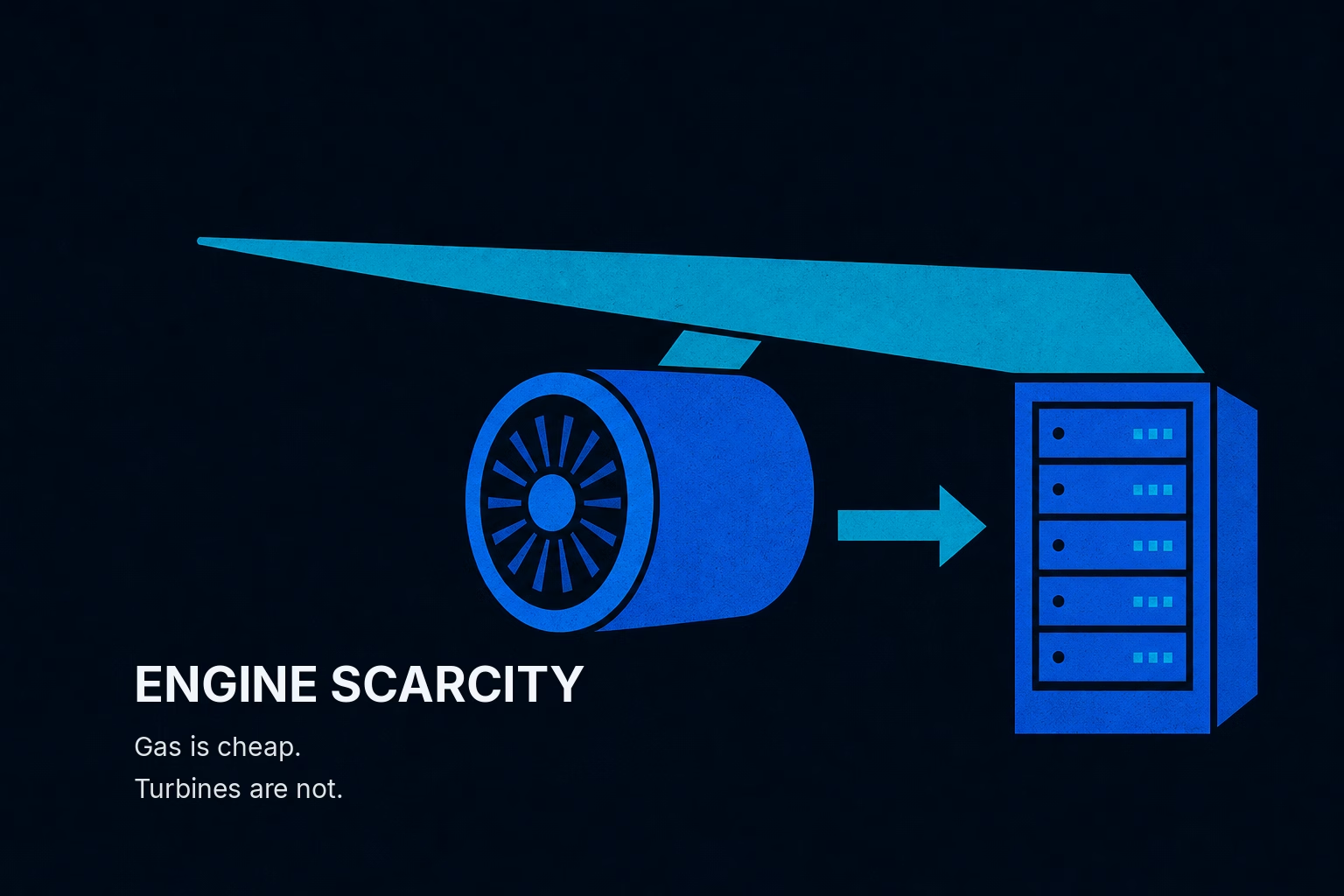
The fastest way to turn America's glut of $1-2 gas into data-center power runs through the aircraft hangar, not the turbine factory. Used jet engines can be converted into generators years before new gas turbines ship, which moves the scarcity from the power grid onto the airlines.
That second point is where intuition breaks. Most people assume a flood of cheap gas makes everything downstream cheaper. In this setup, cheap gas makes the conversion machine more valuable. Any machine that can burn gas gets bid up, including the engines that keep planes in the air. The rest of this article walks through that chain in order, because each step depends on the one before it.
Step 1: Why is the gas so cheap, and why does that matter?
The input price is set by a supply surge that has outrun demand. The US is forecast to grow natural gas production in 2026 by more than the entire European Union produces in a year, and to do it again in 2027. In Appalachia, the gas-rich region spanning Pennsylvania and West Virginia, spot prices are running at roughly $1-2 per million British thermal units (MMBtu). An MMBtu is the standard unit for pricing gas by its heat content.
To see how cheap that is, convert it to oil terms.
Oil-equivalent price = Gas price per MMBtu × 5.8 MMBtu per barrel
At $1: $1 × 5.8 = $5.80 per barrel of oil equivalent. At $2: $2 × 5.8 = $11.60 per barrel of oil equivalent.
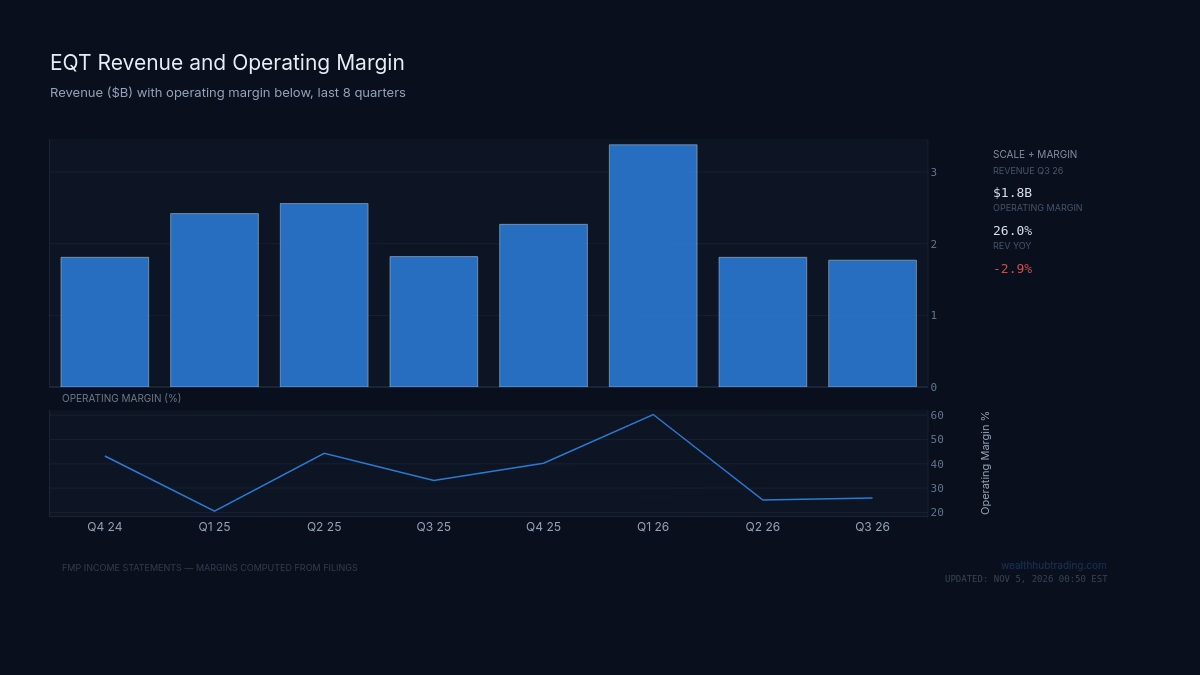
That is energy at $6-12 a barrel, less than Brent crude's daily swing in a volatile session. Producers feel this directly. Low prices are forcing curtailments and consolidation, the clearest example being EQT's $13 billion all-stock purchase of Range Resources, which creates the largest US gas producer. Scale lowers unit costs, and in a glut, unit cost is how a producer survives.
What this means for you: when a commodity trades this far below its energy-equivalent peers, the profit opportunity sits with whoever can move or transform it, not with whoever pulls it out of the ground.
Step 2: What actually limits gas-to-power, if not the gas?
The binding constraint is the gas turbine, the engine that burns natural gas to spin a generator. The major manufacturers are sold out for years. Some reports put new orders at a 2030 delivery date, and buyers are already reserving slots in 2032.
This creates what economists call a conversion spread: the gap between the value of the output (electricity) and the cost of the input (gas). In a normal market, that spread attracts new capacity until it narrows. Here, new capacity cannot arrive for four to six years, so the spread stays wide and the value of the conversion step concentrates in whoever already owns a working machine.
A rough worked example shows the scale. Assume a simple-cycle turbine with a heat rate, the fuel needed per unit of power, of 9,500 Btu per kilowatt-hour, which is 9.5 MMBtu per megawatt-hour.
Fuel cost per MWh = Heat rate (MMBtu/MWh) × Gas price ($/MMBtu)
At $2 gas: 9.5 × $2 = $19 per megawatt-hour in fuel.
For a data center operator racing competitors, a $19 fuel cost is close to irrelevant. What matters is whether the power exists in 2027 or 2031. Time, not money, is the scarce variable. The heat rate here is an illustrative assumption; real figures vary by machine and operating mode.
What this means for you: when a bottleneck sits in equipment rather than fuel, the pricing power belongs to equipment owners, and the fuel stays cheap even as demand rises.
Step 3: How do old jet engines fill the gap?
They fill it through a technology that already exists: the aeroderivative turbine, a gas turbine built from a jet engine design. Utilities and offshore operators have used these for decades because they are compact, start quickly, and can be shipped and installed faster than large industrial units. A jet engine is, at its core, a gas turbine optimized for thrust. Swap the fuel system, attach the output shaft to a generator instead of pushing air out the back, and you have a power plant.
There are tens of thousands of used aircraft engines sitting on planes and in hangars worldwide. With varying amounts of effort, time, and money, those engines can be repurposed. This is the recycle bin of the power buildout: hardware written off as aviation surplus becomes the shortest path to megawatts.
History shows the playbook works under pressure. During the California electricity crisis of 2000 and 2001, the state turned to fast-build peaking units, many of them aeroderivative, because large conventional plants could not be built quickly enough to stop the blackouts. The lesson then is the lesson now. When power is needed on a deadline, speed of deployment beats efficiency, and jet-derived machines are the speed option.
The trade-off is efficiency. A converted jet engine burns more fuel per megawatt-hour than a modern combined-cycle plant. At $2 gas, that penalty barely registers. Go back to the worked example: even if the heat rate rose to 11,000 Btu per kWh, fuel cost would be 11 × $2 = $22 per megawatt-hour, a $3 difference. Cheap gas is precisely what makes inefficient machines economic.
What this means for you: the cheaper the fuel, the less efficiency matters, and the more valuable any fast-to-deploy burner becomes regardless of how wasteful it is.
Step 4: Why would this make flying more expensive?
Because the engines being recycled are the same assets airlines lease, maintain, and rely on to keep fleets flying. Every engine pulled into power generation is one fewer in the spare pool.
The mechanism runs in three links:
- Data center developers, unable to get new turbines before 2030, start bidding for used jet engines.
- Those bids raise the value of used engines and the cost to lease them, since aviation now competes with a buyer that cares more about time than price.
- Airlines face higher engine lease and maintenance costs, and some of that shows up in fares.
The first link is the strongest. Data center buyers have deep pockets and urgent deadlines. The size of the third link is less certain. How much of a higher engine cost passes through to ticket prices depends on how many engines actually get converted, how quickly, and how tight the spare market already is. The source analysis that prompted this piece argues flying is about to get more expensive; the magnitude is not established here, and readers should treat fare pass-through as the least verified step in the chain.
What this means for you: a shortage in one industry can migrate to another that shares the same hardware, and the second industry often does not see it coming.
When does this arbitrage break?
The chain fails at three points, each worth checking against events.
Data center demand fails to materialize. LNG export demand is the more reliable of the two growth drivers; the Gulf Coast terminals are physical projects anyone can track. Data center demand is shakier. The rout in AI equities in late October shook confidence in whether those future power flows are bankable. If developers slow spending, the bid for used engines softens and the scarcity never reaches aviation.
New turbine supply arrives sooner. Manufacturers sold out through 2030 have every incentive to expand capacity. If they pull deliveries forward, the window where recycled engines are the only option shrinks.
Conversion proves slower or costlier than expected. Not every used engine is a candidate. Maintenance history, hours since overhaul, and parts availability all matter. If the effort to convert runs high, fewer engines leave aviation and the price effect stays contained.
Gas itself is not on this list. Supply is abundant enough that rising demand from LNG and power will take time to absorb it, which keeps the fuel cheap and the conversion spread wide.
The practical takeaway
The mechanism in one sentence: abundant gas plus a turbine shortage shifts value to anyone who can burn gas fast, and the largest idle pool of gas burners belongs to aviation. That matters because it reframes the gas glut. The opportunity is in the bottleneck, and bottlenecks tend to spread to whatever shares the same equipment.
The most common misunderstanding is that cheap natural gas lowers costs across the economy; when the burner is scarce, cheap gas instead raises the price of every machine that can burn it, and the number to watch is the delivery date quoted on new gas turbine orders, because the day that date moves earlier is the day this arbitrage starts to close.