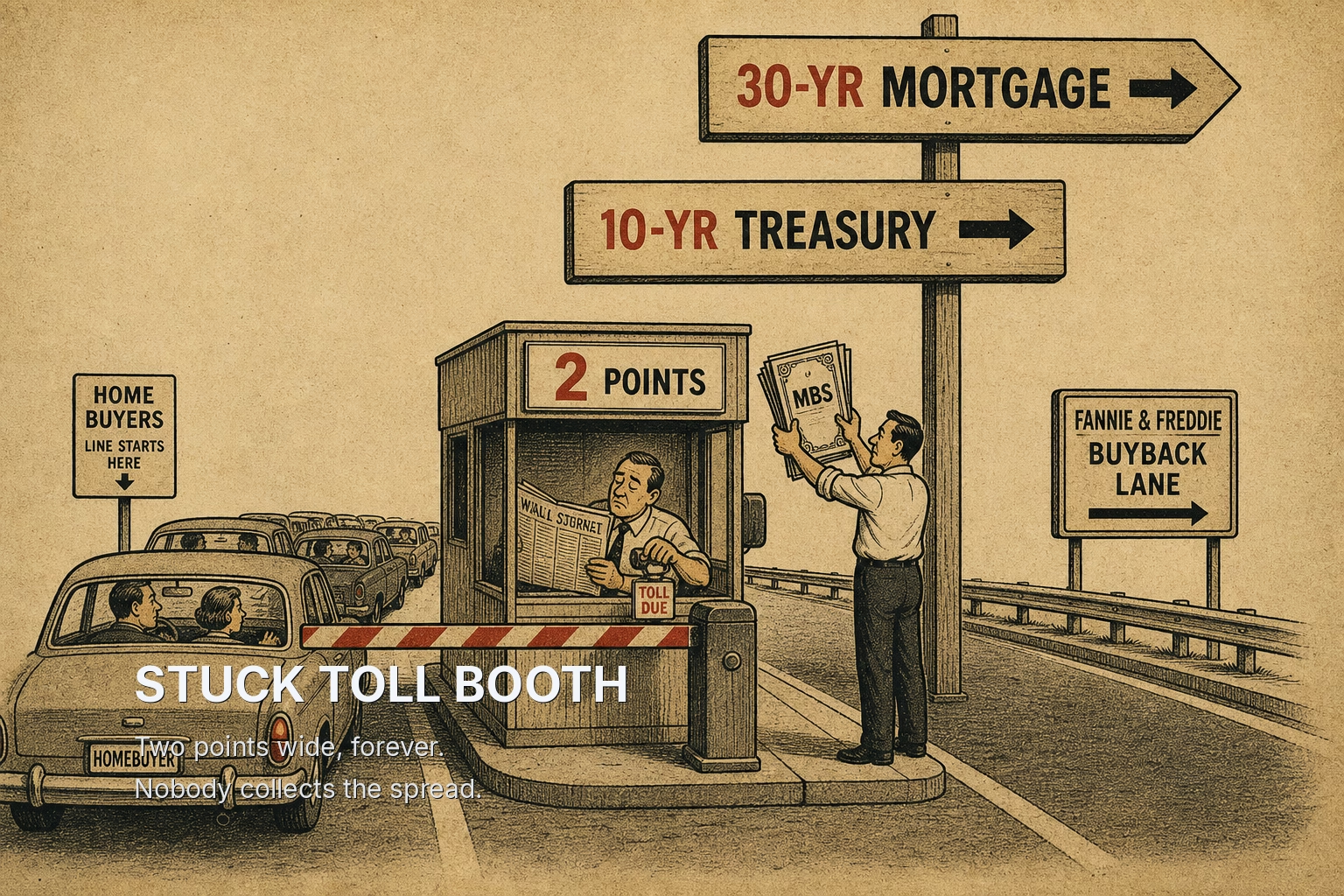
France, with its government in a semi-permanent state of crisis, still borrows for ten years below 5%. The United States Treasury just paid 5.30% at a 10-year auction, the highest since 2000. That reversal of reputations is the most important output of the European Central Bank's quantitative tightening, and it appears nowhere on the ECB's balance sheet.
Think of QT as pumping out one compartment of a ship whose bulkheads are open. The compartment you are watching drains on schedule. The water does not vanish. It finds the lowest point in the hull, and right now the lowest point is the long end of the Treasury curve.
The euro area's reassuring calm and America's bond rout are one event viewed from two ends. Consensus treats the ECB story as a European story with a happy ending. It is a cross-asset story, and the ending has not been written.
What Did the ECB Actually Shed?
The headline figures are remarkable and deserve to be stated plainly. The ECB shed €95 billion of QE bonds and loans in Q3, bringing the combined book down to €3.37 trillion. From the mid-2022 peak of €7.16 trillion, that is a reduction of €3.79 trillion, or 53%. For an institution that spent a decade running negative rates under the banner of Mario Draghi's "whatever it takes," this is a reckoning few thought possible. The ECB also re-hiked twice, by 25 basis points on June 11 and again on September 10, lifting the deposit rate to 2.50%. Balance sheet shrinking and policy rates rising together: this is tightening on both levers.
The composition matters more than the total. Loans fell from €2.2 trillion to roughly 38 billion, a 98% decline. Bonds fell from €4.96 trillion to €3.33 trillion, a 33% decline. Run the arithmetic and about €2.16 trillion of the €3.79 trillion came from the loan book. Well over half of the most celebrated QT program in the world was banks handing back cheap long-term funding, not bonds rolling off into private hands.
That distinction is not pedantry. Loan repayment drains bank reserves, and it puts no sovereign duration back on the market. A bank that repays the central bank does not force a pension fund in Rotterdam to buy an extra Italian ten-year. Bond runoff does exactly that. When a bond matures on the ECB's books, the issuing treasury still needs the money, so it rolls the debt to a private buyer at whatever price that buyer demands.
The loan lever is now exhausted. With roughly 38 billion left, almost every euro of future QT is bond runoff. The easy half of European QT is finished; the hard half begins now.
Why Has Nothing Broken in Europe?
Consensus has this part right. Euro area yields have climbed back into what Wolf Richter calls the pre-QE normal range, the market is pricing inflation and default risk again, and the much-discussed French 10-year remains below 5% despite all the hand-wringing. No spread blowout, no emergency program, no Draghi sequel. The bond market is relearning its job, and it is doing so without a nervous breakdown.
The part consensus misses is where the adjustment was absorbed. A sovereign bond market that loses its largest buyer does not simply reprice locally. Its private replacement buyers are global, price-sensitive, and comparing every sovereign curve against every other. The Bank of Japan has flipped from yield curve control to QT and shed 17% of its assets. The ECB has shed 53%. That is two of the world's largest duration absorbers stepping back at the same time, and the private capital that must replace them is one pool, not three.
When one pool must fund every deficit, it charges the most to the issuer with the largest supply and the least restraint. That issuer is not France. As of October 6, the 10-year Treasury yielded 5.27% and the 2-year 4.79%, a positive 2s10s spread of 48 basis points. A positively sloped curve with the long end above 5% is not the market forecasting Fed hikes. It is the market demanding compensation for holding duration. That is term premium, and term premium is precisely what disappears when central banks buy and reappears when they leave.
I want to be careful about the link I cannot prove. Flows between euro sovereign desks and the Treasury auction are not observable in the balance sheet data, and some portion of the Treasury move is surely domestic: deficits, supply, inflation risk. The mechanism stands regardless. The ECB and the BOJ have each stopped absorbing duration, the global marginal buyer is now private, and private buyers set prices across curves at once.
Europe looks calm because Europe is not the weakest credit in the room. It used to be.
Where Does the Duration Go?

The cross-asset reach runs through the discount rate. A 10-year Treasury yield above 5.25% is the risk-free rate against which every long-dated cash flow in the world gets valued. Growth equities, whose value sits in earnings a decade out, carry the most duration of any risk asset and derate first when the long end moves. Banks often benefit early, as net interest margins widen on a steeper curve, though that benefit tends to fade once funding costs catch up and credit losses arrive. Those are well-documented patterns from the factor literature, and the 2022 cycle illustrated both.
The 2022 analog is the obvious one and it is half right. That year delivered the fastest Fed tightening in four decades, CPI peaking at 9.1%, a 425-basis-point hiking cycle, equities down roughly 20%, and the worst annual losses for long-duration bonds in decades. The key difference is the curve shape. In 2022 the front end led and the curve inverted, because the market was pricing a central bank chasing inflation. Today the curve is positive, the front end sits below the long end, and starting inflation was lower, which limits how far policy rates have to climb.
That difference dictates the trade. A front-end-led selloff punishes everything with a maturity. A term-premium-led selloff punishes the long end and leaves the front end anchored to policy. The instrument most exposed to this thesis resolving is TLT, the 20-plus-year Treasury fund, because it carries the most duration and therefore the most term premium. SHY, short-dated Treasuries, carries almost none and clips a yield near the 2-year's 4.79%.
The position is front end over long end: SHY and, at the margin, IEF, with TLT treated as the funding leg rather than the hedge. Inflation-linked exposure through TIPS or STIP is the sensible insurance if the term premium turns out to be inflation premium in disguise. If the duration thesis is right, the long end keeps paying for Europe's discipline while the front end barely notices.
What Is the Gold Mark Hiding?
Anyone watching the Eurosystem's total assets has been reading the wrong line. The ECB marks its gold to market every quarter, an unusual practice among central banks; neither the Fed nor the BOJ does it. On the September 30 balance sheet, gold and gold receivables were written up by €53 billion to €1.29 trillion. Total assets fell only €35 billion, to €5.95 trillion. Strip out the gold revaluation and total assets fell €88 billion.
The quarter before ran the other way. In Q2 the ECB wrote gold down by roughly 160 billion as prices fell. One quarter's gold swing exceeded more than a quarter and a half of QT runoff at the Q3 pace. During the gold surge of 2025 and Q1 2026, the write-ups were large enough to overpower QT entirely and produce up-jags in total assets. A reader who saw the balance sheet rise concluded the ECB had paused. It had not.
Gold now represents about 22% of the Eurosystem's total assets, on a balance sheet whose QE bond book is shrinking every quarter. The Bundesbank alone accounts for about 31% of the gold. Under Eurosystem accounting, unrealized gains of this kind sit in revaluation accounts rather than flowing through income, which makes the gold pile a cushion of paper equity sitting beside a portfolio of bonds bought at yields far below today's market. A central bank with that cushion can tolerate losses on legacy bonds more comfortably than one without it. I would not overstate the policy relevance; nobody in Frankfurt is selling gold to fund QT. I would state the analytical relevance outright.
The balance sheet headline is a gold price chart with QT buried inside it. Strip the gold out and the tightening is steadier, and more relentless, than the headline suggests.
Who Is Wrong-Footed on the Euro?
Here is the uncomfortable symmetry. The ECB is running pure bond runoff and has hiked twice in a single summer. It is, by any fair reading, a tightening central bank. Yet the speculative crowd is positioned for dollar strength: commercial hedgers in dollar index futures sit net short at 11.2% of open interest while speculators hold the other side long. That configuration has historically resolved against the speculators more often than not. It is a positioning extreme, not a forecast.
The dollar bulls have a coherent argument, and it deserves its due. The 2-year Treasury at 4.79% against an ECB deposit rate of 2.50% leaves a carry differential of more than two percentage points. Carry pays the patient, and on that arithmetic alone the dollar long looks sensible.
Second-level thinking asks what kind of yield rise is happening in the United States. A Treasury selloff driven by a hawkish Fed tends to strengthen the dollar. A Treasury selloff driven by term premium, by a global buyer demanding compensation for funding the largest deficit in the developed world, is a fiscal risk premium. Fiscal risk premia do not reliably support a currency; in the worst cases they do the opposite. The 5.30% auction result, highest since 2000, reads far more like the second kind than the first. The front end is not leading.
Which path wins? I don't know. Based on available consensus data, the most likely outcome is the slow grind: the regime transitions gradually, cross-asset positioning reprices with each new data point, and nothing dramatic happens until it suddenly does. A faster version, where the duration repricing reaches earnings estimates and credit availability before portfolios adjust, is less likely but considerably more likely than a reversal in which the regime simply stabilizes. Two of the three paths run against the crowded dollar long and against long-duration Treasuries. The euro, expressed through FXE, is the cleanest way to own the side of the trade where the speculators are not.
The soft-landing consensus imagines that central banks can withdraw from bond markets one at a time, each judged on its own curve. Markets do not keep separate ledgers. The ECB withdrew trillions, Europe stayed calm, and the United States is now paying a 2000-era yield to fund itself. Europe's discipline was never free; it was invoiced to the long end of the Treasury curve.