Bitcoin is not falling because sentiment turned. It is falling because the largest marginal buyer runs a funding model that stops working when the front...
Bitcoin is not falling because sentiment turned. It is falling because the largest marginal buyer runs a funding model that stops working when the front end of the Treasury curve sits at 4.39% and the term premium refuses to compress. Strip out the narrative about the "hot thing" being AI or SpaceX, and what remains is a rates transmission problem wearing a crypto costume.
The signal to read is not the price. It is the identity of who has been holding the price up, and what that party has to keep paying to keep doing it.
The Marginal Buyer Is a Levered Rates Trade
Strategy owns 847,363 Bitcoin, about 4% of total supply and close to 6% of active circulation. That is already a concentration worth noting. The more important number is flow: the company bought 174,863 Bitcoin this year for roughly $13.7 billion, which JPMorgan estimates at about 70% of net digital-asset flows year to date.
Restate that plainly. Roughly seven of every ten net dollars entering the asset came from a single balance sheet. When one entity is that dominant a share of marginal demand, the asset's price is not clearing against broad conviction. It is clearing against that entity's cost of capital.
And the cost of capital is where the rates lens earns its place. Saylor's purchases are funded through a credit stack, most visibly Stretch, the preferred security issued last July under the ticker STRC. It ranks senior to common equity and pays a variable dividend that management flexes to hold the price near $100 par. The company has placed $10.5 billion of it, alongside $5.0 billion of other preferred. The design goal is a stable-value instrument that funds a volatile-value asset.
That is a duration mismatch dressed as a dividend policy. The financing behaves like short-dated, rate-sensitive paper. The asset it buys is the longest-duration, most convexity-laden thing on the menu.
Why the Curve, Not the Coin, Sets the Ceiling
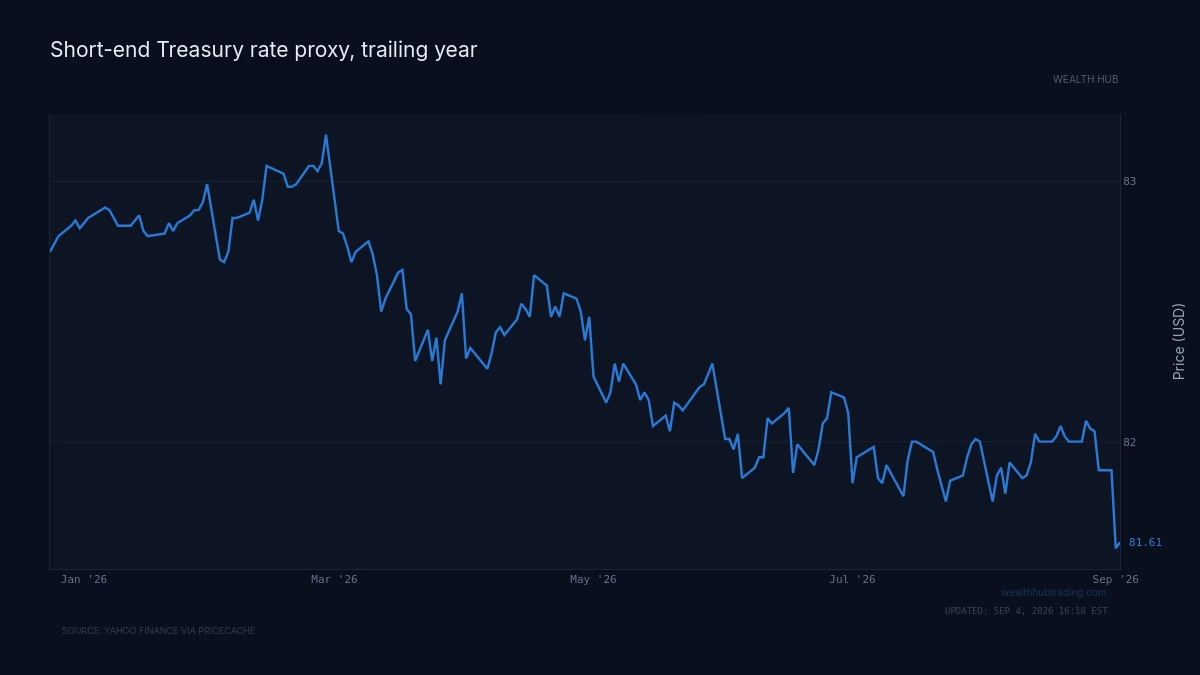
Here is the mechanism consensus skips. A variable-rate preferred that must be held at par is, functionally, a floating-rate liability benchmarked to the front end. With the 2Y at 4.39% and the 10Y at 4.79% as of early September, the dividend the market demands to keep STRC at $100 is anchored to a high and sticky short rate. The 2s10s spread at positive 0.40% tells you the curve is no longer inverted, but it is not steepening in a way that cheapens front-end funding either. It is a flat, high plateau.
When funding is cheap and getting cheaper, a par-pegged preferred is a machine that converts spread into Bitcoin. When funding is high and flat, the same machine has to widen the dividend to defend par, which raises the all-in cost of every incremental coin bought. At some level of front-end rates, the accretion math that made the strategy self-reinforcing on the way up runs in reverse.
Saylor named his headwinds: the Gulf conflict, tighter policy, capital vacuumed into private AI and space deals. Two of those three are rates stories. Tighter policy is the front end. The capital pulled into private mega-rounds is what a high risk-free rate does; it reprices the hurdle for every speculative dollar and sends the surviving flow toward the scarcest narratives. Bitcoin lost that competition not because it stopped being Bitcoin, but because the discount rate rose and a leaky-funded holder cannot outbid a rising risk-free rate indefinitely.
CPI printing at an index level of 332.8 in July, with inflation still the reason the front end stays pinned, closes the loop. The thing keeping short rates high is the same thing raising the cost of the preferred that funds the buying.
The Reflexivity That Cut Both Ways
On the ascent, the loop was elegant. Common equity traded at a premium to net asset value, the premium let the company issue equity and preferred into strength, the proceeds bought more Bitcoin, the larger stack fed the premium. Reflexivity is a wonderful engine when the sign is positive.
The sign is now contested. Bitcoin is down nearly 30% on the year and has surrendered roughly half its value from the $126,000 October peak. A par-pegged preferred does not fall with the asset the way common equity does; that is the point of the structure. But defending par is not free. It is defended with cash dividends, and the dividend rate is set by what buyers demand, which rises precisely when the underlying is weak and rates are high. The instrument is most expensive to service exactly when the asset it financed is least able to help service it.
This is the stretch mark. Not a break, a strain visible on the surface of the structure. The name of the security is more honest than its prospectus.
The Case That This Is Just a Cycle
The strongest counterargument is Saylor's own, and it deserves a fair hearing. Plot the ten-year chart and the drawdown looks like the trough of a familiar cycle rather than the start of a structural unwind. Bitcoin has fallen 50% or more several times and recovered to new highs each time. If that pattern holds, today's weakness is an entry, and the funding stress resolves itself the moment the asset turns.
That case has real support. Nothing in the current drawdown is unprecedented by Bitcoin's own history, and the preferred structure has not missed a dividend or broken par. A holder who never needs to sell can wait out any drawdown, and Strategy's stated posture is exactly that.
But the cycle argument and the funding argument are not symmetric. The cycle only has to be right about the asset. The funding argument has to be right about the asset and the cost of carry simultaneously. If Bitcoin recovers while the front end stays at 4.4%, the strategy survives but stops compounding the way it did. If Bitcoin stays soft while rates stay high, the dividend defense of par gets more expensive every quarter, and the marginal buyer's capacity to be 70% of flows shrinks. The pattern-recognition bull case quietly assumes a rate path it never states.
What Confirms the Read, and What Breaks It
The thesis breaks if the front end falls first. A meaningful decline in the 2Y, a curve that steepens by bull-flattening the short end lower, cheapens STRC's dividend defense and restores the accretion loop before the asset even moves. In that world the funding strain was a rates problem all along and rates fixed it. Watch the 2Y, not the coin.
The thesis confirms if STRC's implied dividend has to climb to hold $100, if new preferred issuance slows or prices at a wider spread, or if Strategy's share of net Bitcoin flows falls sharply from that 70% level while the asset stays soft. Any of those is the funding channel tightening in real time. The tell will show up in the cost and pace of issuance long before it shows up in a headline about crypto sentiment.
For everyone else, the practical read is simpler. Bitcoin's near-term floor is not being set by conviction or halving math. It is being set by one levered buyer's cost of capital, and that cost is a function of the Treasury front end. Until the 2Y moves, the coin is trading the curve. The stretch mark is where you can see it.